Müller Anne, Leinweber Brinja, Fischer Jana, Müller Timo D, Grüters Annette, Tschöp Matthias H, Knäuper Vera, Biebermann Heike, Kleinau Gunnar
Institute of Experimental Pediatric Endocrinology, Charité-Universitätsmedizin Berlin, Augustenburger Platz 1, Ostring 3, 13353 Berlin, Germany.
BMC Res Notes. 2014 Dec 16;7:913. doi: 10.1186/1756-0500-7-913.
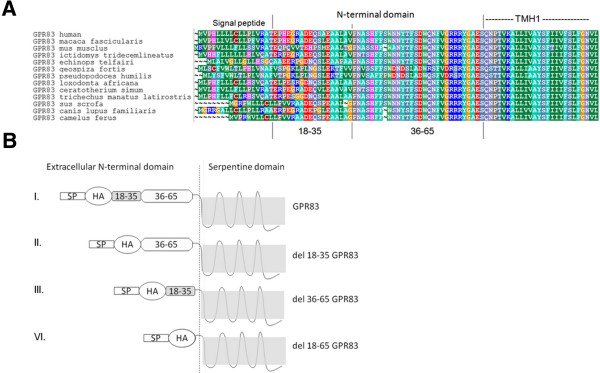
Recently, the orphan G-protein coupled receptor 83 (GPR83) was identified as a new participant in body weight regulation. This receptor is highly expressed in the hypothalamic arcuate nucleus and is regulated in response to nutrient availability. Gpr83 knock-out mice are protected from diet-induced obesity. Moreover, in a previous study, we designed and characterized several artificial constitutively activating mutations (CAMs) in GPR83. A particular CAM was located in the extracellular N-terminal domain (eNDo) that is highly conserved among GPR83 orthologs. This suggests the contribution of this receptor part into regulation of signaling, which needed a more detailed investigation.
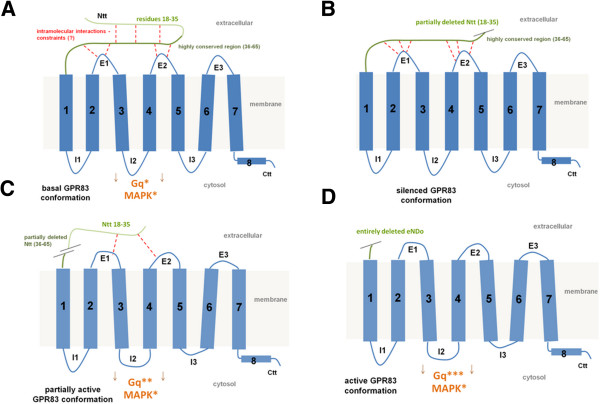
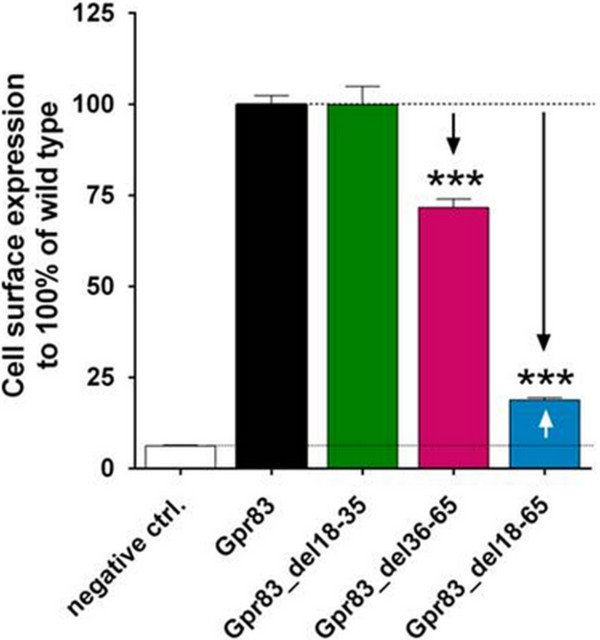
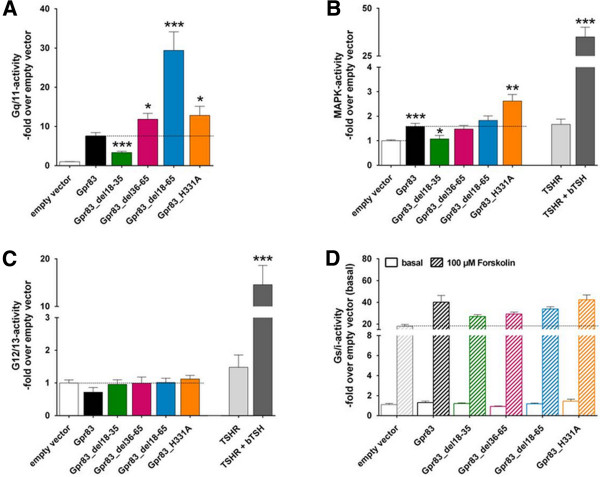
In this present study, therefore, we further explored the role of the eNDo in regulating GPR83-signaling and demonstrate a proof-of-principle approach in that deletion mutants are characterized by a strong increase in basal Gq/11-mediated signaling, whilst none of the additionally characterized signaling pathways (Gs, Gi, G12/13) were activated by the N-terminal deletion variants. Of note, we detected basal GPR83 MAPK-activity of the wild type receptor, which was not increased in the deletion variants.
Finally, the extracellular portion of GPR83 has a strong regulatory function on this receptor. A suppressive - inverse agonistic - effect of the eNDo on GPR83 signaling activity is demonstrated here, which also suggests a putative link between extracellular receptor activation and proteolytic cleavage. These new insights highlight important aspects of GPR83-regulation and might open options in the development of tools to modulate GPR83-signaling.
最近,孤儿G蛋白偶联受体83(GPR83)被确定为体重调节中的一个新参与者。该受体在下丘脑弓状核中高度表达,并根据营养物质的可利用性进行调节。Gpr83基因敲除小鼠可免受饮食诱导的肥胖。此外,在之前的一项研究中,我们设计并鉴定了GPR83中的几种人工组成性激活突变(CAMs)。一种特定的CAM位于细胞外N端结构域(eNDo),该结构域在GPR83直系同源物中高度保守。这表明该受体部分对信号调节有贡献,需要更详细的研究。
因此,在本研究中,我们进一步探讨了eNDo在调节GPR83信号传导中的作用,并证明了一种原理验证方法,即缺失突变体的特征是基础Gq/11介导的信号传导显著增加,而另外鉴定的信号通路(Gs、Gi、G12/13)均未被N端缺失变体激活。值得注意的是,我们检测到野生型受体的基础GPR83 MAPK活性,在缺失变体中未增加。
最后,GPR83的细胞外部分对该受体具有强大的调节功能。本文证明了eNDo对GPR83信号活性具有抑制性——反向激动剂——作用,这也暗示了细胞外受体激活与蛋白水解切割之间的推定联系。这些新见解突出了GPR83调节的重要方面,并可能为开发调节GPR83信号传导的工具提供新的选择。