Meguro Kenichi, Ouchi Yoshitaka, Akanuma Kyoko, Meguro Mitsue, Kasai Mari
Division of Geriatric Behavioral Neurology, CYRIC, Tohoku University, 2-1, Seiryo-machi, Aoba-ku, Sendai, Miyagi, 980-8575, Japan.
BMC Neurol. 2014 Dec 17;14:243. doi: 10.1186/s12883-014-0243-7.
Cholinesterase inhibitors can delay the progression of Alzheimer's disease (AD). Several clinical trials of the drug in moderate to severe AD have consistently reported clinically positive effects. A combining effect with psychosocial intervention was reported in mild to moderate AD patients. Since a therapeutic approach or rehabilitation combined with cholinesterase inhibitors for severe AD patients remains controversial, we performed a prospective intervention for patients in Long-Term Care Health Facilities (LTCHF).
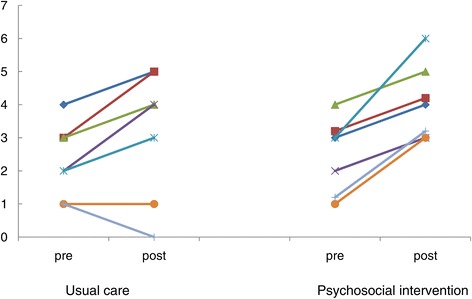
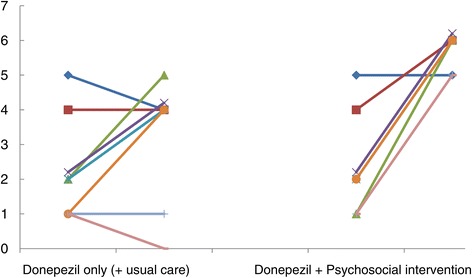
Two LTCHFs (N1, N2) were enrolled. N1 is a 126-bed facility that does not treat with donepezil but rather with psychosocial intervention (reality orientation and reminiscence). N2 is a 150-bed facility with a 50-bed special dementia unit, in which the physician can prescribe donepezil. On top of the similar psychosocial intervention, rehabilitation is performed in N2. Thirty-two severe AD patients (MMSE < 6) in N1 and N2 (16 vs. 16) were compared for the effect of donepezil (10 mg/d for 3 months) with or without psychosocial intervention (n = 8 vs. 8 for each facility). The Vitality Index was used to assess daily activities and the introduction of rehabilitation.
The response ratio (MMSE 3+) of donepezil was 37.5% in N2. The combination of donepezil with the psychosocial intervention improved the Vitality Index total score, and Communication, Eating, and Rehabilitation subscores (Wilcoxon, p = 0.016, 0.038, 0.023, and 0.011, respectively). Most of them were smoothly introduced to rehabilitation, and the proportion of accidental falls decreased. Psychosocial intervention in N1 without the drug only improved the total score (Wilcoxon, p = 0.046).
A combined therapeutic approach of donepezil and psychosocial intervention can have a positive effect, even for severe patients through the introduction of rehabilitation and decreasing accidental falls. However, these findings require replication in a larger cohort.
胆碱酯酶抑制剂可延缓阿尔茨海默病(AD)的进展。该药物在中重度AD中的多项临床试验一直报告具有临床积极效果。在轻度至中度AD患者中报告了与心理社会干预的联合效应。由于针对重度AD患者的一种治疗方法或与胆碱酯酶抑制剂联合的康复治疗仍存在争议,我们对长期护理健康设施(LTCHF)中的患者进行了一项前瞻性干预。
纳入了两个LTCHF(N1、N2)。N1是一家拥有126张床位的机构,不使用多奈哌齐治疗,而是采用心理社会干预(现实定向和回忆疗法)。N2是一家拥有150张床位的机构,设有一个50张床位的特殊痴呆症单元,医生可在其中开具多奈哌齐处方。除了类似的心理社会干预外,N2还进行康复治疗。比较了N1和N2中32例重度AD患者(简易精神状态检查表[MMSE]<6)(各16例)在接受或不接受心理社会干预的情况下使用多奈哌齐(10mg/天,持续3个月)的效果(每个机构各8例)。使用活力指数评估日常活动和康复治疗的引入情况。
在N2中,多奈哌齐的反应率(MMSE≥3)为37.5%。多奈哌齐与心理社会干预相结合改善了活力指数总分以及沟通、进食和康复子分数(Wilcoxon检验,p分别为0.016、0.038、0.023和0.011)。他们中的大多数人顺利接受了康复治疗,意外跌倒的比例降低。N1中不使用药物的心理社会干预仅改善了总分(Wilcoxon检验,p=0.046)。
多奈哌齐与心理社会干预的联合治疗方法即使对重度患者也可通过引入康复治疗和减少意外跌倒产生积极效果。然而,这些发现需要在更大的队列中进行重复验证。