Hiorns Jonathan E, Jensen Oliver E, Brook Bindi S
School of Mathematical Sciences, University of Nottingham, University Park, Nottingham, United Kingdom.
School of Mathematics, University of Manchester, Manchester, United Kingdom.
Biophys J. 2014 Dec 16;107(12):3030-3042. doi: 10.1016/j.bpj.2014.10.067.
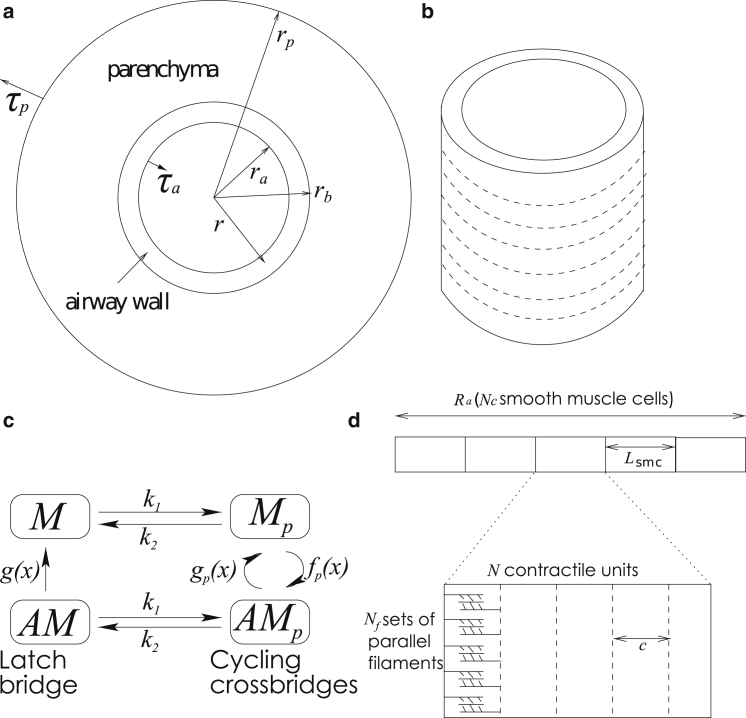
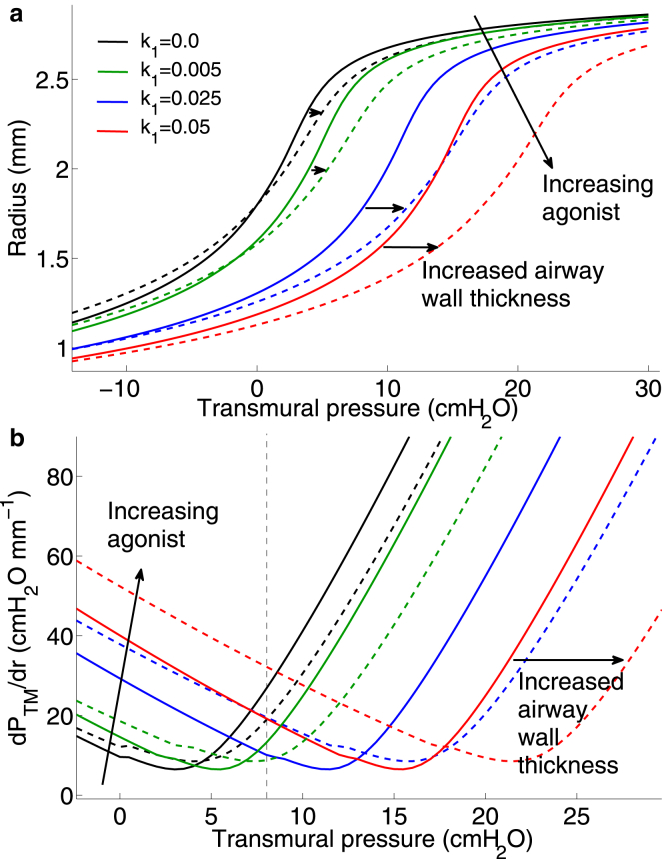
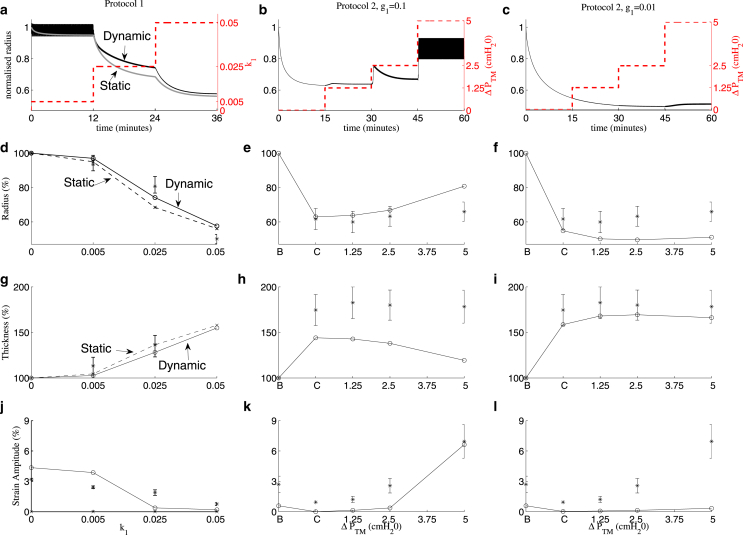
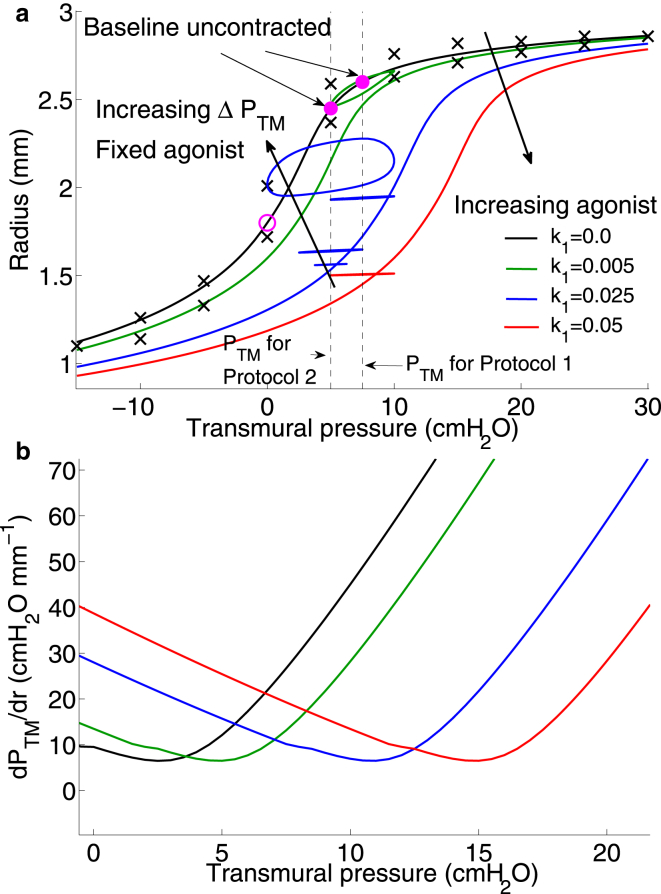
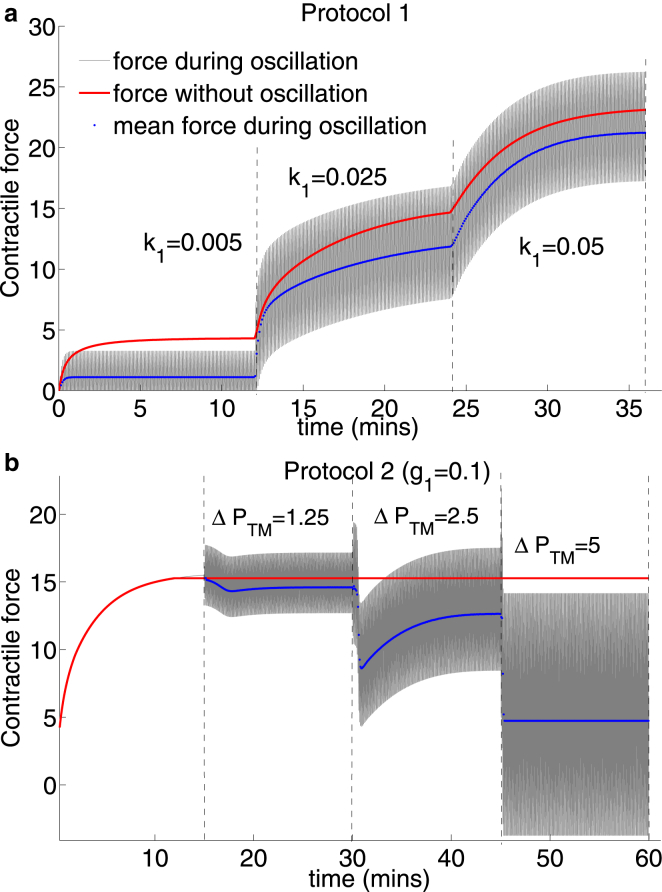
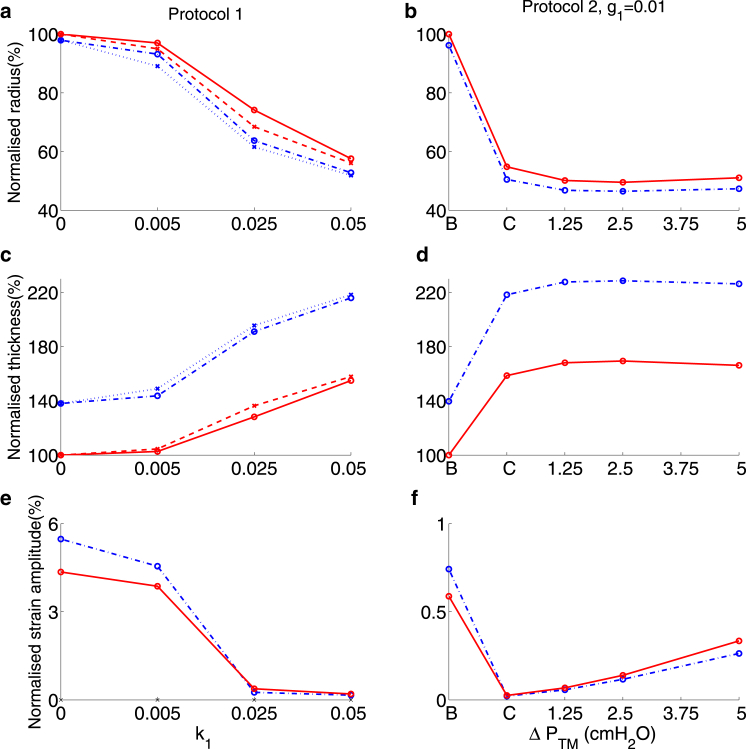
The role of breathing and deep inspirations (DI) in modulating airway hyperresponsiveness remains poorly understood. In particular, DIs are potent bronchodilators of constricted airways in nonasthmatic subjects but not in asthmatic subjects. Additionally, length fluctuations (mimicking DIs) have been shown to reduce mean contractile force when applied to airway smooth muscle (ASM) cells and tissue strips. However, these observations are not recapitulated on application of transmural pressure (PTM) oscillations (that mimic tidal breathing and DIs) in isolated intact airways. To shed light on this paradox, we have developed a biomechanical model of the intact airway, accounting for strain-stiffening due to collagen recruitment (a large component of the extracellular matrix (ECM)), and dynamic actomyosin-driven force generation by ASM cells. In agreement with intact airway studies, our model shows that PTM fluctuations at particular mean transmural pressures can lead to only limited bronchodilation. However, our model predicts that moving the airway to a more compliant point on the static pressure-radius relationship (which may involve reducing mean PTM), before applying pressure fluctuations, can generate greater bronchodilation. This difference arises from competition between passive strain-stiffening of ECM and force generation by ASM yielding a highly nonlinear relationship between effective airway stiffness and PTM, which is modified by the presence of contractile agonist. Effectively, the airway at its most compliant may allow for greater strain to be transmitted to subcellular contractile machinery. The model predictions lead us to hypothesize that the maximum possible bronchodilation of an airway depends on its static compliance at the PTM about which the fluctuations are applied. We suggest the design of additional experimental protocols to test this hypothesis.
呼吸和深吸气(DI)在调节气道高反应性中的作用仍未得到充分理解。特别是,深吸气对非哮喘受试者的收缩气道是有效的支气管扩张剂,但对哮喘受试者则不然。此外,长度波动(模拟深吸气)已被证明应用于气道平滑肌(ASM)细胞和组织条时可降低平均收缩力。然而,在分离的完整气道中应用跨壁压力(PTM)振荡(模拟潮式呼吸和深吸气)时,这些观察结果并未得到重现。为了阐明这一矛盾,我们开发了一个完整气道的生物力学模型,考虑了由于胶原蛋白募集(细胞外基质(ECM)的一个主要成分)引起的应变硬化,以及ASM细胞动态肌动球蛋白驱动的力产生。与完整气道研究一致,我们的模型表明,在特定平均跨壁压力下的PTM波动只能导致有限的支气管扩张。然而,我们的模型预测,在施加压力波动之前,将气道移至静态压力-半径关系上更顺应的点(这可能涉及降低平均PTM),可以产生更大的支气管扩张。这种差异源于ECM的被动应变硬化与ASM产生的力之间的竞争,从而在有效气道刚度和PTM之间产生高度非线性关系,这种关系会因收缩激动剂的存在而改变。实际上,处于最顺应状态的气道可能允许更大的应变传递到亚细胞收缩机制。模型预测使我们假设气道的最大可能支气管扩张取决于其在施加波动的PTM下的静态顺应性。我们建议设计额外的实验方案来检验这一假设