Marsousi N, Daali Y, Rudaz S, Almond L, Humphries H, Desmeules J, Samer C F
1] Department of Clinical Pharmacology and Toxicology, Geneva University Hospitals, Geneva University, Geneva, Switzerland [2] Department of Pharmaceutical Analytical Chemistry, School of Pharmaceutical Sciences, Geneva University, Geneva, Switzerland.
1] Department of Clinical Pharmacology and Toxicology, Geneva University Hospitals, Geneva University, Geneva, Switzerland [2] Swiss Centre for Applied Human Toxicology, Geneva, Switzerland.
CPT Pharmacometrics Syst Pharmacol. 2014 Dec 17;3(12):e152. doi: 10.1038/psp.2014.49.
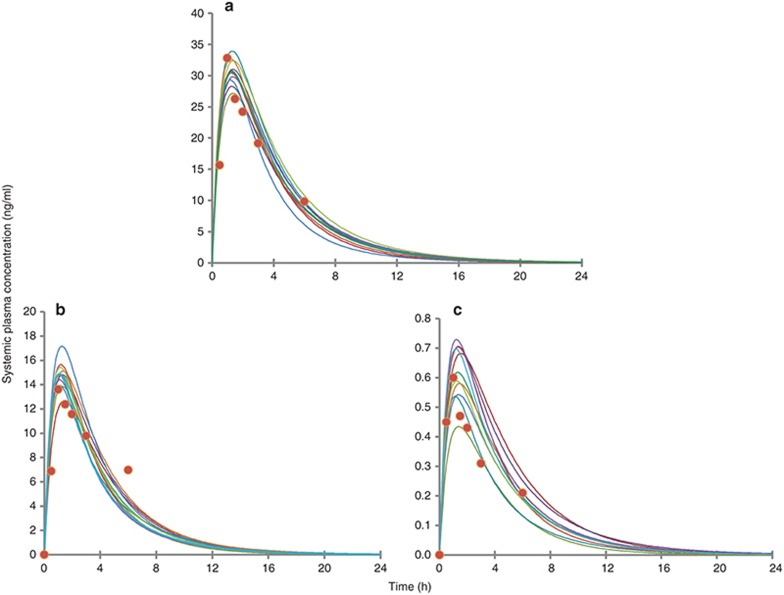
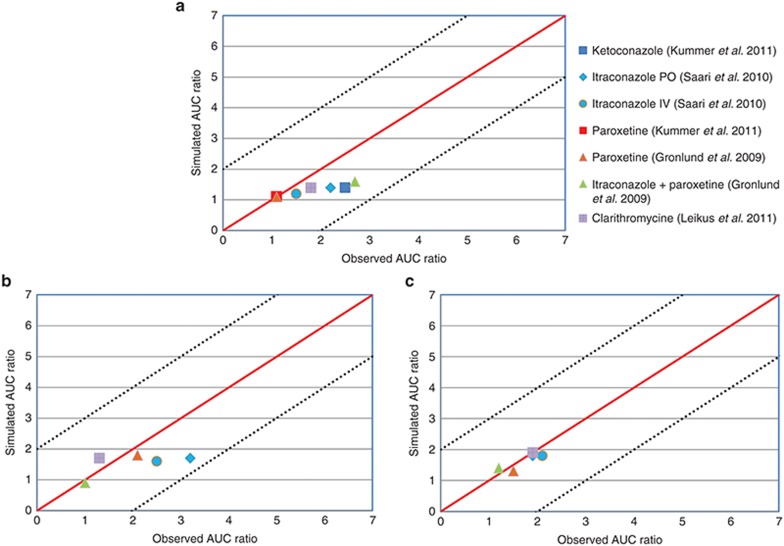
Evaluation of a potential risk of metabolic drug-drug interactions (DDI) is of high importance in the clinical setting. In this study, a physiologically based pharmacokinetic (PBPK) model was developed for oxycodone and its two primary metabolites, oxymorphone and noroxycodone, in order to assess different DDI scenarios using published in vitro and in vivo data. Once developed and refined, the model was able to simulate pharmacokinetics of the three compounds and the DDI extent in case of coadministration with an inhibitor, as well as the oxymorphone concentration variation between CYP2D6 extensive metabolizers (EM) and poor metabolizers (PM). The reliability of the model was tested against published clinical studies monitoring different inhibitors and dose regimens, and all predicted area under the concentration-time curve (AUC) ratios were within the twofold acceptance range. This approach represents a strategy to evaluate the impact of coadministration of different CYP inhibitors using mechanistic incorporation of drug-dependent and system-dependent available in vitro and in vivo data.
在临床环境中,评估代谢性药物相互作用(DDI)的潜在风险至关重要。在本研究中,针对羟考酮及其两种主要代谢物羟吗啡酮和去甲羟考酮建立了基于生理的药代动力学(PBPK)模型,以便使用已发表的体外和体内数据评估不同的DDI情况。一旦建立并完善,该模型能够模拟这三种化合物的药代动力学以及与抑制剂合用时的DDI程度,以及CYP2D6广泛代谢者(EM)和代谢不良者(PM)之间羟吗啡酮浓度的变化。该模型的可靠性通过针对监测不同抑制剂和剂量方案的已发表临床研究进行了测试,所有预测的浓度-时间曲线下面积(AUC)比值均在两倍接受范围内。这种方法代表了一种通过机械整合药物依赖性和系统依赖性的可用体外和体内数据来评估不同CYP抑制剂合用时影响的策略。