Renard Julien, Ballarini Stefania, Mascarenhas Teresa, Zahran Mohamed, Quimper Enrique, Choucair Jacques, Iselin Christophe E
University Hospital of Geneva, Geneva, Switzerland.
Infect Dis Ther. 2014 Dec 18;4(1):125-35. doi: 10.1007/s40121-014-0054-6.
This study investigated the effects of recurrent urinary tract infections (rUTI) and the impact of prophylaxis on rUTI and patients' quality of life (QoL).
Altogether, 575 patients affected by rUTI were included in a 6-month observational study. QoL was assessed using the Hospital Anxiety and Depression (HAD) and the Leicester scales. Statistical analyses were performed using SAS Version 8.2 software (SAS Institute Inc., Cary, NC, USA). The significance level was set at 5%. Spearman correlation was used to assess the degree of correlation between infectious episodes and HAD and Leicester scores. For each parameter, the comparison between Day 0 and Day 180 was performed using Wilcoxon signed-rank test for quantitative data.
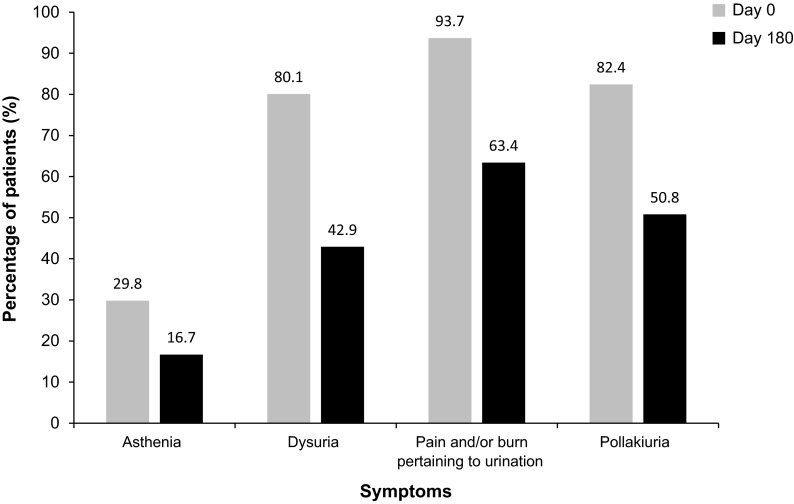
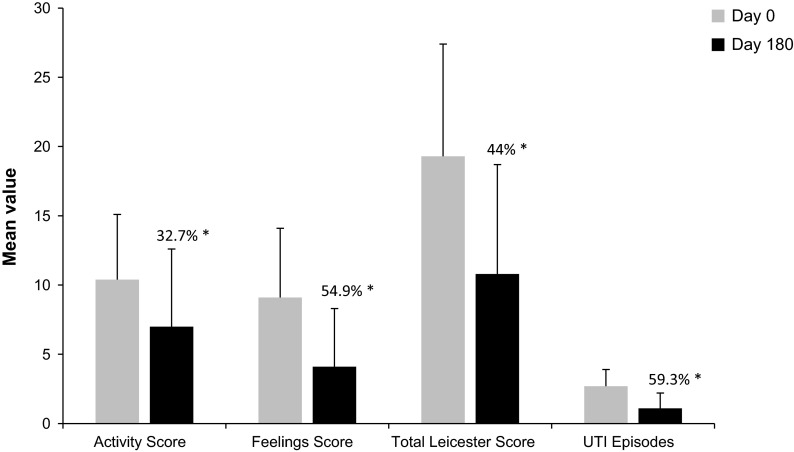
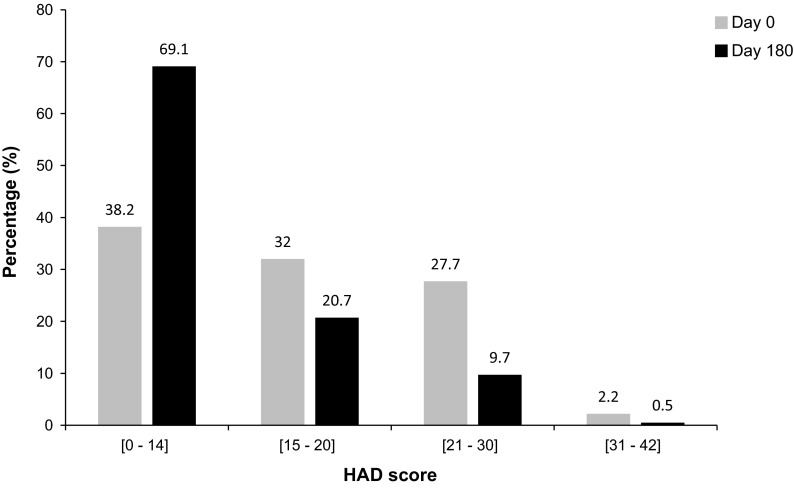
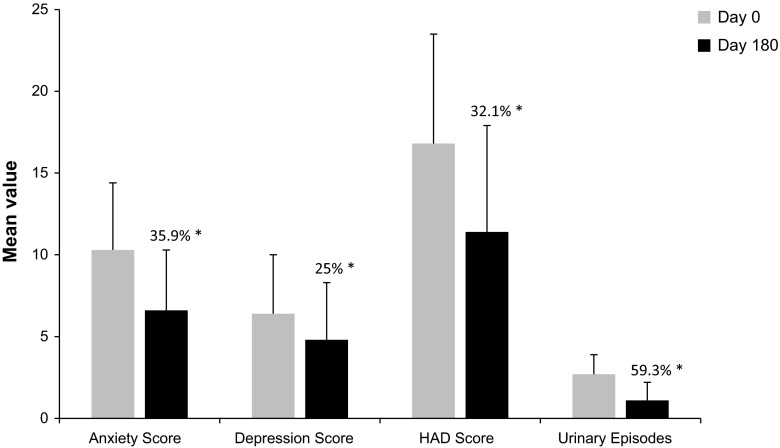
In total, 61.9% of patients suffering from rUTI exhibited some degree of depression at baseline (Day 0). Alternative oral non-antimicrobial prophylactic treatment for rUTI [Escherichia coli lyophilized bacterial lysate (OM-89)] was administered to 94.4% of patients (1 capsule a day for 90 days), followed by a 3-month treatment-free period. At the end of the study (Day 180), the mean number of UTI decreased by 59.3% (P ≤ 0.0001), the total HAD score decreased by 32.1% (P ≤ 0.0001), and the mean Leicester score decreased by 44.0% (P ≤ 0.0001) from baseline. There was a correlation trend between the reduction in the numbers of UTI at the end of the study compared to the 6 months prior to study entry and the reduction in the anxiety, depression, total HAD scores, activity, feeling, and total Leicester scores registered from Day 0 to Day 180, suggesting a lessening of emotional problems, and social and functional handicaps with decreasing UTI incidence.
This study showed that rUTI had a negative impact on patients' QoL and that effective alternative prophylaxis significantly improved their QoL.
本研究调查了复发性尿路感染(rUTI)的影响以及预防措施对rUTI和患者生活质量(QoL)的影响。
共有575例rUTI患者纳入一项为期6个月的观察性研究。使用医院焦虑抑郁量表(HAD)和莱斯特量表评估生活质量。采用SAS 8.2版软件(美国北卡罗来纳州卡里市SAS研究所)进行统计分析。显著性水平设定为5%。采用Spearman相关性分析评估感染发作次数与HAD及莱斯特评分之间的相关程度。对于每个参数,使用Wilcoxon符号秩检验对定量数据进行第0天和第180天之间的比较。
总体而言,61.9%的rUTI患者在基线时(第0天)表现出一定程度的抑郁。94.4%的患者接受了rUTI的替代口服非抗菌预防治疗[大肠杆菌冻干细菌裂解物(OM-89)](每天1粒,共90天),随后为3个月的无治疗期。在研究结束时(第180天),与基线相比,尿路感染的平均次数减少了59.3%(P≤0.0001),HAD总分降低了32.1%(P≤0.0001),莱斯特平均评分降低了44.0%(P≤0.0001)。与研究入组前6个月相比,研究结束时尿路感染次数的减少与第0天至第180天记录的焦虑、抑郁、HAD总分、活动、感觉和莱斯特总分的降低之间存在相关趋势,表明随着尿路感染发病率的降低,情绪问题以及社会和功能障碍有所减轻。
本研究表明,rUTI对患者的生活质量有负面影响,有效的替代预防措施可显著改善其生活质量。