Blasche Sonja, Arens Stefan, Ceol Arnaud, Siszler Gabriella, Schmidt M Alexander, Häuser Roman, Schwarz Frank, Wuchty Stefan, Aloy Patrick, Uetz Peter, Stradal Theresia, Koegl Manfred
Genomics and Proteomics Core Facilities, German Cancer Research Center, Im Neuenheimer Feld 580, 69120 Heidelberg, Germany.
Institute of Molecular Cell Biology, University of Münster, Schlossplatz 5, D-48149 Münster.
Sci Rep. 2014 Dec 18;4:7531. doi: 10.1038/srep07531.
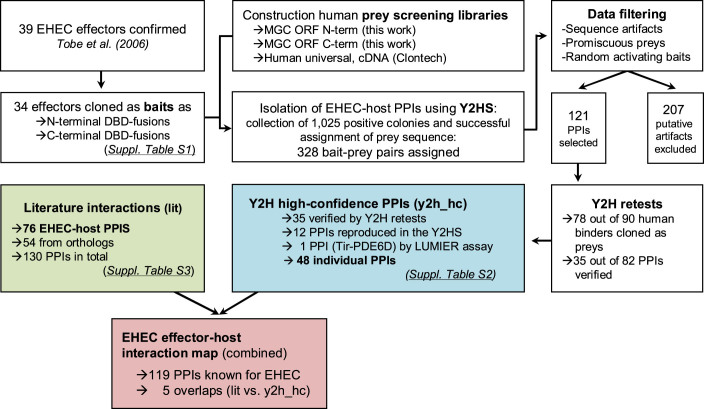
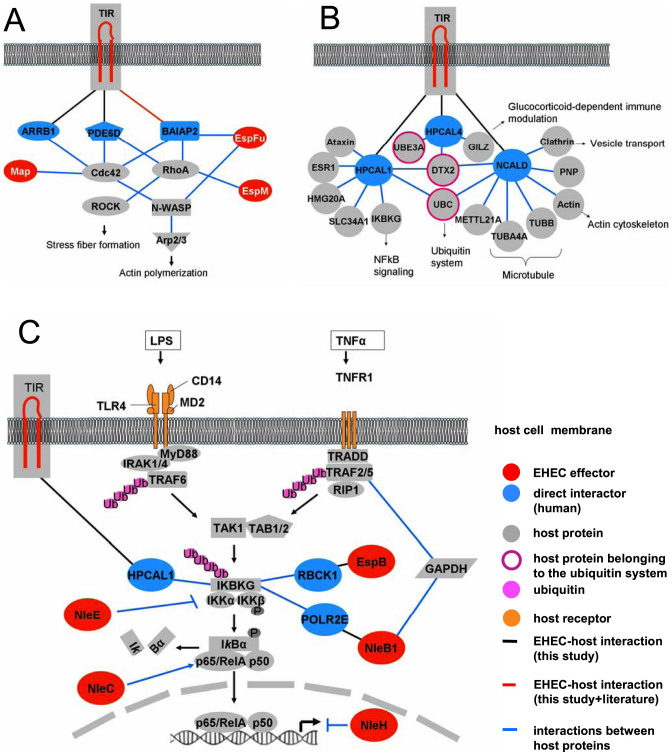
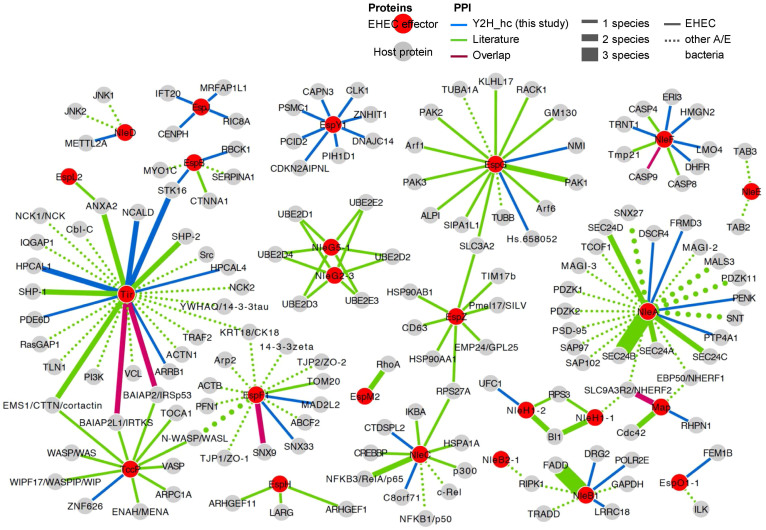
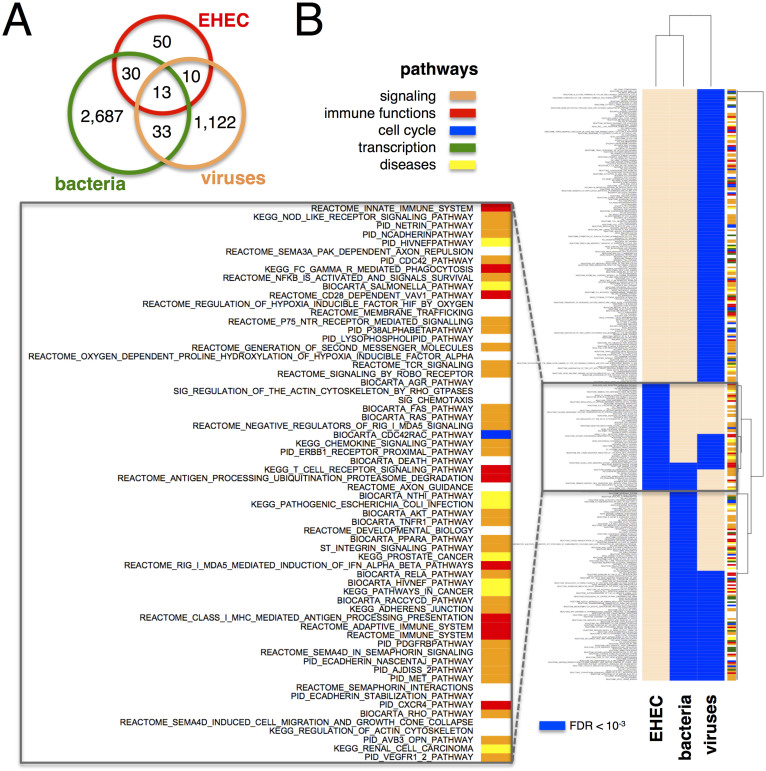
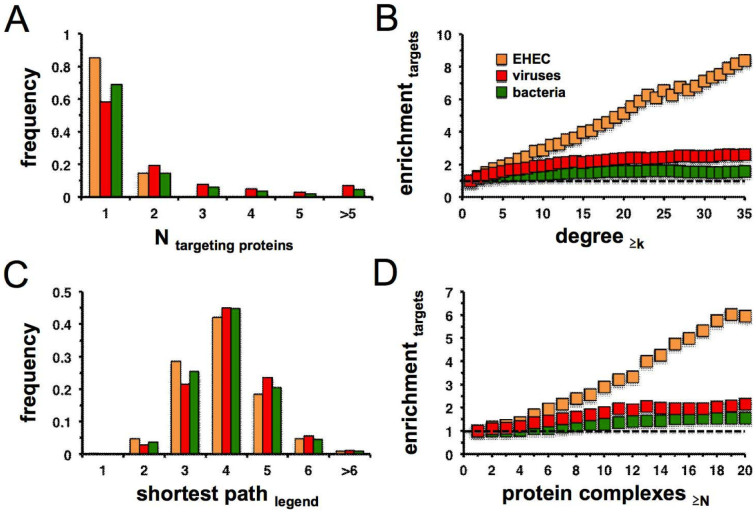
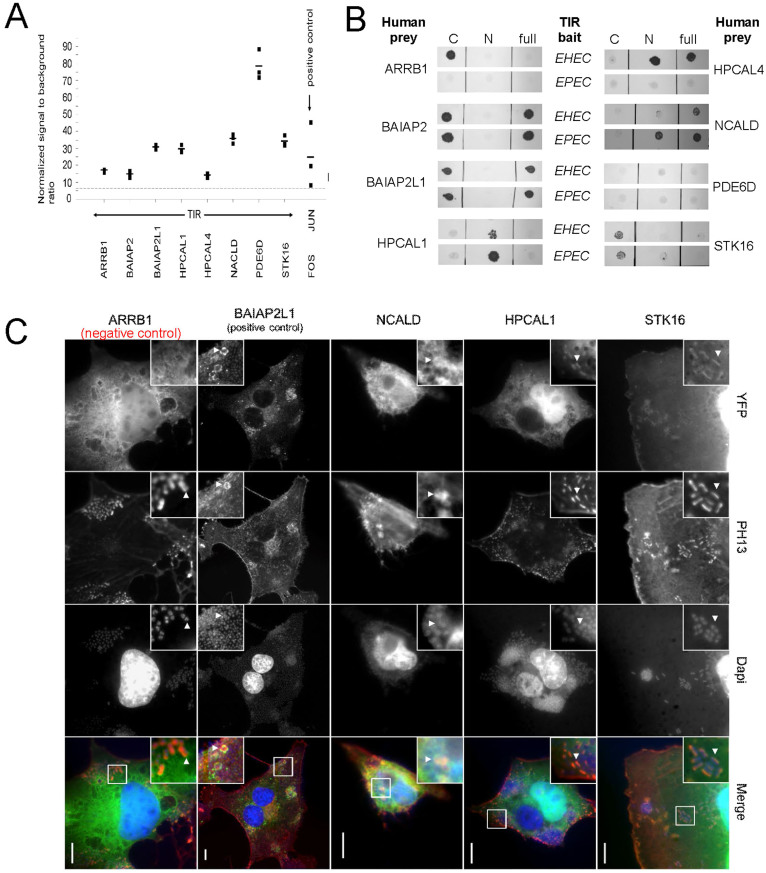
Enterohemorrhagic E. coli (EHEC) manipulate their human host through at least 39 effector proteins which hijack host processes through direct protein-protein interactions (PPIs). To identify their protein targets in the host cells, we performed yeast two-hybrid screens, allowing us to find 48 high-confidence protein-protein interactions between 15 EHEC effectors and 47 human host proteins. In comparison to other bacteria and viruses we found that EHEC effectors bind more frequently to hub proteins as well as to proteins that participate in a higher number of protein complexes. The data set includes six new interactions that involve the translocated intimin receptor (TIR), namely HPCAL1, HPCAL4, NCALD, ARRB1, PDE6D, and STK16. We compared these TIR interactions in EHEC and enteropathogenic E. coli (EPEC) and found that five interactions were conserved. Notably, the conserved interactions included those of serine/threonine kinase 16 (STK16), hippocalcin-like 1 (HPCAL1) as well as neurocalcin-delta (NCALD). These proteins co-localize with the infection sites of EPEC. Furthermore, our results suggest putative functions of poorly characterized effectors (EspJ, EspY1). In particular, we observed that EspJ is connected to the microtubule system while EspY1 appears to be involved in apoptosis/cell cycle regulation.
肠出血性大肠杆菌(EHEC)通过至少39种效应蛋白操纵人类宿主,这些效应蛋白通过直接的蛋白质-蛋白质相互作用(PPI)劫持宿主进程。为了确定它们在宿主细胞中的蛋白质靶点,我们进行了酵母双杂交筛选,从而发现了15种EHEC效应蛋白与47种人类宿主蛋白之间的48种高可信度蛋白质-蛋白质相互作用。与其他细菌和病毒相比,我们发现EHEC效应蛋白更频繁地与枢纽蛋白以及参与更多蛋白质复合物的蛋白结合。该数据集包括涉及转位紧密素受体(TIR)的六种新相互作用,即HPCAL1、HPCAL4、NCALD、ARRB1、PDE6D和STK16。我们比较了EHEC和肠致病性大肠杆菌(EPEC)中的这些TIR相互作用,发现五种相互作用是保守的。值得注意的是,保守的相互作用包括丝氨酸/苏氨酸激酶16(STK16)、类海马钙蛋白1(HPCAL1)以及神经钙蛋白-δ(NCALD)的相互作用。这些蛋白与EPEC的感染位点共定位。此外,我们的结果提示了特征不明确的效应蛋白(EspJ、EspY1)的推定功能。特别是,我们观察到EspJ与微管系统相关,而EspY1似乎参与细胞凋亡/细胞周期调控。