Matamalas Antonia, Bagó Juan, D'Agata Elisabetta, Pellisé Ferran
Department of Orthopaedic Surgery, Hospital Vall d'Hebron, P Vall d'Hebron, 119, 08035 Barcelona, Spain.
Research Institute, Hospital Vall d'Hebrón, P Vall d'Hebrón, 119, 08035 Barcelona, Spain.
Scoliosis. 2014 Dec 14;9(1):23. doi: 10.1186/s13013-014-0023-6. eCollection 2014.
To determine the validity of digital photography as an evaluation method for shoulder balance (ShB) in patients with idiopathic scoliosis.
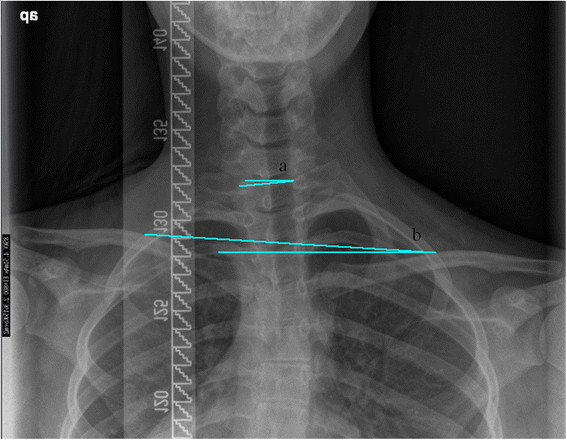
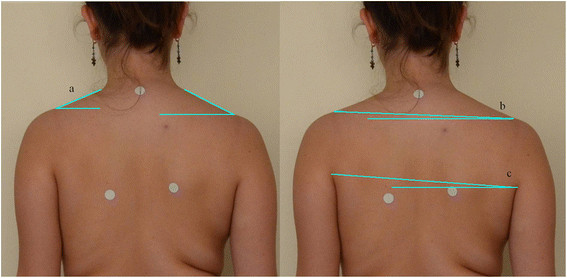
A total of 80 patients were included (mean age 20.3 years; 85% women). We obtained a full x-ray of the vertebral column and front and back clinical photography for all patients. For antero-posterior x-rays we measured the proximal thoracic curve angles (CPT). To evaluate radiological shoulder balance we calculated the clavicle-rib intersection angle (CRIA) and T1-tilt. For clinical photography we measured shoulder height angle (SHA), axilla height angle (AHA) and the left right trapezium angle (LRTA). We analyzed the reliability of the different photographic measurements and the correlation between these and the radiological parameters.
The mean magnitude of PTC, CRIA and T1-tilt were 19°, -0.6° and 1.4° respectively. Mean SHA from the front was -1.7°. All photographic measurements revealed an excellent-near perfect intra and inter-observer reliability in both photographic projections. No correlation was found between the ShB and the magnitude of the PTC. A statistically significant correlation was found between clinical balance of the shoulders and radiological balance (r between 0.37 and 0.51).
Digital clinical photography appears to be a reliable method for objective clinical measurement of ShB. The correlation between clinical and radiological balance is statistically significant although moderate/weak.
确定数码摄影作为评估特发性脊柱侧凸患者肩部平衡(ShB)的一种方法的有效性。
共纳入80例患者(平均年龄20.3岁;85%为女性)。我们为所有患者获取了脊柱的全脊柱X线片以及前后位临床照片。对于前后位X线片,我们测量了近端胸椎曲度角(CPT)。为评估影像学肩部平衡,我们计算了锁骨-肋骨交叉角(CRIA)和T1倾斜度。对于临床照片,我们测量了肩高角(SHA)、腋窝高度角(AHA)和左右梯形角(LRTA)。我们分析了不同摄影测量的可靠性以及这些测量值与影像学参数之间的相关性。
PTC、CRIA和T1倾斜度的平均大小分别为19°、-0.6°和1.4°。正面的平均SHA为-1.7°。所有摄影测量在两种摄影投影中均显示出观察者内和观察者间的可靠性极佳-近乎完美。未发现ShB与PTC大小之间存在相关性。发现肩部临床平衡与影像学平衡之间存在统计学显著相关性(r在0.37至0.51之间)。
数码临床摄影似乎是一种用于客观临床测量ShB的可靠方法。临床平衡与影像学平衡之间的相关性具有统计学显著性,尽管为中度/弱相关。