Department of Molecular and Laboratory Medicine, Mie University School of Medicine, 2-174 Edobashi, Tsu, Mie, 514-8507 Japan.
Department of Blood Transfusion, Mie University School of Medicine, 2-174 Edobashi, Tsu, Mie, 514-8507 Japan.
J Intensive Care. 2014 Feb 20;2(1):15. doi: 10.1186/2052-0492-2-15. eCollection 2014.
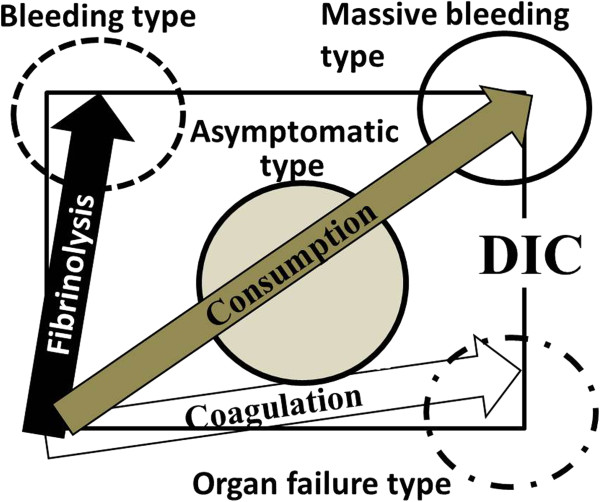
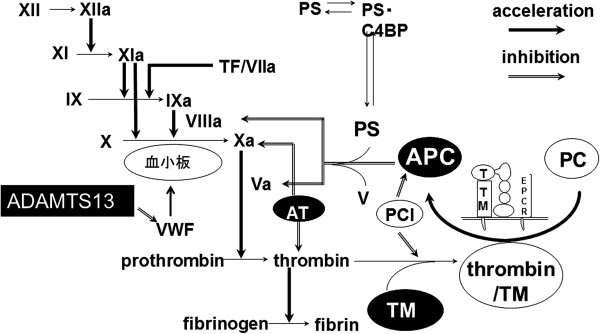
Disseminated intravascular coagulation (DIC) is categorized into bleeding, organ failure, massive bleeding, and non-symptomatic types according to the sum of vectors for hypercoagulation and hyperfibrinolysis. The British Committee for Standards in Haematology, Japanese Society of Thrombosis and Hemostasis, and the Italian Society for Thrombosis and Haemostasis published separate guidelines for DIC; however, there are several differences between these three sets of guidelines. Therefore, the International Society of Thrombosis and Haemostasis (ISTH) recently harmonized these differences and published the guidance of diagnosis and treatment for DIC. There are three different diagnostic criteria according to the Japanese Ministry Health, Labour and Welfare, ISTH, and Japanese Association of Acute Medicine. The first and second criteria can be used to diagnose the bleeding or massive bleeding types of DIC, while the third criteria cover organ failure and the massive bleeding type of DIC. Treatment of underlying conditions is recommended in three types of DIC, with the exception of massive bleeding. Blood transfusions are recommended in patients with the bleeding and massive bleeding types of DIC. Meanwhile, treatment with heparin is recommended in those with the non-symptomatic type of DIC. The administration of synthetic protease inhibitors and antifibrinolytic therapy is recommended in patients with the bleeding and massive bleeding types of DIC. Furthermore, the administration of natural protease inhibitors is recommended in patients with the organ failure type of DIC, while antifibrinolytic treatment is not. The diagnosis and treatment of DIC should be carried out in accordance with the type of DIC.
弥散性血管内凝血(DIC)根据高凝和高纤溶向量的总和分为出血、器官衰竭、大出血和无症状型。英国血液学标准委员会、日本血栓形成与止血学会和意大利血栓形成与止血学会分别发布了 DIC 指南;然而,这三套指南之间存在一些差异。因此,国际血栓形成与止血学会(ISTH)最近协调了这些差异,并发布了 DIC 的诊断和治疗指南。根据日本厚生劳动省、ISTH 和日本急救医学会,有三种不同的诊断标准。第一个和第二个标准可用于诊断 DIC 的出血或大出血类型,而第三个标准涵盖了器官衰竭和大出血类型的 DIC。除了大出血外,三种类型的 DIC 都建议治疗基础疾病。建议对出血和大出血类型的 DIC 患者进行输血。同时,建议对无症状型 DIC 患者使用肝素治疗。建议对出血和大出血类型的 DIC 患者给予合成蛋白酶抑制剂和抗纤溶治疗。此外,建议对器官衰竭类型的 DIC 患者给予天然蛋白酶抑制剂,而不建议进行抗纤溶治疗。DIC 的诊断和治疗应根据 DIC 的类型进行。