Kanehara Akiko, Umeda Maki, Kawakami Norito
Department of Mental Health, School of Public Health, The University of Tokyo, Tokyo, Japan.
Psychiatry Clin Neurosci. 2015 Sep;69(9):523-33. doi: 10.1111/pcn.12267. Epub 2015 Feb 9.
The reasons for accessing and maintaining access to mental health services in Japan may be different to those in other countries. Using the World Health Organization World Mental Health Japan survey data, this study investigated the prevalence of sociodemographic correlates of barriers for the use of, reasons for delayed access to, and reasons for dropping out from mental health care in a Japanese community-based sample.
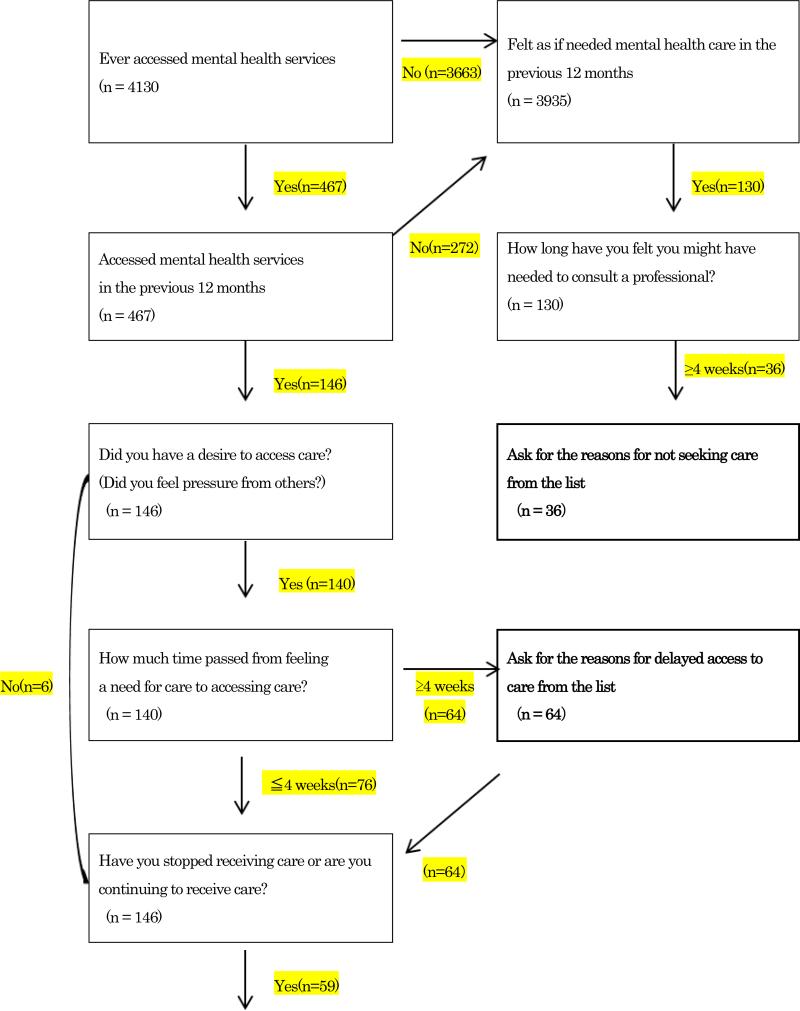
An interview survey was conducted with a random sample of residents living in 11 communities across Japan during the years 2002-2006. Data from 4130 participants were analyzed.
The most frequently reported reason for not seeking mental health care was a low perceived need (63.9%). The most common reason for delaying access to help was the wish to handle the problem on one's own (68.8%), while the most common reason for dropping out of care was also a low perceived need (54.2%). Being a woman and of younger age were key sociodemographic barriers to the use of mental health services.
Low perceived need was a major reason for not seeking, delay in using, and dropout from mental health services in Japan. In addition, low perceived need and structural barriers were more frequently reported than attitudinal barriers, with the exception of a desire to handle the problem on one's own. These findings suggest that improving therapist-patient communication and quality of mental health care, as well as mental health literacy education in the community, might improve access to care in Japan.
在日本,寻求和持续接受心理健康服务的原因可能与其他国家不同。本研究利用世界卫生组织日本心理健康调查数据,在一个基于日本社区的样本中,调查了社会人口学因素与使用心理健康服务的障碍、延迟就诊的原因以及退出心理健康护理的原因之间的相关性。
在2002年至2006年期间,对日本11个社区的居民进行了随机抽样访谈调查。对4130名参与者的数据进行了分析。
最常报告的不寻求心理健康护理的原因是感知需求低(63.9%)。延迟寻求帮助的最常见原因是希望自己解决问题(68.8%),而退出护理的最常见原因也是感知需求低(54.2%)。女性和年轻是使用心理健康服务的关键社会人口学障碍。
在日本,感知需求低是不寻求、延迟使用和退出心理健康服务的主要原因。此外,除了希望自己解决问题外,感知需求低和结构性障碍比态度障碍更常被报告。这些发现表明,改善治疗师与患者的沟通以及心理健康护理质量,以及在社区开展心理健康素养教育,可能会改善日本的就诊情况。