Institute for Advanced Biosciences, Keio University, Tsuruoka 997-0017, Japan Systems Biology Program, Graduate School of Media and Governance, Keio University, Fujisawa 252-0882, Japan.
Institute for Advanced Biosciences, Keio University, Tsuruoka 997-0017, Japan.
RNA. 2015 Feb;21(2):230-42. doi: 10.1261/rna.045799.114. Epub 2014 Dec 18.
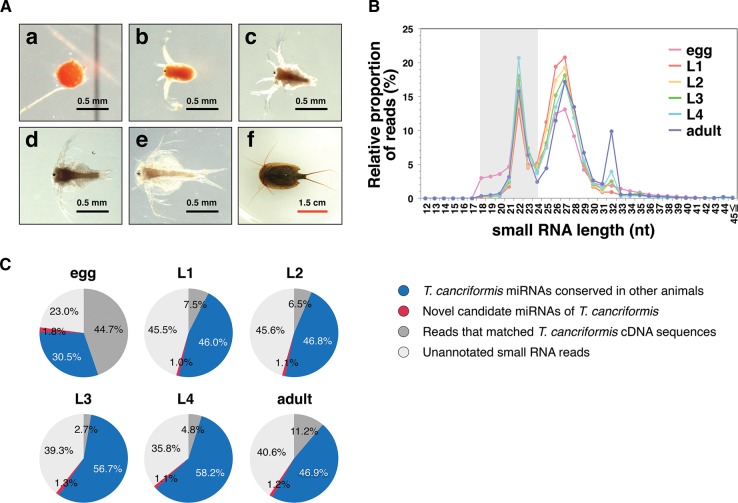
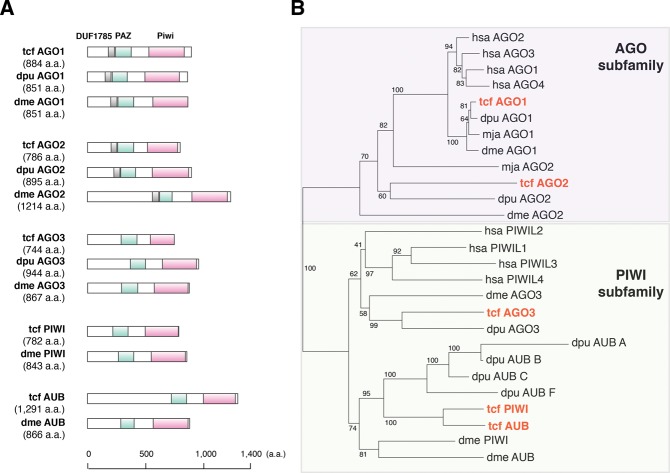
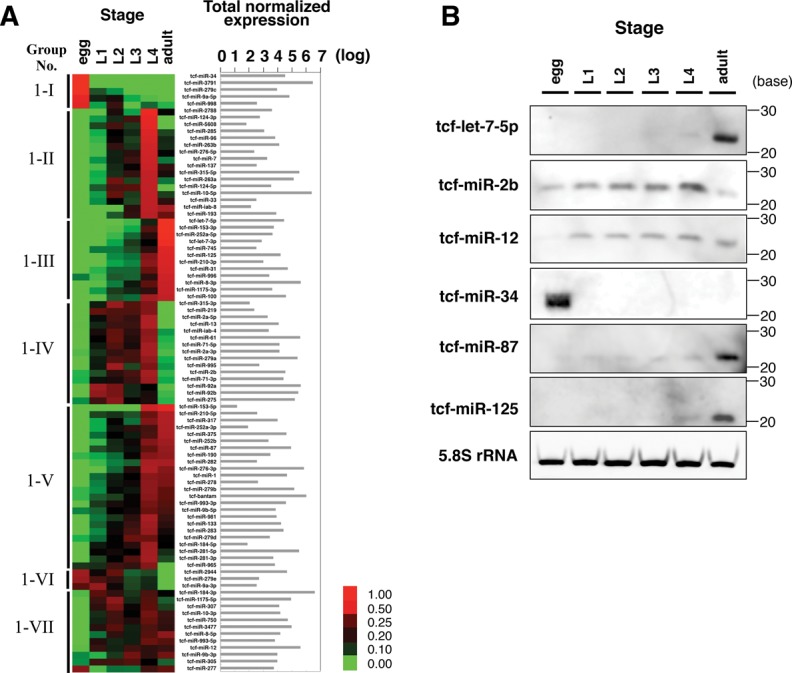
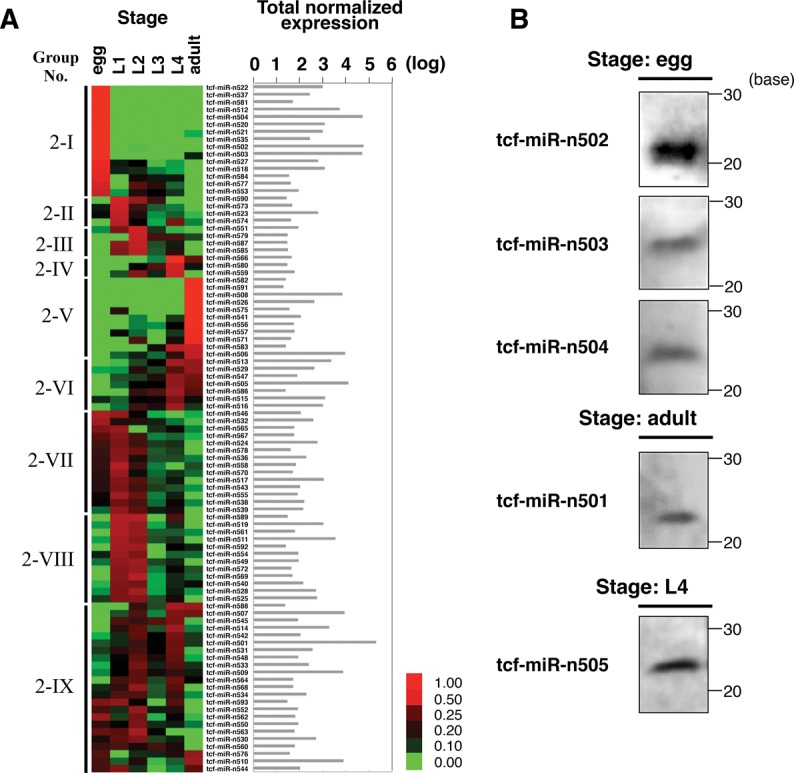
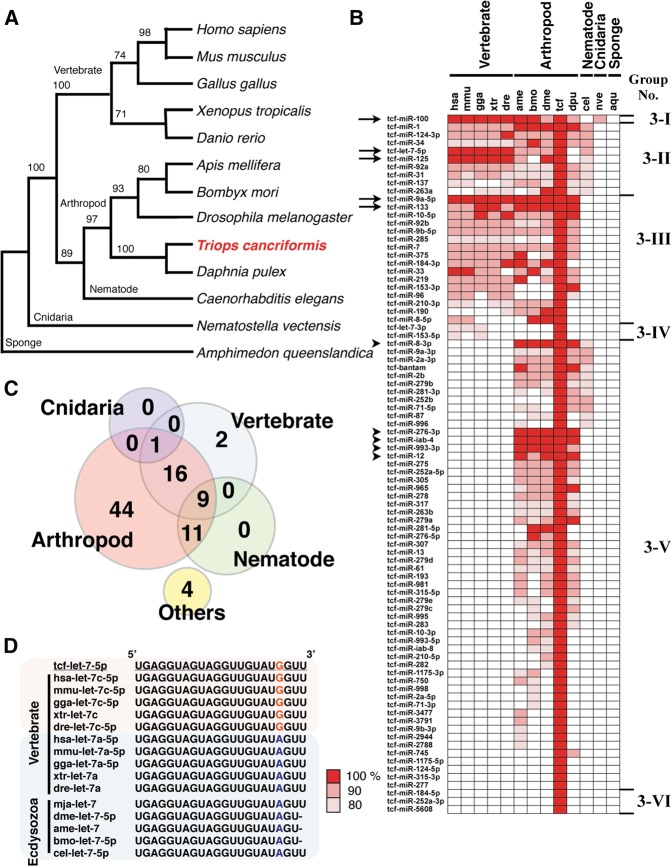
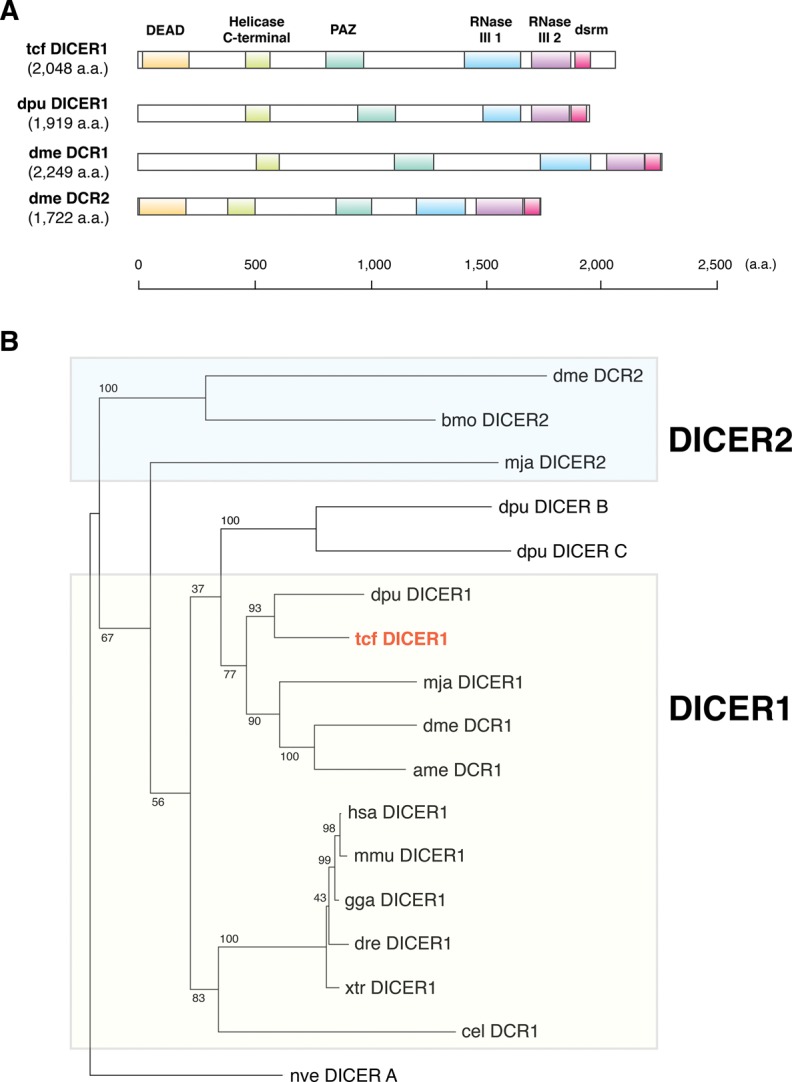
MicroRNAs have been identified and analyzed in various model species, but an investigation of miRNAs in nonmodel species is required for a more complete understanding of miRNA evolution. In this study, we investigated the miRNAs of the nonmodel species Triops cancriformis (tadpole shrimp), a "living fossil," whose morphological form has not changed in almost 200 million years. Dramatic ontogenetic changes occur during its development. To clarify the evolution of miRNAs, we comparatively analyzed its miRNAs and the components of its RNAi machinery. We used deep sequencing to analyze small RNA libraries from the six different developmental stages of T. cancriformis (egg, first-fourth instars, and adult), and also analyzed its genomic DNA with deep sequencing. We identified 180 miRNAs (87 conserved miRNAs and 93 novel candidate miRNAs), and deduced the components of its RNAi machinery: the DICER1, AGO1-3, PIWI, and AUB proteins. A comparative miRNA analysis of T. cancriformis and Drosophila melanogaster showed inconsistencies in the expression patterns of four conserved miRNAs. This suggests that although the miRNA sequences of the two species are very similar, their roles differ across the species. An miRNA conservation analysis revealed that most of the conserved T. cancriformis miRNAs share sequence similarities with those of arthropods, although T. cancriformis is called a "living fossil." However, we found that let-7 and DICER1 of T. cancriformis are more similar to those of the vertebrates than to those of the arthropods. These results suggest that miRNA systems of T. cancriformis have evolved in a unique fashion.
微小 RNA 已在各种模式物种中被鉴定和分析,但为了更全面地了解 miRNA 的进化,需要对非模式物种的 miRNA 进行研究。在这项研究中,我们研究了非模式物种三肢轮虫(蟾蝾)的 miRNA,三肢轮虫是一种“活化石”,其形态在近 2 亿年中没有发生变化。在其发育过程中会发生剧烈的个体发育变化。为了阐明 miRNA 的进化,我们比较分析了其 miRNA 和 RNAi 机制的组成部分。我们使用深度测序技术分析了 T. cancriformis 的六个不同发育阶段(卵、一至四龄幼虫和成虫)的小 RNA 文库,还使用深度测序分析了其基因组 DNA。我们鉴定了 180 个 miRNA(87 个保守 miRNA 和 93 个新的候选 miRNA),并推断了其 RNAi 机制的组成部分:DICER1、AGO1-3、PIWI 和 AUB 蛋白。T. cancriformis 和 Drosophila melanogaster 的比较 miRNA 分析显示,四个保守 miRNA 的表达模式不一致。这表明,尽管这两个物种的 miRNA 序列非常相似,但它们在不同物种中的作用不同。miRNA 保守性分析表明,大多数保守的 T. cancriformis miRNA 与节肢动物的 miRNA 具有序列相似性,尽管 T. cancriformis 被称为“活化石”。然而,我们发现 T. cancriformis 的 let-7 和 DICER1 与其脊椎动物的相似度高于其节肢动物的相似度。这些结果表明,T. cancriformis 的 miRNA 系统以独特的方式进化。