Yu Ying-Ying, Chen Chao, Kong Fan-fei, Zhang Wei
Obstetrics and Gynecology Hospital, Fudan University, Shanghai, People's Republic of China.
Department of Gynecology, Shanghai First Maternity and Infant Hospital Affiliated to TongJi University, Shanghai, People's Republic of China.
Drug Des Devel Ther. 2014 Dec 5;8:2423-30. doi: 10.2147/DDDT.S71815. eCollection 2014.
Previous reports indicate that RUNX3 is a tumor suppressor in several types of human tumors, including breast cancer (BC). However, the correlation between RUNX3 hypermethylation and the incidence of BC remains unclear. In this study, we conducted a systematic review and meta-analysis aiming to comprehensively assess the potential role of RUNX3 hypermethylation in the pathogenesis of BC.
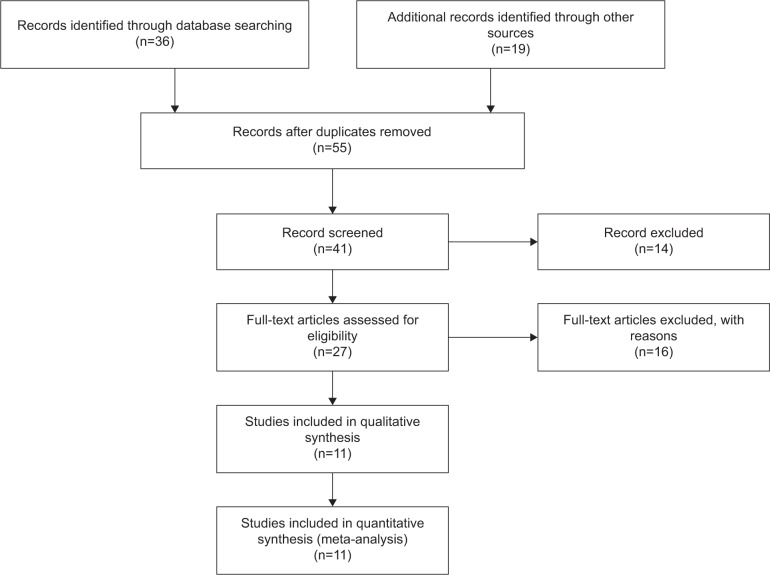
A detailed literature search was made to identify studies for related research publications. Methodological quality of the studies was evaluated. Analysis of pooled data was performed. Odds ratio (OR) was calculated and summarized respectively.
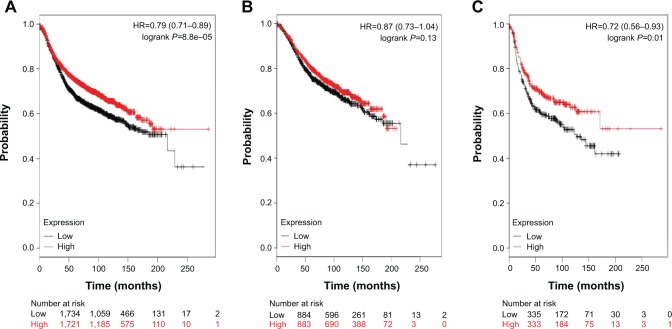
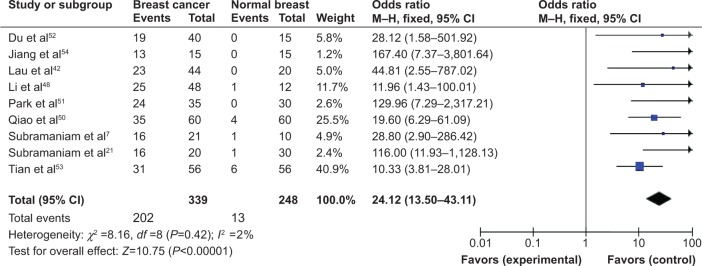
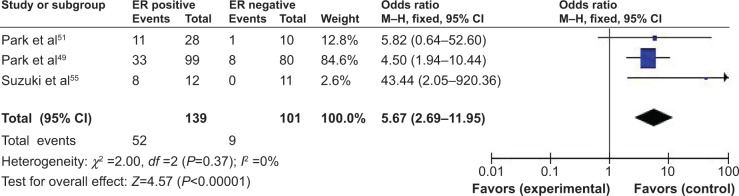
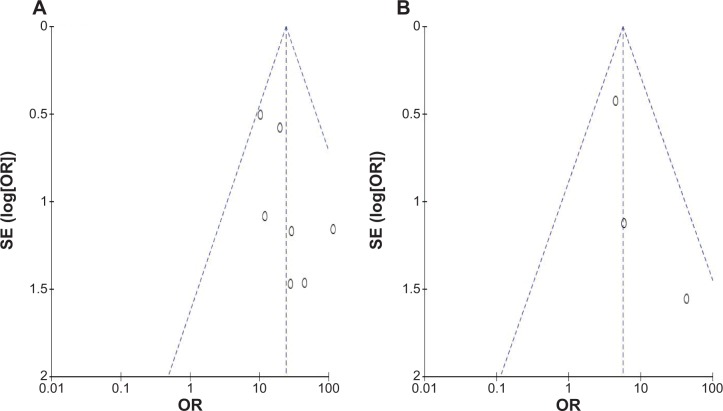
Final analysis of 565 BC patients from eleven eligible studies was performed. The results showed that RUNX3 hypermethylation was significantly higher in BC than in normal breast tissue, the pooled OR from nine studies including 339 BC and 248 normal breast tissue (OR =24.12, 95% confidence interval [CI] =13.50-43.11, Z=10.75, P<0.00001). Further analysis also showed significantly increased OR of RUNX3 hypermethylation in estrogen receptor (ER)-positive than in ER-negative BC patients (OR =5.67, 95% CI =2.69-11.95, Z=4.57, P<0.00001). In addition, RUNX3 messenger RNA (mRNA) high expression was found to be correlated to better overall survival in 3,455 cases of BC patients that were followed up for 20 years (hazard ratio [HR] 0.79, P=8.8×10(-5)). Interestingly, RUNX3 mRNA overexpression was found to be correlated to better overall survival in only 668 cases of ER-negative patients (HR 0.72, P=0.01), but not in 1,767 cases of ER-positive patients (HR 0.87, P=0.13).
The results of this meta-analysis suggest that RUNX3 hypermethylation may be implicated in the pathogenesis of BC. Detection of RUNX3 mRNA may be a helpful and valuable biomarker for diagnosis of BC, especially in ER-negative BC. We also discussed the significance of RUNX3 as a potential drug target.
既往报道表明,RUNX3在包括乳腺癌(BC)在内的多种人类肿瘤中是一种肿瘤抑制因子。然而,RUNX3高甲基化与BC发病率之间的相关性仍不清楚。在本研究中,我们进行了一项系统评价和荟萃分析,旨在全面评估RUNX3高甲基化在BC发病机制中的潜在作用。
进行详细的文献检索以识别相关研究出版物。评估研究的方法学质量。进行汇总数据的分析。分别计算并总结比值比(OR)。
对来自11项合格研究的565例BC患者进行了最终分析。结果显示,BC中RUNX3高甲基化显著高于正常乳腺组织,来自9项研究(包括339例BC和248例正常乳腺组织)的汇总OR为(OR = 24.12,95%置信区间[CI] = 13.50 - 43.11,Z = 10.75,P < 0.00001)。进一步分析还显示,雌激素受体(ER)阳性的BC患者中RUNX3高甲基化的OR显著高于ER阴性患者(OR = 5.67,95% CI = 2.69 - 11.95,Z = 4.57,P < 0.00001)。此外,在对3455例随访20年的BC患者中发现,RUNX3信使核糖核酸(mRNA)高表达与更好的总生存期相关(风险比[HR] 0.79,P = 8.8×10⁻⁵)。有趣的是,仅在668例ER阴性患者中发现RUNX3 mRNA过表达与更好的总生存期相关(HR 0.72,P = 0.01),而在1767例ER阳性患者中未发现相关性(HR 0.87,P = 0.13)。
这项荟萃分析的结果表明,RUNX3高甲基化可能与BC的发病机制有关。检测RUNX3 mRNA可能是诊断BC的一种有用且有价值的生物标志物,尤其是在ER阴性的BC中。我们还讨论了RUNX3作为潜在药物靶点的意义。