Ozaki Toshinori, Nakagawara Akira, Nagase Hiroki
Laboratory of DNA Damage Signaling, Chiba Cancer Center Research Institute, 666-2 Nitona, Chuohku, Chiba 260-8717, Japan.
Int J Genomics. 2013;2013:271347. doi: 10.1155/2013/271347. Epub 2013 Sep 3.
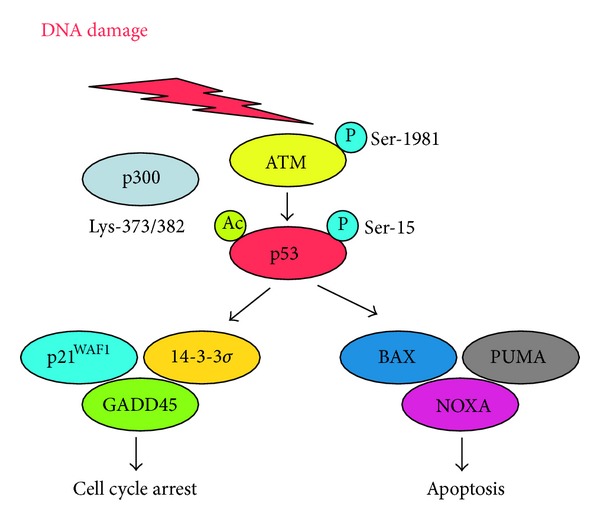
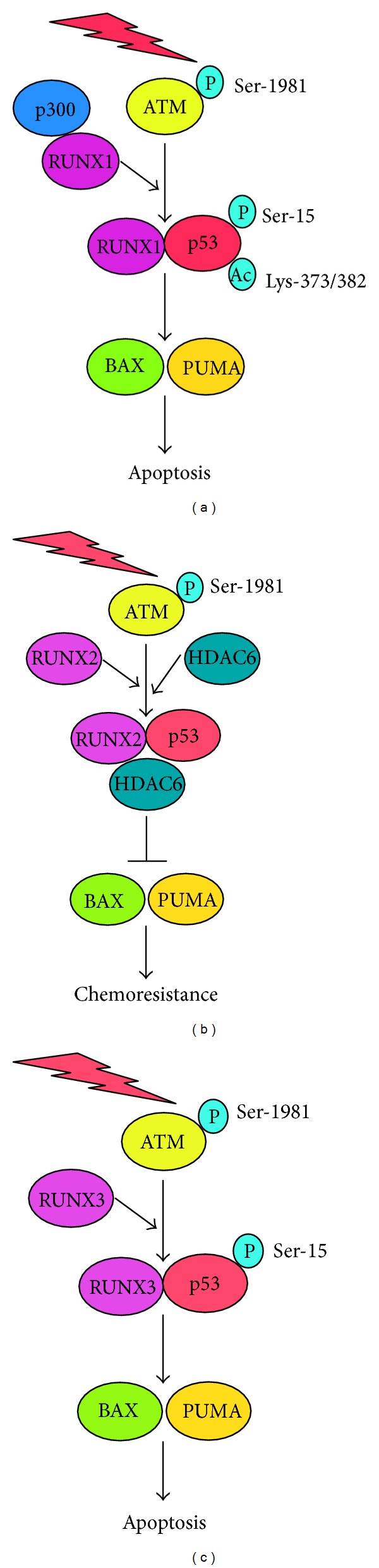
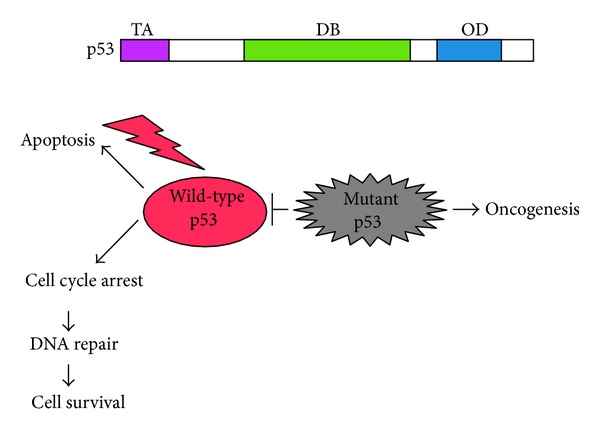
A proper DNA damage response (DDR), which monitors and maintains the genomic integrity, has been considered to be a critical barrier against genetic alterations to prevent tumor initiation and progression. The representative tumor suppressor p53 plays an important role in the regulation of DNA damage response. When cells receive DNA damage, p53 is quickly activated and induces cell cycle arrest and/or apoptotic cell death through transactivating its target genes implicated in the promotion of cell cycle arrest and/or apoptotic cell death such as p21(WAF1) , BAX, and PUMA. Accumulating evidence strongly suggests that DNA damage-mediated activation as well as induction of p53 is regulated by posttranslational modifications and also by protein-protein interaction. Loss of p53 activity confers growth advantage and ensures survival in cancer cells by inhibiting apoptotic response required for tumor suppression. RUNX family, which is composed of RUNX1, RUNX2, and RUNX3, is a sequence-specific transcription factor and is closely involved in a variety of cellular processes including development, differentiation, and/or tumorigenesis. In this review, we describe a background of p53 and a functional collaboration between p53 and RUNX family in response to DNA damage.
适当的DNA损伤反应(DDR)可监测并维持基因组完整性,被视为防止肿瘤发生和发展的基因改变的关键屏障。代表性的肿瘤抑制因子p53在DNA损伤反应的调控中发挥重要作用。当细胞受到DNA损伤时,p53会迅速被激活,并通过反式激活其与促进细胞周期停滞和/或凋亡性细胞死亡相关的靶基因(如p21(WAF1)、BAX和PUMA)来诱导细胞周期停滞和/或凋亡性细胞死亡。越来越多的证据强烈表明,DNA损伤介导的p53激活以及诱导是由翻译后修饰以及蛋白质-蛋白质相互作用调控的。p53活性的丧失赋予癌细胞生长优势,并通过抑制肿瘤抑制所需的凋亡反应来确保其存活。由RUNX1、RUNX2和RUNX3组成的RUNX家族是一种序列特异性转录因子,密切参与包括发育、分化和/或肿瘤发生在内的多种细胞过程。在本综述中,我们描述了p53的背景以及p53与RUNX家族在应对DNA损伤时的功能协作。