Hankins Jane S, Aygun Banu, Nottage Kerri, Thornburg Courtney, Smeltzer Matthew P, Ware Russell E, Wang Winfred C
From the St. Jude Children's Research Hospital, Memphis, TN (JSH, KN, MPS, WCW); Cohen Children's Medical Center of New York, New Hyde Park, NY (BA); Duke University, Durham, NC (CT); and Cincinnati Children's Hospital Medical Center, Cincinnati, OH (REW).
Medicine (Baltimore). 2014 Dec;93(28):e215. doi: 10.1097/MD.0000000000000215.
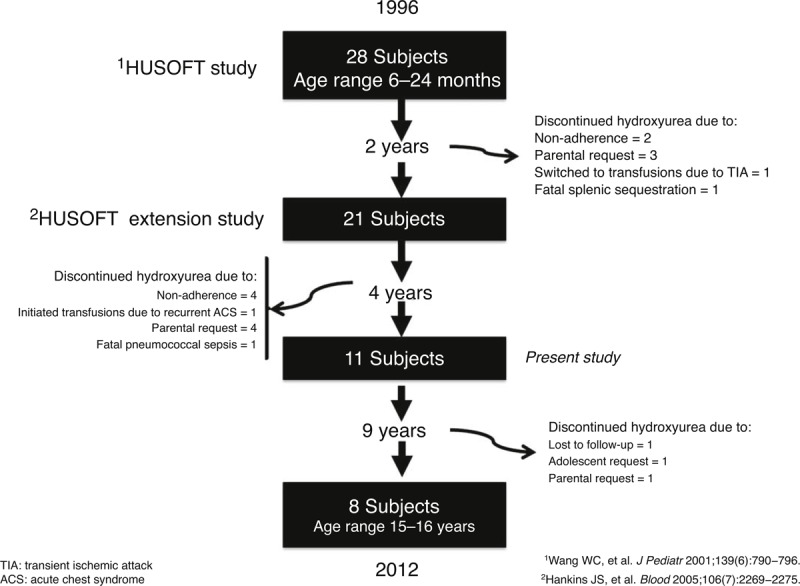
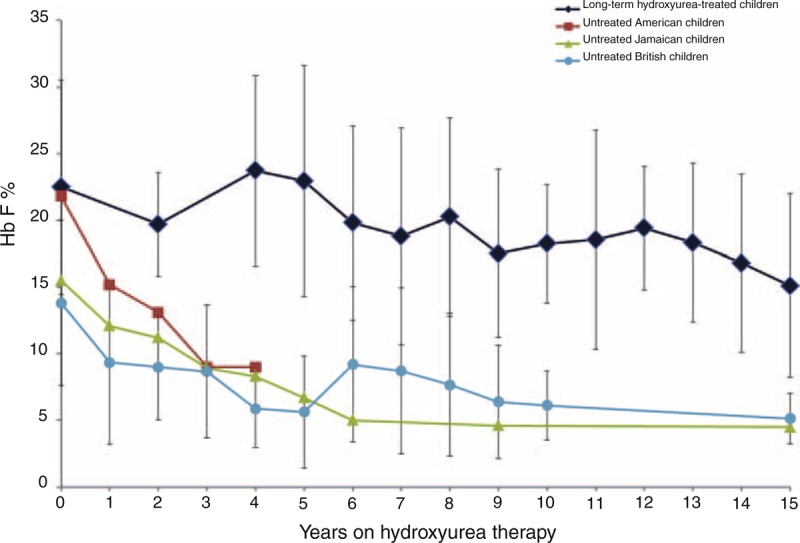
Despite documented laboratory and clinical benefits of hydroxyurea for children with sickle cell anemia (SCA), the drug's long-term safety and efficacy remains poorly defined. The HUSOFT trial and extension study examined feasibility, toxicity, and hematological efficacy of hydroxyurea in infants with SCA. This report describes HUSOFT participants who have continued hydroxyurea therapy for 15 years. With IRB approval, medical records were reviewed for clinical, laboratory, and growth parameters. Twenty-eight infants enrolled in the original 2-year HUSOFT study received open-label liquid hydroxyurea at 20 mg/kg/day; 17 completed the extension study with dose escalation to 30 mg/kg/day. Eight of these 17 (6 girls and 2 boys, all HbSS) have continued on daily hydroxyurea for at least 15 years (median age at last follow-up 17.6 years) without interruption. All hematologic indices (Hb concentration, mean corpuscular volume (MCV), fetal hemoglobin) showed sustained effect after 15 years. The median maximum tolerated dose of hydroxyurea has decreased from 30 to 26 mg/kg/day (range 19.5-31.2); neutropenia [absolute neutrophil count (ANC)<1.0×10⁹/L] prompting temporary drug discontinuation occurred a total of 10 times in 4 subjects and there was no severe neutropenia (ANC<0.5×10⁹/L). Growth rates over 15 years continued at the 50th percentile for both height and weight, and puberty occurred without delay (age range 10-14 years). There were 5.1 vaso-occlusive events (pain and acute chest syndrome)/100 patient years, 7.3 packed red blood cell transfusions/100 patient years. No malignancies, strokes, or deaths occurred. At last follow up, all subjects were at appropriate grade level (10-12 grade) with no history of repeated grades. A cohort of young teenagers with SCA who initiated treatment in infancy have had sustained and continued hematological benefits for a decade and a half. Growth and sexual development are normal and comparable to the general pediatric population. Continuous hydroxyurea therapy since infancy appears safe and efficacious in SCA.
尽管有文献记载羟基脲对镰状细胞贫血(SCA)患儿具有实验室和临床益处,但该药物的长期安全性和疗效仍不明确。HUSOFT试验及扩展研究考察了羟基脲在SCA婴儿中的可行性、毒性及血液学疗效。本报告描述了持续接受羟基脲治疗15年的HUSOFT参与者。经机构审查委员会批准,对临床、实验室及生长参数的病历进行了回顾。最初为期2年的HUSOFT研究中入组的28名婴儿接受了20mg/kg/天的开放标签液体羟基脲治疗;17名完成了扩展研究,剂量递增至30mg/kg/天。这17名中的8名(6名女孩和2名男孩,均为HbSS型)持续每日服用羟基脲至少15年(末次随访时的中位年龄为17.6岁)且未中断。15年后所有血液学指标(血红蛋白浓度、平均红细胞体积(MCV)、胎儿血红蛋白)均显示出持续效果。羟基脲的中位最大耐受剂量从30mg/kg/天降至26mg/kg/天(范围为19.5 - 31.2);4名受试者共出现10次因中性粒细胞减少症[绝对中性粒细胞计数(ANC)<1.0×10⁹/L]导致暂时停药的情况,且无严重中性粒细胞减少症(ANC<0.5×10⁹/L)。15年期间身高和体重的生长速率持续处于第50百分位,青春期正常出现(年龄范围为10 - 14岁)。每100患者年有5.1次血管闭塞事件(疼痛和急性胸综合征),每100患者年有7.3次浓缩红细胞输注。未发生恶性肿瘤、中风或死亡。在末次随访时,所有受试者处于适当年级水平(10 - 12年级),无留级史。一组婴儿期开始治疗的SCA青少年在十五年间持续获得血液学益处。生长和性发育正常,与普通儿科人群相当。婴儿期起开始的持续羟基脲治疗在SCA中似乎安全有效。