Blanc Matthieu, Marais Clémence, Debs Alexandre, Cousin Vladimir L, Tissières Pierre
IHU-PROMETHEUS Comprehensive Sepsis Center and Pediatric Intensive Care, Neonatal Medicine, and Pediatric Emergency Department, AP-HP Paris Saclay University, Bicêtre Hospital, Le Kremlin-Bicêtre, France.
Institute of Integrative Biology of the Cell, CNRS, CEA, Paris Saclay University, Gif-sur-Yvette, France.
Crit Care Explor. 2025 Feb 12;7(2):e1218. doi: 10.1097/CCE.0000000000001218. eCollection 2025 Feb 1.
Malignant pertussis, the most severe manifestation of Bordetella pertussis infection, is characterized by multiple organ failure and a high mortality rate despite advanced intensive care measures. Hyperleukocytosis is the hallmark of malignant pertussis and necessitates urgent and aggressive interventions. Among the therapeutic options, leukoreduction via whole blood exchange (BE) transfusion has been associated with significant procedural risks and potential clinical deterioration. Hydroxyurea was recently proposed as a pharmacological alternative for leukoreduction. This study reports our clinical experience with hydroxyurea as an alternative to BE in managing infants with malignant pertussis admitted to a PICU.
Prospective case series.
A referral PICU in France.
Critically ill infants (n = 27) with severe pertussis infection.
Hydroxyurea therapy or BE transfusion.
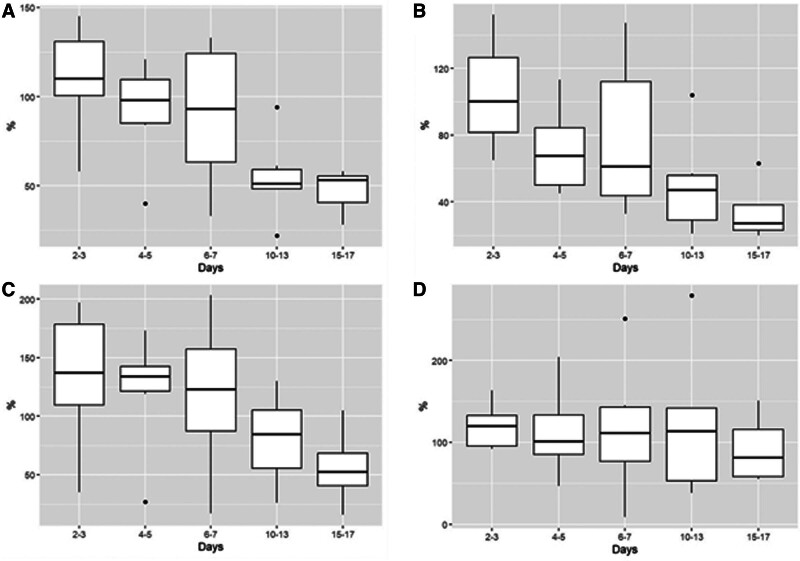
We reviewed all critically ill infants admitted to our unit for severe pertussis between January 2017 and July 2024. The primary outcome was 28-day survival, and the secondary outcome was the efficacy of hydroxyurea on blood leukocyte count reduction. Among the 27 infants admitted for severe pertussis, 12 exhibited features of malignant pertussis. Of these, seven were treated with hydroxyurea and five with BE. The majority of infants were term and under 3 months old. All patients required ventilatory support, with eight on invasive mechanical ventilation and three receiving extracorporeal membrane oxygenation therapy. Overall mortality was three of 12 (25%). Hydroxyurea was administered at a dose of 20 mg/kg/d for a median duration of 12 days. Hyperleukocytosis was successfully reduced within 7 days.
Hydroxyurea is an alternative therapy for malignant pertussis infection that can efficiently address hyperleukocytosis with limited mortality.
恶性百日咳是百日咳博德特氏菌感染最严重的表现形式,其特征为多器官功能衰竭,尽管采取了先进的重症监护措施,但死亡率仍很高。白细胞增多是恶性百日咳的标志,需要紧急且积极的干预措施。在治疗选择中,通过全血置换(BE)输血进行白细胞去除术存在重大的操作风险和潜在的临床病情恶化风险。最近有人提出使用羟基脲作为白细胞去除的药理学替代方法。本研究报告了我们使用羟基脲替代BE治疗入住儿科重症监护病房(PICU)的恶性百日咳婴儿的临床经验。
前瞻性病例系列研究。
法国一家转诊PICU。
患有严重百日咳感染的危重症婴儿(n = 27)。
羟基脲治疗或BE输血。
我们回顾了2017年1月至2024年7月期间入住我们科室的所有因严重百日咳而病情危急的婴儿。主要结局指标是28天生存率,次要结局指标是羟基脲对降低血液白细胞计数的疗效。在27名因严重百日咳入院的婴儿中,12名表现出恶性百日咳的特征。其中,7名接受了羟基脲治疗,5名接受了BE治疗。大多数婴儿为足月儿且年龄在3个月以下。所有患者均需要通气支持,其中8名接受有创机械通气,3名接受体外膜肺氧合治疗。总体死亡率为12例中的3例(25%)。羟基脲的给药剂量为20 mg/kg/d,中位疗程为12天。白细胞增多在7天内成功得到缓解。
羟基脲是治疗恶性百日咳感染的一种替代疗法,可有效解决白细胞增多问题,且死亡率有限。