Bianchi Daniele, Di Santo Angelo, Gaziev Gabriele, Miano Roberto, Musco Stefania, Vespasiani Giuseppe, Finazzi Agrò Enrico
School of Specialization in Urology, University of Rome Tor Vergata, Viale Oxford, 81-00133 Rome, Italy.
BMC Urol. 2014 Dec 19;14:103. doi: 10.1186/1471-2490-14-103.
Aim of this study was to make a comparison between penile cuff test (PCT) and standard pressure-flow study (PFS) in the preoperative evaluation of patients candidates for trans-urethral resection of prostate (TURP) for benign prostatic obstruction (BPO).
We enrolled male patients with lower urinary tract symptoms candidates for TURP. Each of them underwent a PCT and a subsequent PFS. A statistical analysis was performed: sensitivity (SE), specificity (SP), positive predictive value (PPV), negative predictive value (NPV), likelihood ratio and ratio of corrected classified were calculated. Fisher exact test was used to evaluate relationships between PCT and maximal urine flow (Qmax): a p-value < 0.05 was considered statistically significant.
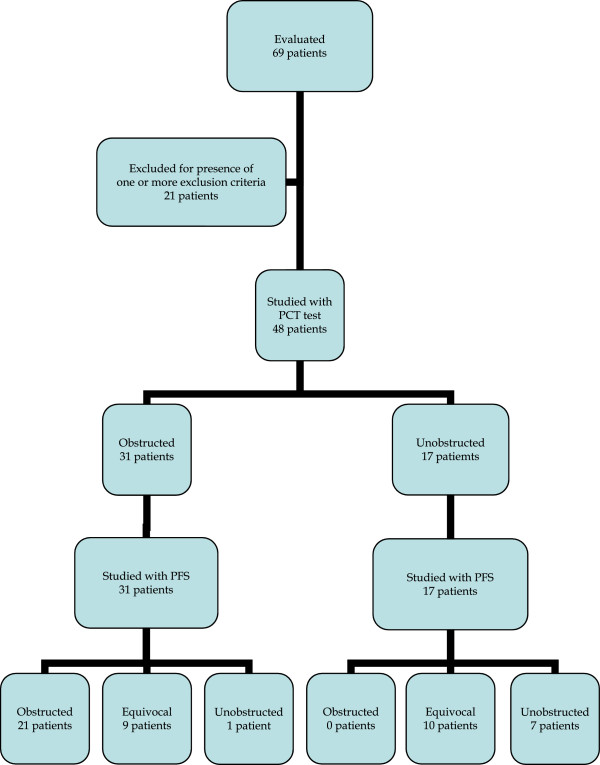
We enrolled 48 consecutive patients. Overall, at PCT 31 patients were diagnosed as obstructed and 17 patients as unobstructed. At the subsequent PFS, 21 out of 31 patients diagnosed as obstructed at PCT were confirmed to be obstructed; one was diagnosed as unobstructed; the remaining 9 patients appeared as equivocal. Concerning the 17 patients unobstructed at PCT, all of them were confirmed not to be obstructed at PFS, with 10 equivocal and 7 unobstructed. The rate of correctly classified patients at PCT was 79% (95%-CI 65%-90%). About detecting obstructed patients, PCT showed a SE of 100% and a SP of 63%. The PPV was 68%, while the NPV was 100%.
PCT can be an efficient tool in evaluating patients candidates for TURP. In particular, it showed good reliability in ruling out BPO because of its high NPV, with a high rate of correctly classified patients overall. Further studies on a huger number of patients are needed, including post-operative follow-up as well.
本研究的目的是在经尿道前列腺切除术(TURP)治疗良性前列腺梗阻(BPO)的术前评估中,比较阴茎袖带试验(PCT)和标准压力-流率研究(PFS)。
我们纳入了有下尿路症状且适合TURP的男性患者。他们每人都接受了PCT及随后的PFS。进行了统计学分析:计算了敏感度(SE)、特异度(SP)、阳性预测值(PPV)、阴性预测值(NPV)、似然比和校正分类比。采用Fisher精确检验评估PCT与最大尿流率(Qmax)之间的关系:p值<0.05被认为具有统计学意义。
我们连续纳入了48例患者。总体而言,在PCT中,31例患者被诊断为梗阻,17例患者被诊断为无梗阻。在随后的PFS中,PCT诊断为梗阻的31例患者中有21例被确认为梗阻;1例被诊断为无梗阻;其余9例结果不明确。关于PCT时无梗阻的17例患者,在PFS时均被确认为无梗阻,其中10例结果不明确,7例无梗阻。PCT时正确分类患者的比例为79%(95%可信区间65%-90%)。关于检测梗阻患者,PCT的SE为100%,SP为63%。PPV为68%,而NPV为100%。
PCT可以作为评估适合TURP患者的有效工具。特别是,由于其高NPV以及总体上较高的正确分类患者比例,它在排除BPO方面显示出良好的可靠性。还需要对更多患者进行进一步研究,包括术后随访。