Pedersen Lise, Nybo Mads, Poulsen Mikael Kjær, Henriksen Jan Erik, Dahl Jordi, Rasmussen Lars Melholt
Department of Clinical Biochemistry and Pharmacology, Odense University Hospital, Sdr, Boulevard 29, 5000 Odense C, Denmark.
BMC Cardiovasc Disord. 2014 Dec 19;14:196. doi: 10.1186/1471-2261-14-196.
Plasma calprotectin is a potential biomarker of cardiovascular disease (CVD), insulin resistance (IR), and obesity. We examined the relationship between plasma calprotectin concentrations, CVD manifestations and the metabolic syndrome (MetS) in patients with type 2 diabetes mellitus (T2DM) in order to evaluate plasma calprotectin as a risk assessor of CVD in diabetic patients without known CVD.
An automated immunoassay for determination of plasma calprotectin was developed based on a fecal Calprotectin ELIA, and a reference range was established from 120 healthy adults. Plasma calprotectin concentrations were measured in 305 T2DM patients without known CVD. They were screened for carotid arterial disease, peripheral arterial disease (PAD), and myocardial ischemia (MI) by means of carotid artery ultrasonography, peripheral ankle and toe systolic blood pressure measurements, and myocardial perfusion scintigraphy.
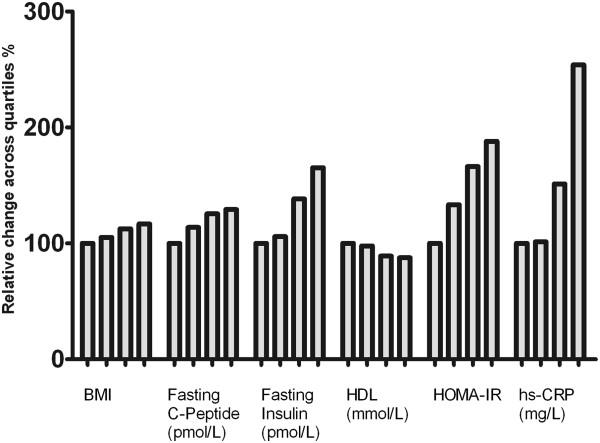
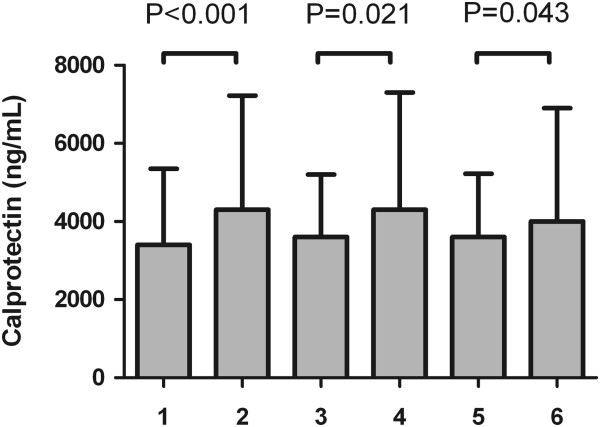
The reference population had a median plasma calprotectin concentration of 2437 ng/mL (2.5-97.5% reference range: 1040-4262 ng/mL). The T2DM patients had significantly higher concentrations (3754 ng/mL, p < 0.0001), and within this group plasma calprotectin was significantly higher in patients with MetS (p < 0.0001) and also in patients with autonomic neuropathy, PAD, and MI compared with patients without (p < 0.001, p = 0.021 and p = 0.043, respectively). Plasma calprotectin was by linear regression analysis found independently associated with BMI, C-reactive protein, and HDL cholesterol. However, plasma calprotectin did not predict autonomic neuropathy, PAD, MI or CVD when these variables entered the multivariable regression analysis as separate outcome variables.
T2DM patients had higher concentrations of plasma calprotectin, which were associated with obesity, MetS status, autonomic neuropathy, PAD, and MI. However, plasma calprotectin was not an independent predictor of CVD, MI, autonomic neuropathy or PAD.
NCT00298844.
血浆钙卫蛋白是心血管疾病(CVD)、胰岛素抵抗(IR)和肥胖的潜在生物标志物。我们研究了2型糖尿病(T2DM)患者血浆钙卫蛋白浓度、CVD表现与代谢综合征(MetS)之间的关系,以评估血浆钙卫蛋白作为无已知CVD的糖尿病患者CVD风险评估指标的价值。
基于粪便钙卫蛋白酶联免疫吸附测定法(ELIA)开发了一种用于测定血浆钙卫蛋白的自动化免疫测定法,并从120名健康成年人中建立了参考范围。对305例无已知CVD的T2DM患者测定血浆钙卫蛋白浓度。通过颈动脉超声、外周踝部和趾部收缩压测量以及心肌灌注闪烁显像对他们进行颈动脉疾病、外周动脉疾病(PAD)和心肌缺血(MI)筛查。
参考人群的血浆钙卫蛋白浓度中位数为2437 ng/mL(2.5 - 97.5%参考范围:1040 - 4262 ng/mL)。T2DM患者的浓度显著更高(3754 ng/mL,p < 0.0001),在该组中,与无MetS的患者相比,MetS患者(p < 0.0001)以及自主神经病变、PAD和MI患者的血浆钙卫蛋白也显著更高(分别为p < 0.001、p = 0.021和p = 0.043)。通过线性回归分析发现血浆钙卫蛋白与体重指数、C反应蛋白和高密度脂蛋白胆固醇独立相关。然而,当这些变量作为单独的结局变量进入多变量回归分析时,血浆钙卫蛋白并不能预测自主神经病变、PAD、MI或CVD。
T2DM患者的血浆钙卫蛋白浓度较高,这与肥胖、MetS状态、自主神经病变、PAD和MI相关。然而,血浆钙卫蛋白不是CVD、MI、自主神经病变或PAD的独立预测指标。
NCT00298844。