Wade Kaitlin H, Forouhi Nita G, Cook Derek G, Johnson Paul, McConnachie Alex, Morris Richard W, Rodriguez Santiago, Ye Zheng, Ebrahim Shah, Padmanabhan Sandosh, Watt Graham, Bruckdorfer K Richard, Wareham Nick J, Whincup Peter H, Chanock Stephen, Sattar Naveed, Lawlor Debbie A, Davey Smith George, Timpson Nicholas J
From the Medical Research Council (MRC) Integrative Epidemiology Unit (KHW, DAL, GDS, and NJT) and the School of Social and Community Medicine (KHW, NGF, SR, DAL, GDS, and NJT), University of Bristol, Bristol, United Kingdom; the MRC Epidemiology Unit, University of Cambridge School of Clinical Medicine, Institute of Metabolic Science, Cambridge, United Kingdom (NGF, ZY, and NJW); the Division of Community and Health Sciences, St. George's University of London, London, United Kingdom (DGC and PHW); the Robertson Centre for Biostatistics, Glasgow, United Kingdom (PJ and AM); the Department of Primary Care & Population Health (RWM), the Department of Structural and Molecular Biology, University College London (KRB), London, United Kingdom (RWM); the London School of Hygiene and Tropical Medicine, London, United Kingdom (SE); the British Heart Foundation Glasgow Cardiovascular Research Centre, Faculty of Medicine (SP and NS) and General Practice and Primary Care, Division of Community Based Sciences (GW), University of Glasgow, Glasgow, United Kingdom; and the Division of Cancer Epidemiology and Genetics, National Cancer Institute, Bethesda, MD (SC).
Am J Clin Nutr. 2015 Jan;101(1):202-9. doi: 10.3945/ajcn.114.092981. Epub 2014 Nov 19.
Observational studies showed that circulating L-ascorbic acid (vitamin C) is inversely associated with cardiometabolic traits. However, these studies were susceptible to confounding and reverse causation.
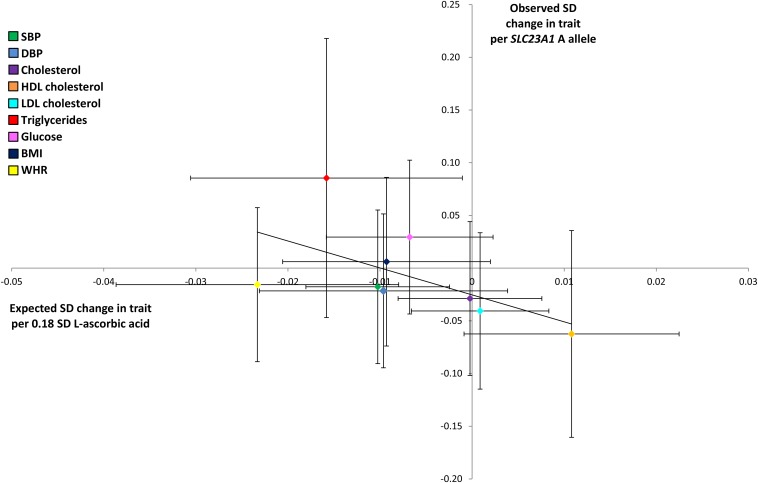
We assessed the relation between L-ascorbic acid and 10 cardiometabolic traits by using a single nucleotide polymorphism in the solute carrier family 23 member 1 (SLC23A1) gene (rs33972313) associated with circulating L-ascorbic acid concentrations. The observed association between rs33972313 and cardiometabolic outcomes was compared with that expected given the rs33972313-L-ascorbic acid and L-ascorbic acid-outcome associations.
A meta-analysis was performed in the following 5 independent studies: the British Women's Heart and Health Study (n = 1833), the MIDSPAN study (n = 1138), the Ten Towns study (n = 1324), the British Regional Heart Study (n = 2521), and the European Prospective Investigation into Cancer (n = 3737).
With the use of a meta-analysis of observational estimates, inverse associations were shown between L-ascorbic acid and systolic blood pressure, triglycerides, and the waist-hip ratio [the strongest of which was the waist-hip ratio (-0.13-SD change; 95% CI: -0.20-, -0.07-SD change; P = 0.0001) per SD increase in L-ascorbic acid], and a positive association was shown with high-density lipoprotein (HDL) cholesterol. The variation at rs33972313 was associated with a 0.18-SD (95% CI: 0.10-, 0.25-SD; P = 3.34 × 10⁻⁶) increase in L-ascorbic acid per effect allele. There was no evidence of a relation between the variation at rs33972313 and any cardiometabolic outcome. Although observed estimates were not statistically different from expected associations between rs33972313 and cardiometabolic outcomes, estimates for low-density lipoprotein cholesterol, HDL cholesterol, triglycerides, glucose, and body mass index were in the opposite direction to those expected.
The nature of the genetic association exploited in this study led to limited statistical application, but despite this, when all cardiometabolic traits were assessed, there was no evidence of any trend supporting a protective role of L-ascorbic acid. In the context of existing work, these results add to the suggestion that observational relations between L-ascorbic acid and cardiometabolic health may be attributable to confounding and reverse causation.
观察性研究表明,循环中的L-抗坏血酸(维生素C)与心脏代谢特征呈负相关。然而,这些研究容易受到混杂因素和反向因果关系的影响。
我们通过使用溶质载体家族23成员1(SLC23A1)基因(rs33972313)中的单核苷酸多态性来评估L-抗坏血酸与10种心脏代谢特征之间的关系,该基因与循环中的L-抗坏血酸浓度相关。将rs33972313与心脏代谢结局之间观察到的关联与考虑到rs33972313-L-抗坏血酸和L-抗坏血酸-结局关联后预期的关联进行比较。
在以下5项独立研究中进行了荟萃分析:英国女性心脏与健康研究(n = 1833)、MIDSPAN研究(n = 1138)、十城镇研究(n = 1324)、英国地区心脏研究(n = 2521)和欧洲癌症前瞻性调查(n = 3737)。
通过对观察性估计值进行荟萃分析,发现L-抗坏血酸与收缩压、甘油三酯和腰臀比之间存在负相关[其中最强的是腰臀比(每增加1个标准差的L-抗坏血酸,变化为-0.13个标准差;95%置信区间:-0.20,-0.07个标准差变化;P = 0.0001)],与高密度脂蛋白(HDL)胆固醇呈正相关。rs33972313处的变异与每个效应等位基因使L-抗坏血酸增加0.18个标准差(95%置信区间:0.10,0.25个标准差;P = 3.34×10⁻⁶)相关。没有证据表明rs33972313处的变异与任何心脏代谢结局之间存在关联。尽管观察到的估计值与rs33972313和心脏代谢结局之间的预期关联在统计学上没有差异,但低密度脂蛋白胆固醇、HDL胆固醇、甘油三酯、葡萄糖和体重指数的估计值与预期方向相反。
本研究中利用的基因关联性质导致统计应用有限,但尽管如此,在评估所有心脏代谢特征时,没有证据表明有任何趋势支持L-抗坏血酸的保护作用。结合现有研究工作来看,这些结果进一步表明,L-抗坏血酸与心脏代谢健康之间的观察性关联可能归因于混杂因素和反向因果关系。