Labi Appiah-Korang, Obeng-Nkrumah Noah, Addison Naa Okaikor, Donkor Eric S
BMC Infect Dis. 2014 Dec 21;14:3857. doi: 10.1186/s12879-014-0697-7.
Despite the clinical significance of Salmonella infections, surveillance data worldwide remains limited and is more so exemplified by the lack of reports from Africa especially in eastern, central and western Africa. This study reports on Salmonella serotypes as significant causes of blood stream infections (BSI) and multidrug antibiotic resistance at Korle-Bu Teaching Hospital in Accra, Ghana.
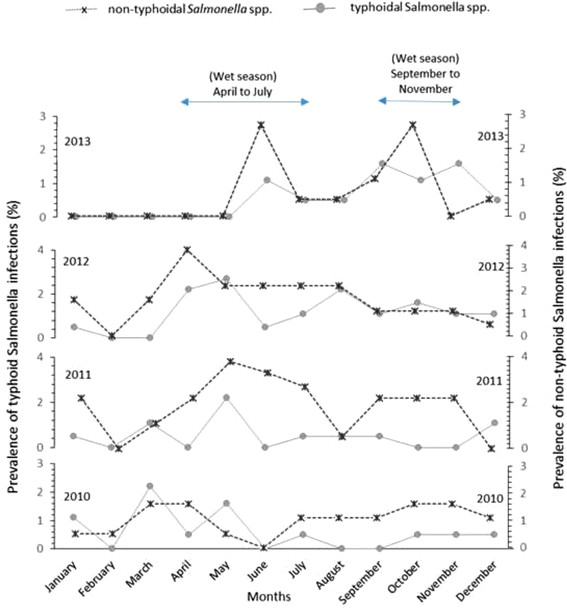
Antibiogram patterns, seasonal variations in disease incidence and predisposing factors for infection with Salmonella serotypes were analyzed retrospectively over a 4-year period from January 2010 to December 2013. Blood cultures were processed with BACTEC 9240 blood culture system. Speciation was done with BBL Crystal Enteric/Nonfermenter identification system®, and with slide agglutination using specific antisera. Antimicrobial susceptibility testing was carried out by the Kirby-Bauer disc diffusion method according to Clinical and Laboratory Standard Institute guidelines.
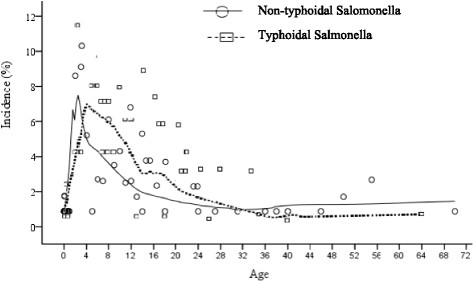
We report a 6.5% (n = 181/2768) prevalence of Salmonella bacteraemia at the Korle-Bu Teaching Hospital; with a preponderance of non-typhoidal salmonellae (NTS) over typhoidal salmonella (TS) (n = 115/181, 63.5% versus n = 66/181, 36.5%; P-value <0.002). Children under 5 years bore the brunt of the disease (n = 93/174, 53.4%). Resistance to ciprofloxacin (n = 1/127, 0.7%), amikacin (n = 3/81, 3.7%), and cefotaxime (n = 6/99, 6.1%) remained low, despite high levels of multidrug resistant Salmonella phenotypes (n = 81/181, 44.2%). In multivariate analysis, and among patients with Salmonella BSI, those < 1 year old had reduced risk of non-typhoidal infections [Odds ratio, 0.51; 95% confidence interval (95% CI), 0.16-0.92, P-value 0.021]. Similarly, patients with cefuroxime resistant strans were at increased risk of having multidrug resistant Salmonella BSI (OR, 8.97; 95% CI, 3.62-24.15; P-value, 0.001).
Salmonellae, predominantly NTS, account for a reasonable low proportion of positive blood cultures in our tertiary care setting; but with significant multidrug resistant phenotypes and low ciprofloxacin and cefotaxime resistance.
尽管沙门氏菌感染具有临床重要性,但全球范围内的监测数据仍然有限,非洲地区尤其是东非、中非和西非缺乏相关报告的情况更为突出。本研究报告了加纳阿克拉科勒-布教学医院中作为血流感染(BSI)重要病因的沙门氏菌血清型以及多重耐药情况。
回顾性分析了2010年1月至2013年12月这4年间沙门氏菌血清型感染的抗菌谱模式、疾病发病率的季节性变化以及易感因素。采用BACTEC 9240血培养系统进行血培养。使用BBL Crystal肠杆菌/非发酵菌鉴定系统®进行菌种鉴定,并使用特异性抗血清进行玻片凝集试验。根据临床和实验室标准协会指南,采用 Kirby-Bauer 纸片扩散法进行药敏试验。
我们报告科勒-布教学医院沙门氏菌血症的患病率为6.5%(n = 181/2768);非伤寒沙门氏菌(NTS)比伤寒沙门氏菌(TS)更为常见(n = 115/181,63.5% 对 n = 66/181,36.5%;P值<0.002)。5岁以下儿童受该病影响最为严重(n = 93/174,53.4%)。尽管多重耐药沙门氏菌表型水平较高(n = 81/181,44.2%),但对环丙沙星(n = 1/127,0.7%)、阿米卡星(n = 3/81,3.7%)和头孢噻肟(n = 6/99,6.1%)的耐药率仍然较低。在多变量分析中,在患有沙门氏菌BSI的患者中,1岁以下的患者非伤寒感染风险降低[比值比,0.51;95%置信区间(95%CI),0.16 - 0.92,P值0.021]。同样,对头孢呋辛耐药的患者发生多重耐药沙门氏菌BSI的风险增加(OR,8.97;95%CI,3.62 - 24.15;P值,0.001)。
在我们的三级医疗环境中,沙门氏菌,主要是NTS,在血培养阳性中所占比例相对较低;但具有显著的多重耐药表型,且对环丙沙星和头孢噻肟的耐药率较低。