Hyun Kyung-Rae, Kang Sungwook, Lee Sunmi
Health Insurance Policy Research Institute, National Health Insurance Service, Mapo-gu, Seoul, South Korea.
School of Public Health, Daegu Haany University, Gyeongsan-si, Gyeongsangbuk-Do, South Korea.
BMC Health Serv Res. 2014 Dec 21;14:630. doi: 10.1186/s12913-014-0630-1.
This study examines the effects of long-term care insurance (LTCI) on the length of stay (LoS) of senior citizens under the national health insurance of Korea.
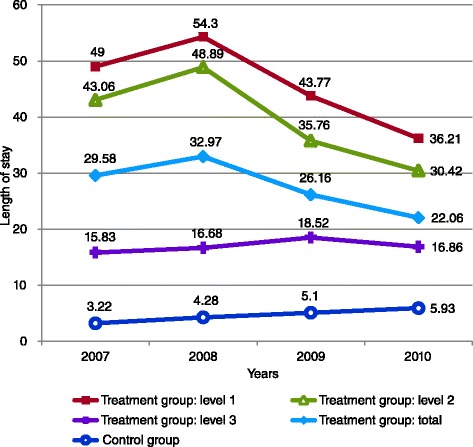
The subjects include 3,903,448 people aged 65 and over as of July 1, 2008 when the LTCI was introduced in Korea. This study uses their panel data which traced the records of medical services and LTCI services for the same people from 2007 to 2010, and applies a difference-in-difference approach on LTCI users from levels 1, 2, and 3 who are the treatment group and non-LTCI users who are the control group.
We found that the LoS of LTCI users is 1.27 days greater than that of non-LTCI users, but the LoS of level 1 and level 2 beneficiaries decreases by 8.35 and 2.84 days, respectively, whereas the LTCI does not reduce the LoS of level 3 beneficiaries.
The reason why there is an effect on the LoS of level 1 and 2 beneficiaries is that these groups could choose to utilize institutional care services provided by the LTCI, and out-of-pocket costs of institutions are lower than that of hospitals. However, the reason why there is no effect on the LoS of level 3 beneficiaries is that they are not permitted to use the institutional care services in the Korean LTCI policy. Therefore, we recommend a modification in the LTCI system that facilitates the use of long-term care institutional services by level 3 beneficiaries without conflicting Korea's LTCI principle to promote home-based care services instead of the institutional care services.
本研究考察了长期护理保险(LTCI)对韩国国民健康保险覆盖下老年人住院时间(LoS)的影响。
研究对象包括截至2008年7月1日韩国引入LTCI时年龄在65岁及以上的3,903,448人。本研究使用了他们的面板数据,该数据追踪了同一批人在2007年至2010年期间的医疗服务和LTCI服务记录,并对作为治疗组的1级、2级和3级LTCI使用者以及作为对照组的非LTCI使用者采用了双重差分法。
我们发现,LTCI使用者的住院时间比非LTCI使用者长1.27天,但1级和2级受益人的住院时间分别减少了8.35天和2.84天,而LTCI并未缩短3级受益人的住院时间。
1级和2级受益人住院时间受到影响的原因是,这些群体可以选择使用LTCI提供的机构护理服务,且机构的自付费用低于医院。然而,3级受益人住院时间未受影响的原因是,在韩国LTCI政策中他们不被允许使用机构护理服务。因此,我们建议对LTCI系统进行修改,在不违背韩国LTCI促进居家护理服务而非机构护理服务原则的前提下,方便3级受益人使用长期护理机构服务。