Kugeler Kiersten J, Staples J Erin, Hinckley Alison F, Gage Kenneth L, Mead Paul S
Emerg Infect Dis. 2015 Jan;21(1):16-22. doi: 10.3201/eid2101.140564.
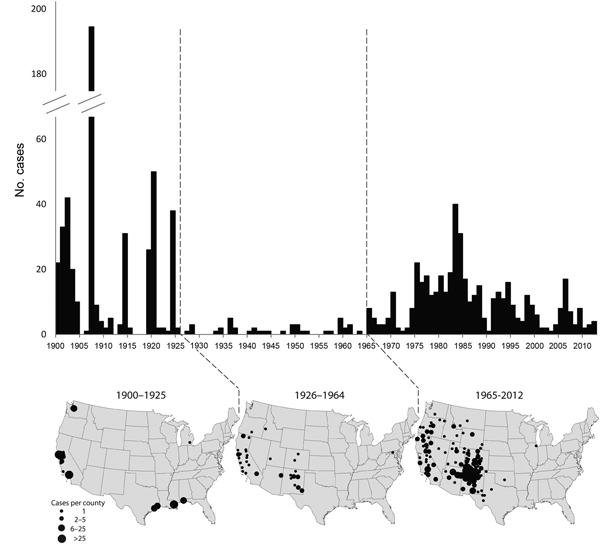
We summarize the characteristics of 1,006 cases of human plague occurring in the United States over 113 years, beginning with the first documented case in 1900. Three distinct eras can be identified on the basis of the frequency, nature, and geographic distribution of cases. During 1900-1925, outbreaks were common but were restricted to populous port cities. During 1926-1964, the geographic range of disease expanded rapidly, while the total number of reported cases fell. During 1965-2012, sporadic cases occurred annually, primarily in the rural Southwest. Clinical and demographic features of human illness have shifted over time as the disease has moved from crowded cities to the rural West. These shifts reflect changes in the populations at risk, the advent of antibiotics, and improved detection of more clinically indistinct forms of infection. Overall, the emergence of human plague in the United States parallels observed patterns of introduction of exotic plants and animals.
我们总结了113年间在美国发生的1006例人间鼠疫病例的特征,始于1900年有记录的首例病例。根据病例的发生频率、性质和地理分布,可以确定三个不同的时期。1900年至1925年期间,疫情频发,但仅限于人口众多的港口城市。1926年至1964年期间,疾病的地理范围迅速扩大,而报告的病例总数下降。1965年至2012年期间,每年都有散发病例,主要发生在西南部农村地区。随着疾病从拥挤的城市转移到西部农村,人类疾病的临床和人口统计学特征随时间发生了变化。这些变化反映了高危人群的变化、抗生素的出现以及对更多临床症状不明显的感染形式的检测改善。总体而言,美国人间鼠疫的出现与外来动植物引入的观察模式相似。