Koch Lutz, Frommhold David, Buschmann Kirsten, Kuss Navina, Poeschl Johannes, Ruef Peter
Department of Neonatology, University Children's Hospital, Medical School, University of Heidelberg, 69120 Heidelberg, Germany ; Department of Neonatology, Catholic Children's Hospital Wilhelmstift, 22149 Hamburg, Germany.
Department of Neonatology, University Children's Hospital, Medical School, University of Heidelberg, 69120 Heidelberg, Germany.
Mediators Inflamm. 2014;2014:283126. doi: 10.1155/2014/283126. Epub 2014 Oct 30.
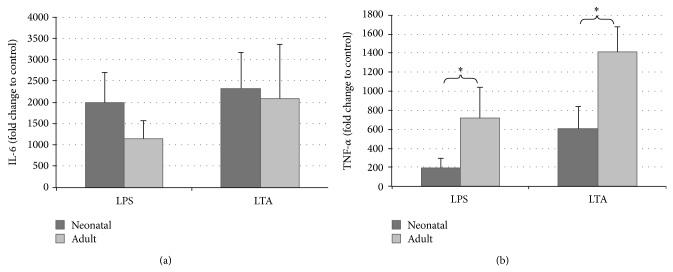
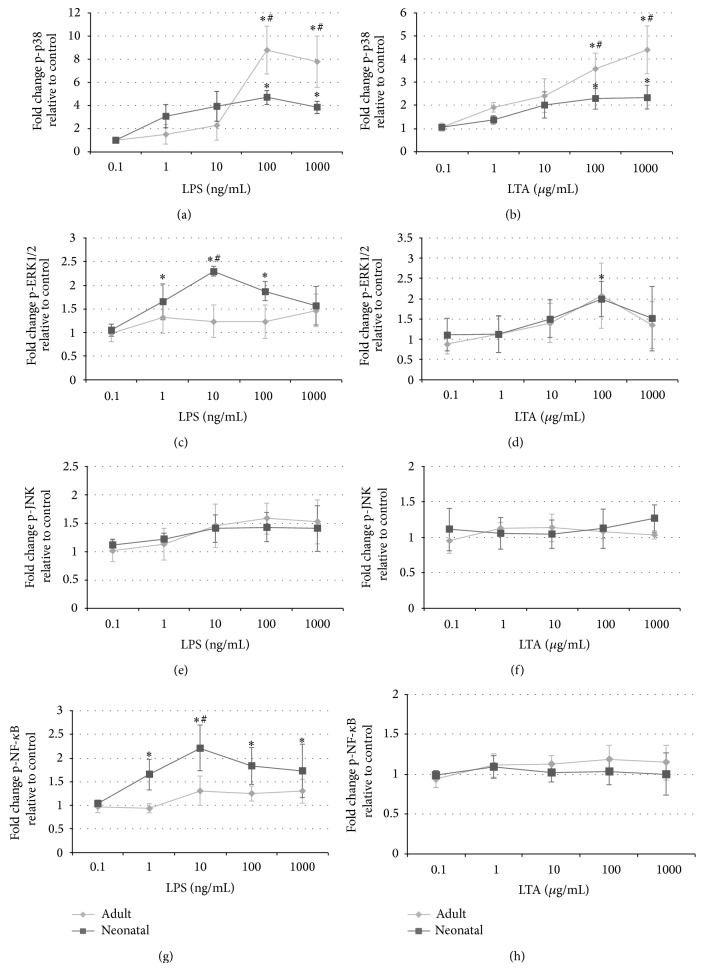
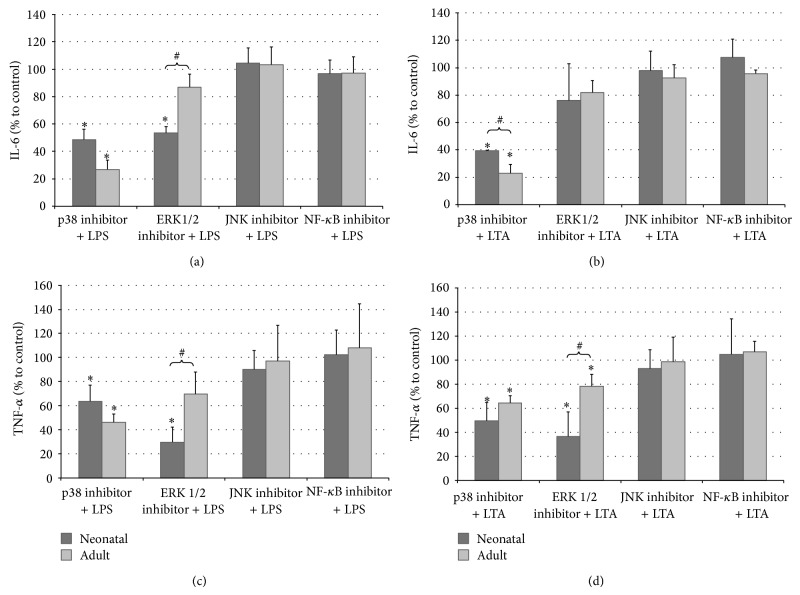
As nuclear factor kappa B (NF-κB) and mitogen-activated protein kinases (MAPKs) seem to be critical mediators in the inflammatory response, we studied the effects of lipopolysaccharide (LPS) and lipoteichoic acid (LTA) on (a) the activation of NF-κB and MAPKs and (b) the expression of tumor necrosis factor alpha (TNF-α) and interleukin 6 (IL-6) with or without the specific inhibitors of these intracellular signal transduction pathways in neonatal cord and adult blood. TNF-α and IL-6 concentrations showed a sharp increase in the supernatants of cord and adult whole blood after stimulation. TNF-α concentrations were significantly higher, whereas IL-6 concentrations were tendentially lower in adult blood after stimulation. Stimulation with LPS or LTA resulted in a significantly decreased activation of p38 MAPK in neonatal compared with adult blood. Although LTA failed to induce additional ERK1/2 phosphorylation, LPS stimulation mediated the moderately increased levels of activated ERK1/2 in neonatal monocytes. The addition of the p38 MAPK inhibitor SB202190 significantly decreased IL-6 and TNF-α production upon LPS or LTA stimulation. Furthermore, the inhibition of ERK1/2 was able to reduce LPS-stimulated TNF-α production in neonatal blood. We conclude that p38 MAPK as well as ERK1/2 phosphorylation is crucially involved in LPS activation and could explain the differences in early cytokine response between neonatal and adult blood.
由于核因子κB(NF-κB)和丝裂原活化蛋白激酶(MAPKs)似乎是炎症反应中的关键介质,我们研究了脂多糖(LPS)和脂磷壁酸(LTA)对(a)新生儿脐带血和成人血液中NF-κB和MAPKs的激活,以及(b)肿瘤坏死因子α(TNF-α)和白细胞介素6(IL-6)的表达的影响,实验中使用或不使用这些细胞内信号转导途径的特异性抑制剂。刺激后,脐带血和成人全血上清液中的TNF-α和IL-6浓度急剧升高。刺激后,成人血液中TNF-α浓度显著更高,而IL-6浓度则呈下降趋势。与成人血液相比,LPS或LTA刺激导致新生儿血液中p38 MAPK的激活显著降低。尽管LTA未能诱导额外的ERK1/2磷酸化,但LPS刺激介导了新生儿单核细胞中活化ERK1/2水平的适度升高。添加p38 MAPK抑制剂SB202190可显著降低LPS或LTA刺激后IL-6和TNF-α的产生。此外,抑制ERK1/2能够降低新生儿血液中LPS刺激的TNF-α产生。我们得出结论,p38 MAPK以及ERK1/2磷酸化在LPS激活中起关键作用,这可以解释新生儿血液和成人血液在早期细胞因子反应上的差异。