Shi Ying, Han Yue, Xie Fang, Wang Anna, Feng Xiaokun, Li Ning, Guo Hongliang, Chen Dexi
Beijing Youan Hospital, Capital University of Medical Sciences, Beijing, China; Beijing Institute of Hepatology, Beijing, China.
J Cell Mol Med. 2015 Mar;19(3):535-43. doi: 10.1111/jcmm.12435. Epub 2014 Dec 23.
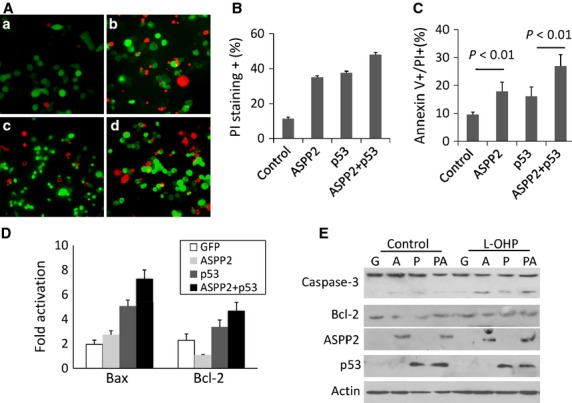
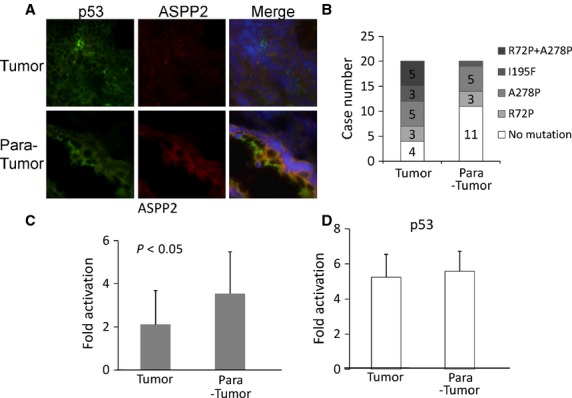
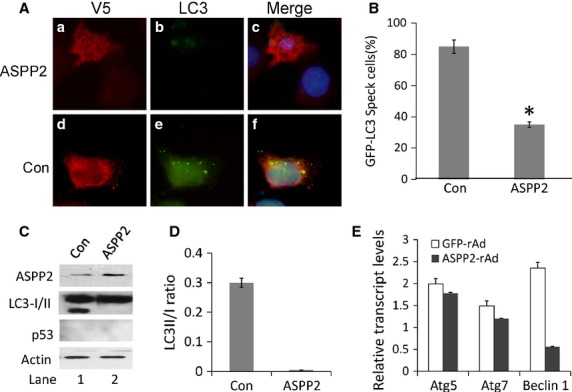
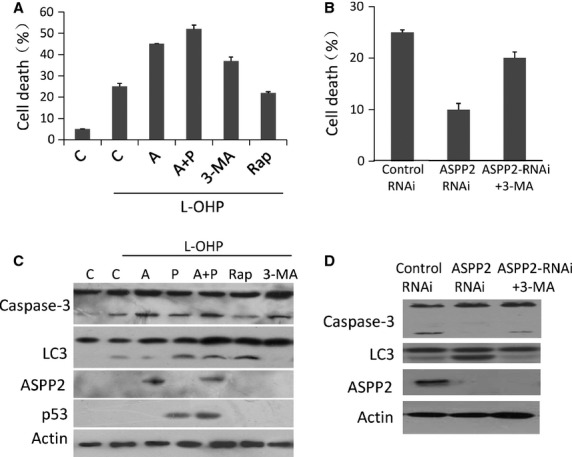
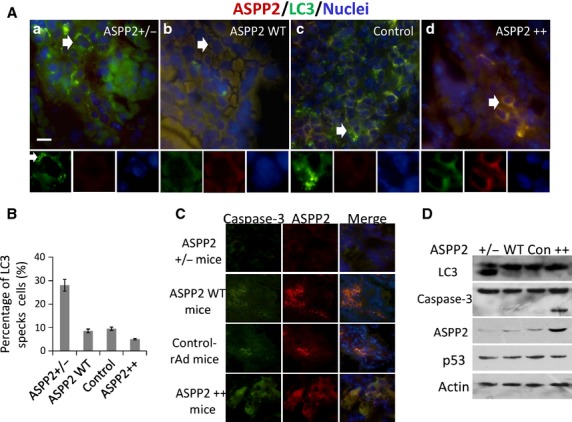
Inactivation of p53-mediated cell death pathways is a central component of cancer progression. ASPP2 (apoptosis stimulated protein of p53-2) is a p53 binding protein that specially stimulates pro-apoptosis function of p53. Down-regulation of ASPP2 is observed in many human cancers and is associated with poor prognosis and metastasis. In this study, ASPP2 was found to enhance L-OHP-induced apoptosis in HCT116 p53(-/-) cells in a p53-independent manner. Such apoptosis-promoting effect of ASPP2 was achieved by inhibiting autophagy. Further experiments with ASPP2 RNA interference and autophagy inhibitor (3-methyladenine, 3-MA) confirmed that ASPP2 enhanced HCT116 p53(-/-) cell apoptosis via inhibiting the autophagy. The association of cell death and autophagy was also found in ASPP2(+/-) mice, where colon tissue with reduced ASPP2 expression displayed more autophagy and less cell death. Finally, colorectal tumours and their adjacent normal tissues from 20 colorectal cancer patients were used to examine ASPP2 expression, p53 expression and p53 mutation, to understand their relationships with the patients' outcome. Three site mutations were found in p53 transcripts from 16 of 20 patients. ASPP2 mRNA expressions were higher, and autophagy level was lower in the adjacent normal tissues, compared with the tumour tissues, which was independent of both p53 mutation and expression level. Taken together, ASPP2 increased tumour sensitivity to chemotherapy via inhibiting autophagy in a p53-independent manner, which was associated with the tumour formation, suggesting that both p53 inactivation and ASPP2 expression level were involved in the sensitivity of colorectal cancer to chemotherapy.
p53介导的细胞死亡通路失活是癌症进展的核心组成部分。ASPP2(p53凋亡刺激蛋白2)是一种p53结合蛋白,专门刺激p53的促凋亡功能。在许多人类癌症中都观察到ASPP2的下调,并且与预后不良和转移相关。在本研究中,发现ASPP2以不依赖p53的方式增强奥沙利铂(L-OHP)诱导的HCT116 p53(-/-)细胞凋亡。ASPP2的这种促凋亡作用是通过抑制自噬实现的。使用ASPP2 RNA干扰和自噬抑制剂(3-甲基腺嘌呤,3-MA)的进一步实验证实,ASPP2通过抑制自噬增强HCT116 p53(-/-)细胞凋亡。在ASPP2(+/-)小鼠中也发现了细胞死亡与自噬的关联,其中ASPP2表达降低的结肠组织表现出更多的自噬和更少的细胞死亡。最后,使用来自20名结直肠癌患者的结直肠肿瘤及其相邻正常组织来检测ASPP2表达、p53表达和p53突变,以了解它们与患者预后的关系。在20名患者中的16名患者的p53转录本中发现了三个位点突变。与肿瘤组织相比,相邻正常组织中的ASPP2 mRNA表达更高,自噬水平更低,这与p53突变和表达水平均无关。综上所述,ASPP2通过以不依赖p53的方式抑制自噬增加肿瘤对化疗的敏感性,这与肿瘤形成有关,表明p53失活和ASPP2表达水平均参与了结直肠癌对化疗的敏感性。