Lindhoud Simon, Westphal Adrie H, van Mierlo Carlo P M, Visser Antonie J W G, Borst Jan Willem
Laboratory of Biochemistry, Wageningen University, Wageningen 6703HA, The Netherlands.
Int J Mol Sci. 2014 Dec 19;15(12):23836-50. doi: 10.3390/ijms151223836.
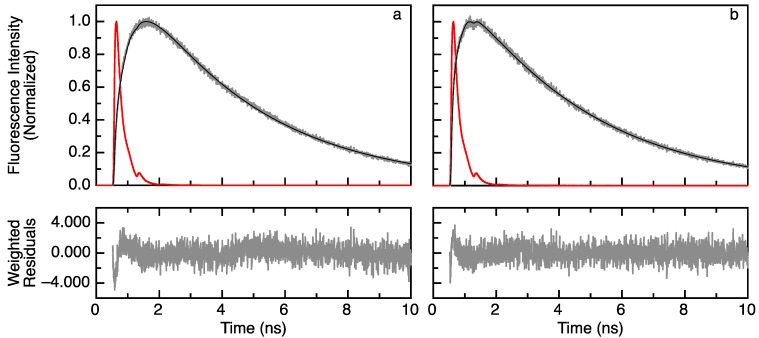
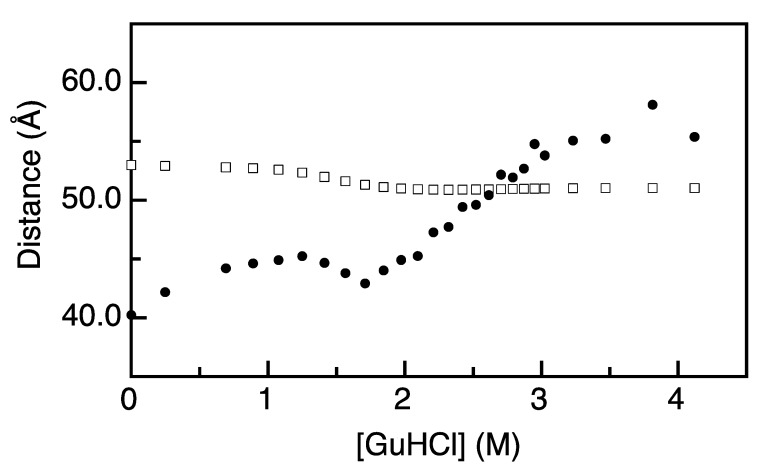
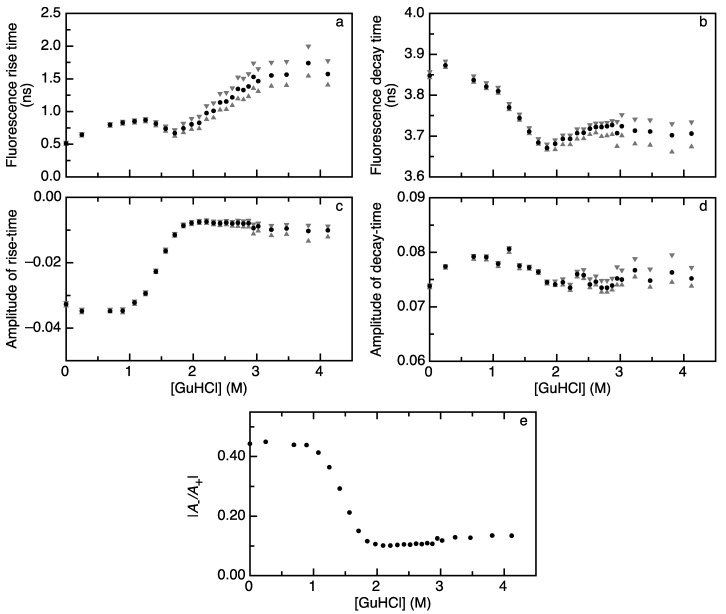
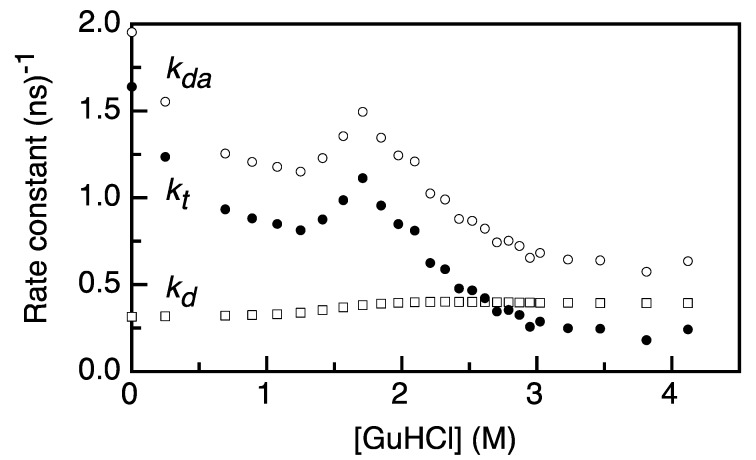
Uniform labeling of proteins with fluorescent donor and acceptor dyes with an equimolar ratio is paramount for accurate determination of Förster resonance energy transfer (FRET) efficiencies. In practice, however, the labeled protein population contains donor-labeled molecules that have no corresponding acceptor. These FRET-inactive donors contaminate the donor fluorescence signal, which leads to underestimation of FRET efficiencies in conventional fluorescence intensity and lifetime-based FRET experiments. Such contamination is avoided if FRET efficiencies are extracted from the rise time of acceptor fluorescence upon donor excitation. The reciprocal value of the rise time of acceptor fluorescence is equal to the decay rate of the FRET-active donor fluorescence. Here, we have determined rise times of sensitized acceptor fluorescence to study the folding of double-labeled apoflavodoxin molecules and show that this approach tracks the characteristics of apoflavodoxin's complex folding pathway.
用等摩尔比的荧光供体和受体染料对蛋白质进行均匀标记,对于准确测定Förster共振能量转移(FRET)效率至关重要。然而,在实际操作中,标记的蛋白质群体中包含没有相应受体的供体标记分子。这些无FRET活性的供体污染了供体荧光信号,导致在传统的基于荧光强度和寿命的FRET实验中FRET效率被低估。如果从供体激发后受体荧光的上升时间提取FRET效率,就可以避免这种污染。受体荧光上升时间的倒数等于有FRET活性的供体荧光的衰减率。在这里,我们测定了敏化受体荧光的上升时间,以研究双标记脱辅基黄素氧还蛋白分子的折叠,并表明这种方法追踪了脱辅基黄素氧还蛋白复杂折叠途径的特征。