Di Gregorio Sabrina, Perazzi Beatriz, Ordoñez Andrea Martinez, De Gregorio Stella, Foccoli Monica, Lasala María Beatriz, García Susana, Vay Carlos, Famiglietti Angela, Mollerach Marta
1 Facultad de Farmacia y Bioquímica, Universidad de Buenos Aires , Ciudad Autónoma de Buenos Aires, Argentina .
Microb Drug Resist. 2015 Feb;21(1):25-34. doi: 10.1089/mdr.2014.0190. Epub 2014 Dec 23.
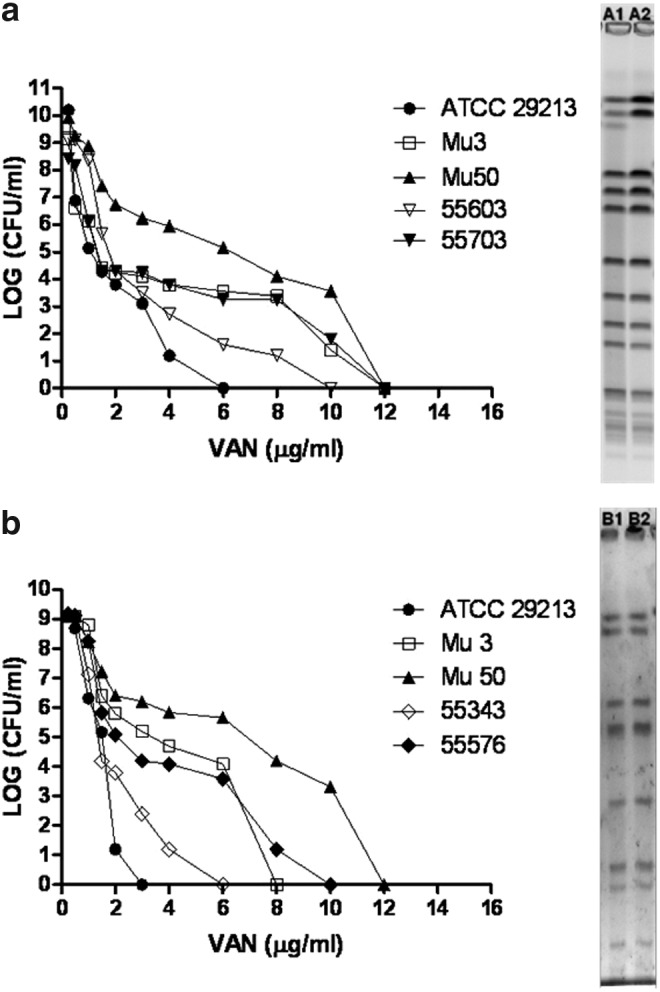
The emergence of vancomycin intermediate Staphylococcus aureus (VISA) and heterogeneous VISA (hVISA) is of major concern worldwide. Our objective was to investigate the prevalence, phenotypic and molecular features of hVISA strains isolated from bacteremic patients and to determine the clinical significance of the hVISA phenotype in patients with bacteremia. A total of 104 S. aureus blood isolates were collected from a teaching hospital of Argentina between August 2009 and November 2010. No VISA isolate was recovered, and 3 out of 92 patients (3.3%) were infected with hVISA, 2 of them methicillin-resistant S. aureus (MRSA) (4.5% of MRSA). Macro Etest and prediffusion method detected 3/3 and 2/3 hVISA respectively. Considering the type of bacteremia, the three cases were distributed as follows: two patients had suffered multiple episodes of bacteremia (both hVISA strains recovered in the second episode), while only one patient had suffered a single episode of bacteremia with hVISA infection. MRSA bloodstream isolates exhibiting the hVISA phenotype were related to HA-MRSA Cordobes clone (ST5-SCCmec I-spa t149) and MRSA Argentinean pediatric clone (ST100-SCCmec IVNV-spa t002), but not to CA-MRSA-ST30-SCCmec IV-spa t019 clone that was one of the most frequent in our country. Although still relatively infrequent in our hospital, hVISA strains were significantly associated with multiple episodes of bacteremia (p=0.037) and genetically unrelated.
万古霉素中介金黄色葡萄球菌(VISA)和异质性VISA(hVISA)的出现是全球主要关注的问题。我们的目的是调查从菌血症患者中分离出的hVISA菌株的流行情况、表型和分子特征,并确定hVISA表型在菌血症患者中的临床意义。2009年8月至2010年11月期间,从阿根廷一家教学医院收集了104株金黄色葡萄球菌血培养分离株。未分离出VISA菌株,92例患者中有3例(3.3%)感染hVISA,其中2例为耐甲氧西林金黄色葡萄球菌(MRSA)(占MRSA的4.5%)。宏Etest和预扩散法分别检测出3/3和2/3的hVISA。考虑到菌血症的类型,三例分布如下:两名患者有多次菌血症发作(两次发作均分离出hVISA菌株),而只有一名患者有一次hVISA感染的菌血症发作。表现出hVISA表型的MRSA血流分离株与医院获得性MRSA科尔多瓦克隆(ST5-SCCmec I-spa t149)和MRSA阿根廷儿科克隆(ST100-SCCmec IVNV-spa t002)有关,但与我国最常见的社区获得性MRSA-ST30-SCCmec IV-spa t019克隆无关。虽然在我们医院hVISA菌株仍然相对少见,但与多次菌血症发作显著相关(p=0.037)且基因不相关。