Vonberg Isabelle, Ehlen Felicitas, Fromm Ortwin, Klostermann Fabian
Charité - University Medicine Berlin, Department of Neurology, CBF, Motor and Cognition Group, Berlin, Germany.
PLoS One. 2014 Dec 23;9(12):e115846. doi: 10.1371/journal.pone.0115846. eCollection 2014.
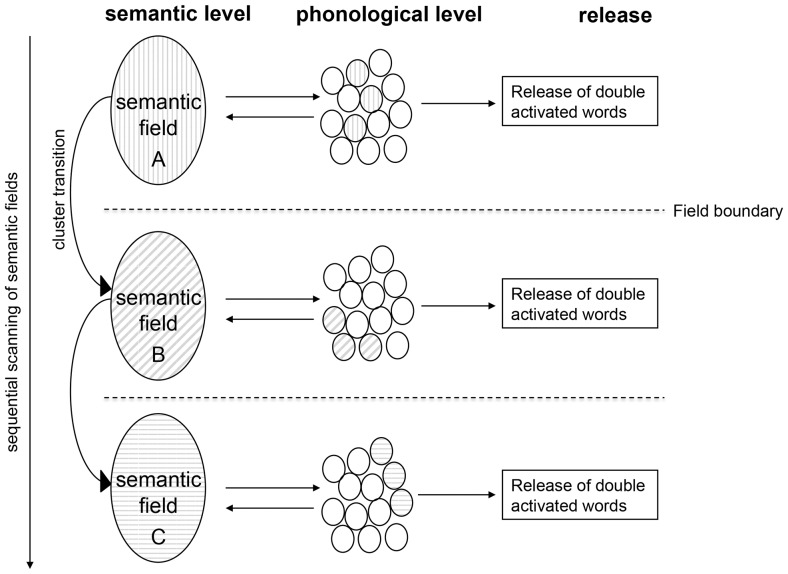
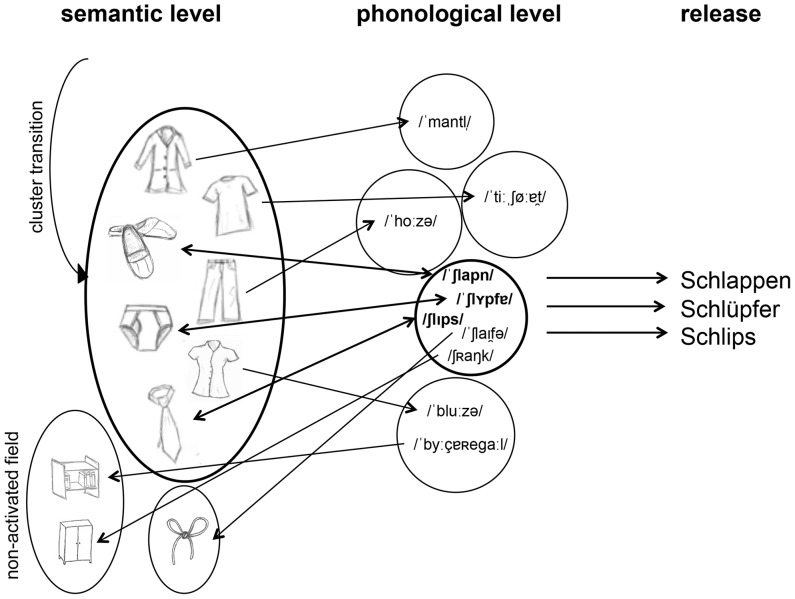
For word production, we may consciously pursue semantic or phonological search strategies, but it is uncertain whether we can retrieve the different aspects of lexical information independently from each other. We therefore studied the spread of semantic information into words produced under exclusively phonemic task demands.
42 subjects participated in a letter verbal fluency task, demanding the production of as many s-words as possible in two minutes. Based on curve fittings for the time courses of word production, output spurts (temporal clusters) considered to reflect rapid lexical retrieval based on automatic activation spread, were identified. Semantic and phonemic word relatedness within versus between these clusters was assessed by respective scores (0 meaning no relation, 4 maximum relation).
Subjects produced 27.5 (±9.4) words belonging to 6.7 (±2.4) clusters. Both phonemically and semantically words were more related within clusters than between clusters (phon: 0.33±0.22 vs. 0.19±0.17, p<.01; sem: 0.65±0.29 vs. 0.37±0.29, p<.01). Whereas the extent of phonemic relatedness correlated with high task performance, the contrary was the case for the extent of semantic relatedness.
The results indicate that semantic information spread occurs, even if the consciously pursued word search strategy is purely phonological. This, together with the negative correlation between semantic relatedness and verbal output suits the idea of a semantic default mode of lexical search, acting against rapid task performance in the given scenario of phonemic verbal fluency. The simultaneity of enhanced semantic and phonemic word relatedness within the same temporal cluster boundaries suggests an interaction between content and sound-related information whenever a new semantic field has been opened.
在词汇生成过程中,我们可能会有意识地采用语义或语音搜索策略,但我们能否彼此独立地检索词汇信息的不同方面尚不确定。因此,我们研究了语义信息在仅受音素任务要求下生成的单词中的传播情况。
42名受试者参与了一项字母言语流畅性任务,要求在两分钟内尽可能多地生成以字母s开头的单词。基于单词生成时间进程的曲线拟合,识别出被认为反映基于自动激活扩散的快速词汇检索的输出爆发(时间簇)。通过各自的分数评估这些簇内和簇间的语义和音素词相关性(0表示无关系,4表示最大关系)。
受试者生成了27.5(±9.4)个单词,属于6.7(±2.4)个簇。音素和语义上,簇内的单词比簇间的单词相关性更强(音素:0.33±0.22对0.19±0.17,p<.01;语义:0.65±0.29对0.37±0.29,p<.01)。虽然音素相关性程度与高任务表现相关,但语义相关性程度则相反。
结果表明,即使有意识采用的单词搜索策略纯粹是语音方面的,语义信息也会传播。这一点,再加上语义相关性与言语输出之间的负相关,符合词汇搜索的语义默认模式的观点,即在给定的音素言语流畅性场景中不利于快速任务表现。在相同的时间簇边界内增强的语义和音素词相关性的同时出现表明,每当一个新的语义领域被打开时,内容和声音相关信息之间就会发生相互作用。