Susa Takao, Ikaga Reina, Kajitani Takashi, Iizuka Masayoshi, Okinaga Hiroko, Tamamori-Adachi Mimi, Okazaki Tomoki
Departments of Biochemistry, Teikyo University School of Medicine, Japan.
J Cell Physiol. 2015 Jul;230(7):1594-606. doi: 10.1002/jcp.24906.
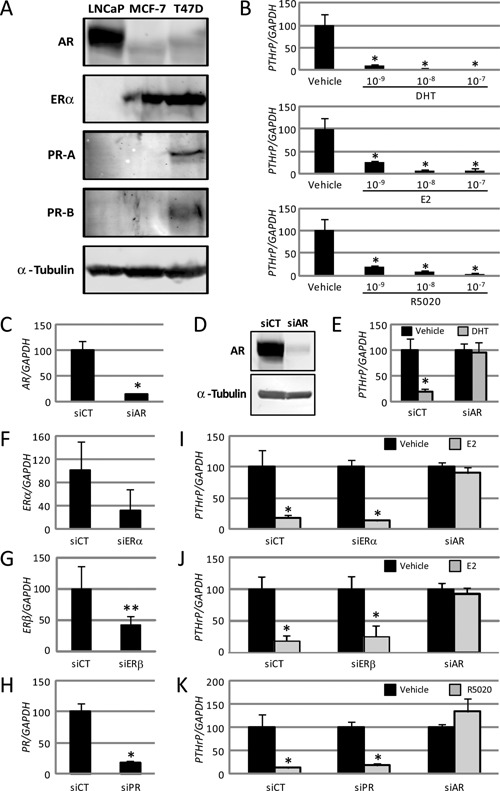
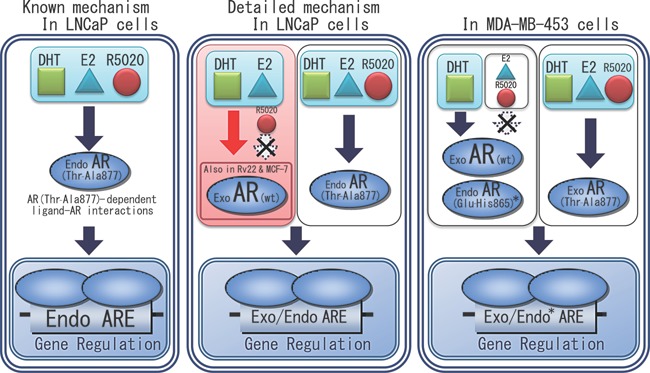
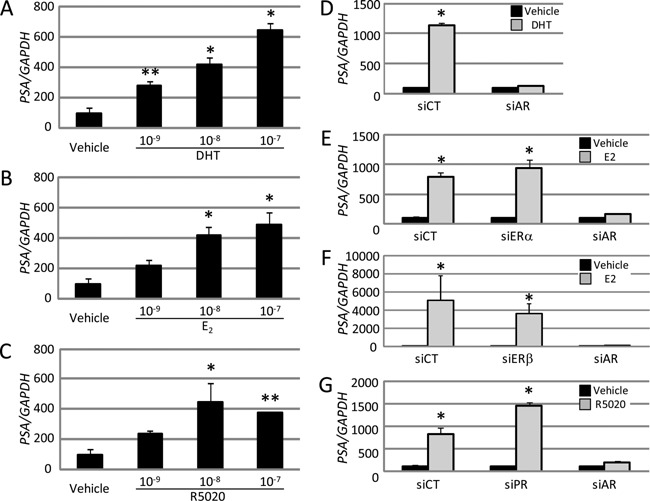
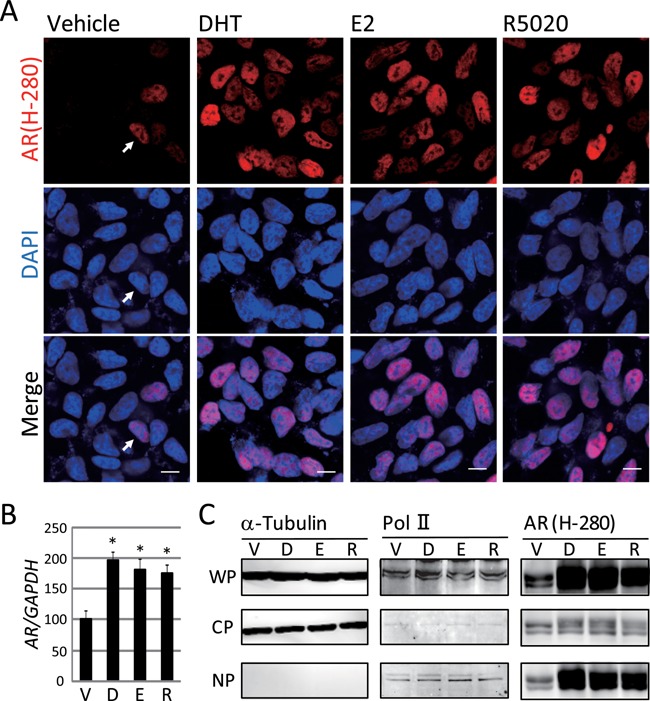
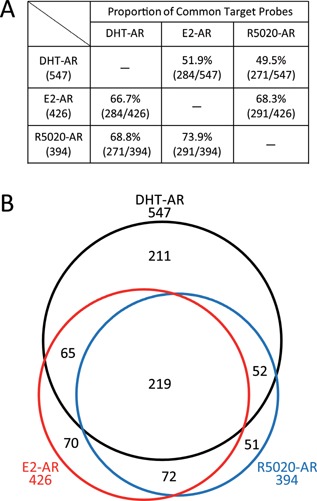
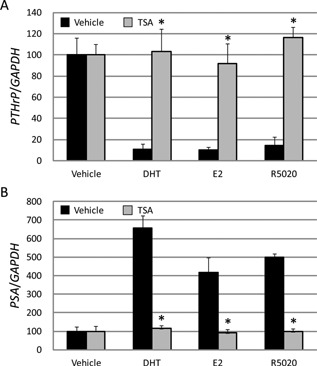
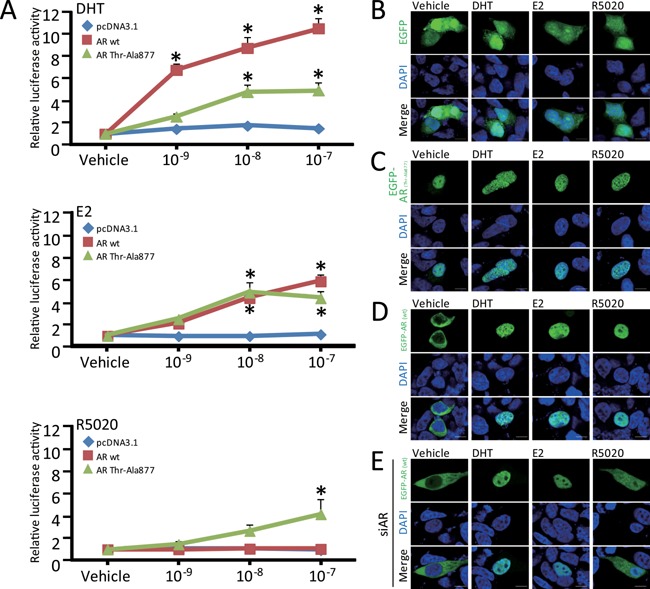
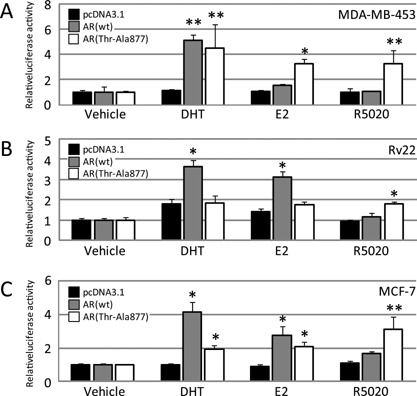
We previously encountered regulatory processes wherein dihydrotestosterone (DHT) exerted its inhibitory effect on parathyroid hormone-related protein (PTHrP) gene repression through the estrogen receptor (ER)α, but not the androgen receptor (AR), in breast cancer MCF-7 cells. Here, we investigated whether such aberrant ligand-nuclear receptor (NR) interaction is present in prostate cancer LNCaP cells. First, we confirmed that LNCaP cells expressed large amounts of AR at negligible levels of ERα/β or progesterone receptor. Both suppression of PTHrP and activation of prostate-specific antigen genes were observed after independent administration of 17β-estradiol (E2), DHT, or R5020. Consistent with the notion that the LNCaP AR lost its ligand specificity due to a mutation (Thr-Ala877), experiments with siRNA targeting the respective NR revealed that the AR monopolized the role of the mediator of shared hormone-dependent regulation, which was invariably associated with nuclear translocation of this mutant AR. Microarray analysis of gene regulation by DHT, E2, or R5020 disclosed that more than half of the genes downstream of the AR (Thr-Ala877) overlapped in the LNCaP cells. Of particular interest, we realized that the AR (wild-type [wt]) and AR (Thr-Ala877) were equally responsible for the E2-AR interactions. Fluorescence microscopy experiments demonstrated that both EGFP-AR (wt) and EGFP-AR (Thr-Ala877) were exclusively localized within the nucleus after E2 or DHT treatment. Furthermore, reporter assays revealed that some other cancer cells exhibited aberrant E2-AR (wt) signaling similar to that in the LNCaP cells. We herein postulate the presence of entangled interactions between wt AR and E2 in certain hormone-sensitive cancer cells.
在乳腺癌MCF-7细胞中,二氢睾酮(DHT)通过雌激素受体(ER)α而非雄激素受体(AR)对甲状旁腺激素相关蛋白(PTHrP)基因的抑制发挥作用。在此,我们研究了这种异常的配体-核受体(NR)相互作用是否存在于前列腺癌LNCaP细胞中。首先,我们证实LNCaP细胞大量表达AR,而ERα/β或孕激素受体的表达水平可忽略不计。单独给予17β-雌二醇(E2)、DHT或R5020后,均观察到PTHrP的抑制和前列腺特异性抗原基因的激活。与LNCaP AR因突变(Thr-Ala877)而失去配体特异性这一观点一致,针对各自NR的siRNA实验表明,AR垄断了共享激素依赖性调节介质的作用,这总是与该突变AR的核转位相关。对DHT、E2或R5020介导的基因调控进行微阵列分析发现,LNCaP细胞中AR(Thr-Ala877)下游超过一半的基因存在重叠。特别值得关注的是,我们发现AR(野生型[wt])和AR(Thr-Ala877)对E2-AR相互作用的作用相同。荧光显微镜实验表明,E2或DHT处理后,EGFP-AR(wt)和EGFP-AR(Thr-Ala877)均仅定位于细胞核内。此外,报告基因检测显示,其他一些癌细胞表现出与LNCaP细胞类似的异常E2-AR(wt)信号。我们在此推测,在某些激素敏感癌细胞中存在野生型AR与E2之间的复杂相互作用。