Hu Sun-Jun, Chang Shi-Min, Li Xiao-Hua, Yu Guang-Rong
Tongji University, School of Medicine, Yangpu Hospital, People's Republic of China, Department of Orthopedic Surgery, Yangpu Hospital, Tongji University School of Medicine, People's Republic of China.
Tongji University, School of Medicine, Tongji Hospital, People's Republic of China, Department of Orthopedic Surgery, Tongji Hospital, Tongji University School of Medicine, People's Republic of China.
Acta Ortop Bras. 2014;22(6):315-20. doi: 10.1590/1413-78522014220600576.
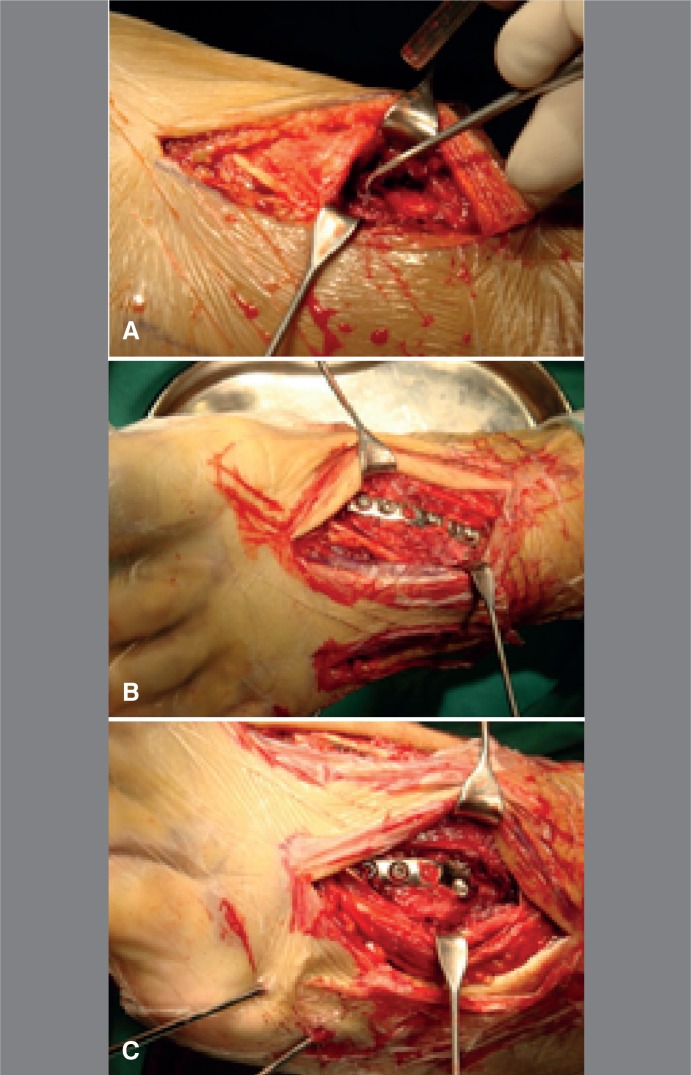
The objective of this prospective study was to test whether the treatment of Lisfranc injuries with open reduction and dorsal plate fixation would have the same or better functional outcomes as treatment with standard trans-articular screw fixation.
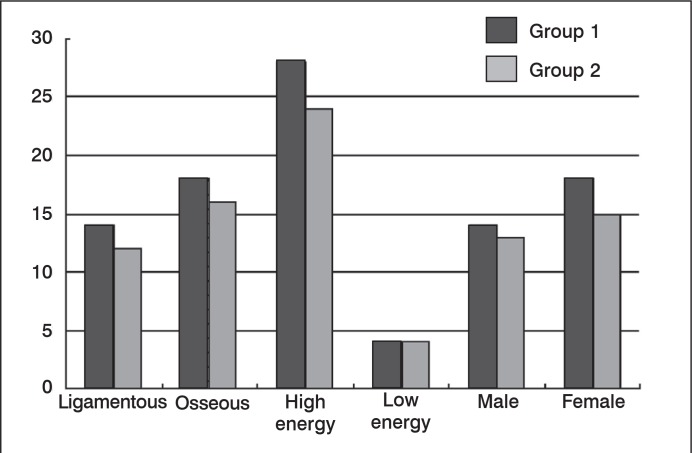
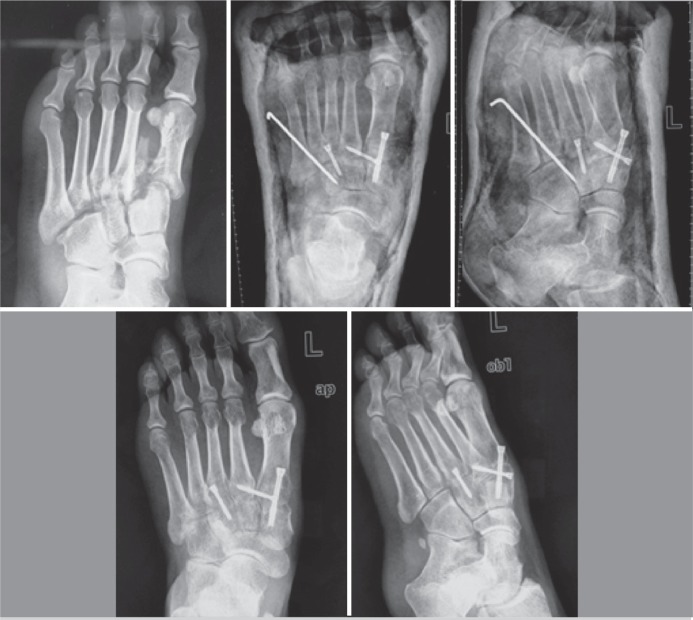
Sixty patients with primarily isolated Lisfranc joint injury were treated by open reduction and dorsal plate fixation or standard screw fixation. The patients were followed on average for 31 months. Evaluation was performed with patients' chief complaint, clinical examination, radiography, and AOFAS Midfoot Scale.
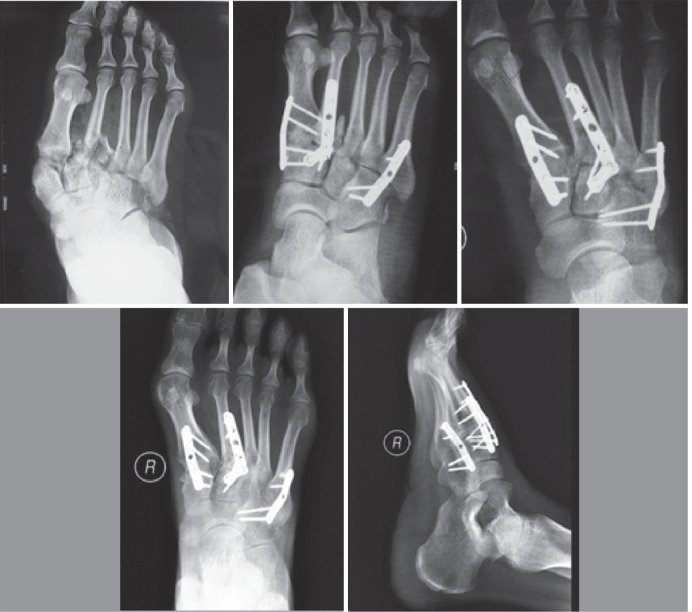
Thirty two patients were treated with open reduction and dorsal plate fixation, and twenty eight patients were treated with open reduction and screw fixation. After two years follow-up, the mean AOFAS Midfoot score was 83.1 points in the dorsal plate fixation group and 78.5 points in the screw fixation group (p<0.01). Of the dorsal plate fixation group, radiographic analysis revealed anatomic reduction in twenty-nine patients (90.6%, 29/32) and nonanatomic reduction in three patients. Of the screw fixation group, radiographic analysis revealed anatomic reduction in twenty-three patients and nonanatomic reduction in five patients (82.1%, 23/28).
Open reduction and dorsal plate fixation for a dislocated Lisfranc injury do have better short and median term outcome and a lower reoperation rate than standard screw ORIF. In our experience, we recommend using dorsal plate in ORIF on dislocated Lisfranc injuries. Level of Evidence II, Prospective Comparative Study.
本前瞻性研究的目的是测试切开复位联合背侧钢板固定治疗Lisfranc损伤的功能结局是否与标准经关节螺钉固定治疗相同或更好。
60例主要为单纯Lisfranc关节损伤的患者接受了切开复位联合背侧钢板固定或标准螺钉固定治疗。患者平均随访31个月。通过患者主诉、临床检查、影像学检查和AOFAS中足评分进行评估。
32例患者接受切开复位联合背侧钢板固定治疗,28例患者接受切开复位联合螺钉固定治疗。随访两年后,背侧钢板固定组的平均AOFAS中足评分为83.1分,螺钉固定组为78.5分(p<0.01)。在背侧钢板固定组中,影像学分析显示29例患者解剖复位(90.6%,29/32),3例患者非解剖复位。在螺钉固定组中,影像学分析显示23例患者解剖复位,5例患者非解剖复位(82.1%,23/28)。
对于脱位的Lisfranc损伤,切开复位联合背侧钢板固定的短期和中期结局优于标准螺钉切开复位内固定,且再次手术率更低。根据我们的经验,我们建议在脱位的Lisfranc损伤切开复位内固定中使用背侧钢板。证据级别II,前瞻性比较研究。