McKendrick Douglas R A, Cumming Grant P, Lee Amanda J
Department of Anesthesia, Dr. Gray's Hospital, Elgin, United Kingdom ; School of Medicine and Dentistry, Dr Gray's Hospital, Elgin, United Kingdom.
School of Medicine and Dentistry, Dr Gray's Hospital, Elgin, United Kingdom ; Department of Obstetrics and Gynecology, Dr Gray's Hospital, Elgin, United Kingdom ; University of the Highlands and Islands, United Kingdom.
Saudi J Anaesth. 2014 Nov;8(Suppl 1):S8-S14. doi: 10.4103/1658-354X.144053.
Preoperative preparation (assessment) of patients reduces cancellations on the day of surgery. A Center for Reviews and Dissemination review (2007) concluded "the evidence was weak and it was uncertain that preassessment reduced cancellations." The aim of this study was to observe the impact of a preoperative preparation clinic on cancellations of operating room cases on the day of surgery, and in particular on those causes of cancellation on the day of surgery which were expected to be affected by preoperative preparation.
Observational study conducted in a 194 bed District General Hospital in the United Kingdom from April 1, 2006 to March 31, 2011. 42,082 operating room cases were scheduled for operation during this period. Surgical sessions which did not require anesthetic input were excluded. Contemporaneous data were collected and analyzed on a monthly basis, and also grouped by year over a 5-year period. The cancellations on the day of surgery were divided into two groups: Those considered to be affected by preoperative preparation and those which were not. Comparisons were made between these two groups and between individual reasons for cancellation.
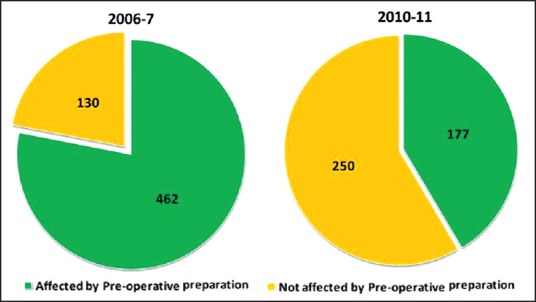
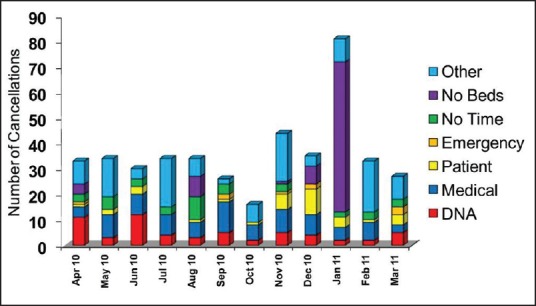
A total of 28,928 cases met the inclusion criteria. The clinic introduction reduced cancellations considered to be affected by preoperative preparation from 462 to 177 (78% and 42% total cancellations, respectively) (P < 0.001). There was a decrease in cancellations due to patients who did not arrive (P < 0.001) and medical reasons (P < 0.001), but an increase in the number of cancellations by the patients themselves (P = 0.002). Cancellations due to lack of beds and "other" reasons both increased (P < 0.001) across the study period.
This study suggests that the introduction of preoperative preparation clinics for patients reduces cancellations on the day of surgery.
对患者进行术前准备(评估)可减少手术当日的取消手术情况。综述与传播中心的一项综述(2007年)得出结论:“证据不足,且不确定术前评估能否减少取消手术情况。”本研究的目的是观察术前准备诊所对手术当日手术室病例取消情况的影响,特别是对那些预计会受术前准备影响的手术当日取消手术的原因的影响。
于2006年4月1日至2011年3月31日在英国一家拥有194张床位的地区综合医院进行观察性研究。在此期间,计划进行42,082例手术室手术。排除不需要麻醉的手术时段。每月收集并分析同期数据,并按5年期间逐年分组。手术当日的取消手术情况分为两组:被认为受术前准备影响的和不受术前准备影响的。对这两组以及取消手术的个体原因进行比较。
共有28,928例病例符合纳入标准。诊所的设立使被认为受术前准备影响的取消手术情况从462例降至177例(分别占总取消手术情况的78%和42%)(P<0.001)。因患者未到院(P<0.001)和医疗原因导致的取消手术情况有所减少,但患者自身取消手术的数量有所增加(P = 0.002)。在研究期间,因床位不足和“其他”原因导致的取消手术情况均有所增加(P<0.001)。
本研究表明,为患者设立术前准备诊所可减少手术当日的取消手术情况。