• 文献检索
  • 文档翻译
  • 深度研究
  • 学术资讯
  • Suppr Zotero 插件Zotero 插件
  • 邀请有礼
  • 套餐&价格
  • 历史记录
应用&插件
Suppr Zotero 插件Zotero 插件浏览器插件Mac 客户端Windows 客户端微信小程序
定价
高级版会员购买积分包购买API积分包
服务
文献检索文档翻译深度研究API 文档MCP 服务
关于我们
关于 Suppr公司介绍联系我们用户协议隐私条款
关注我们

Suppr 超能文献

核心技术专利:CN118964589B侵权必究
粤ICP备2023148730 号-1Suppr @ 2026

文献检索

告别复杂PubMed语法,用中文像聊天一样搜索,搜遍4000万医学文献。AI智能推荐,让科研检索更轻松。

立即免费搜索

文件翻译

保留排版,准确专业,支持PDF/Word/PPT等文件格式,支持 12+语言互译。

免费翻译文档

深度研究

AI帮你快速写综述,25分钟生成高质量综述,智能提取关键信息,辅助科研写作。

立即免费体验

基于心理学的误导分类法。

A psychologically-based taxonomy of misdirection.

机构信息

Department of Psychology, Goldsmiths, University of London London, UK.

Centre for Systems Neuroscience, University of Leicester Leicester, UK.

出版信息

Front Psychol. 2014 Dec 9;5:1392. doi: 10.3389/fpsyg.2014.01392. eCollection 2014.

DOI:10.3389/fpsyg.2014.01392
PMID:25538648
原文链接:https://pmc.ncbi.nlm.nih.gov/articles/PMC4260479/
Abstract

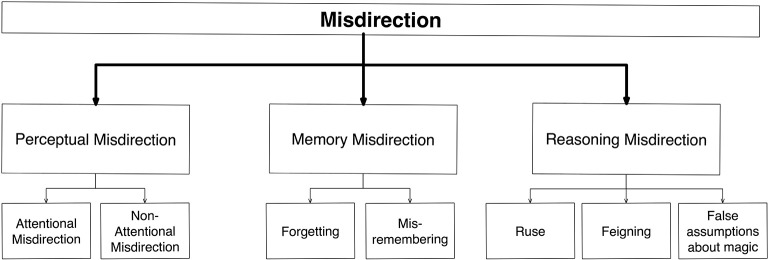
Magicians use misdirection to prevent you from realizing the methods used to create a magical effect, thereby allowing you to experience an apparently impossible event. Magicians have acquired much knowledge about misdirection, and have suggested several taxonomies of misdirection. These describe many of the fundamental principles in misdirection, focusing on how misdirection is achieved by magicians. In this article we review the strengths and weaknesses of past taxonomies, and argue that a more natural way of making sense of misdirection is to focus on the perceptual and cognitive mechanisms involved. Our psychologically-based taxonomy has three basic categories, corresponding to the types of psychological mechanisms affected: perception, memory, and reasoning. Each of these categories is then divided into subcategories based on the mechanisms that control these effects. This new taxonomy can help organize magicians' knowledge of misdirection in a meaningful way, and facilitate the dialog between magicians and scientists.

摘要

魔术师利用误导来防止你意识到创造魔术效果所使用的方法,从而让你体验到一个看似不可能的事件。魔术师已经掌握了很多关于误导的知识,并提出了几种误导的分类法。这些分类法描述了误导中的许多基本原则,重点介绍了魔术师是如何实现误导的。在本文中,我们回顾了过去分类法的优缺点,并认为,理解误导的一种更自然的方式是关注所涉及的感知和认知机制。我们基于心理学的分类法有三个基本类别,对应于受影响的心理机制类型:感知、记忆和推理。然后,根据控制这些效果的机制,将每个类别进一步细分为子类别。这种新的分类法可以帮助以有意义的方式组织魔术师对误导的了解,并促进魔术师和科学家之间的对话。
https://cdn.ncbi.nlm.nih.gov/pmc/blobs/59f5/4260479/4f10cee6c140/fpsyg-05-01392-g0009.jpg
https://cdn.ncbi.nlm.nih.gov/pmc/blobs/59f5/4260479/6e493a3e9f72/fpsyg-05-01392-g0001.jpg
https://cdn.ncbi.nlm.nih.gov/pmc/blobs/59f5/4260479/268ebd34124e/fpsyg-05-01392-g0002.jpg
https://cdn.ncbi.nlm.nih.gov/pmc/blobs/59f5/4260479/ebe93e057f32/fpsyg-05-01392-g0003.jpg
https://cdn.ncbi.nlm.nih.gov/pmc/blobs/59f5/4260479/a2a1f0d5eaa8/fpsyg-05-01392-g0004.jpg
https://cdn.ncbi.nlm.nih.gov/pmc/blobs/59f5/4260479/64c8802fecbc/fpsyg-05-01392-g0005.jpg
https://cdn.ncbi.nlm.nih.gov/pmc/blobs/59f5/4260479/6ca9fe0977ee/fpsyg-05-01392-g0006.jpg
https://cdn.ncbi.nlm.nih.gov/pmc/blobs/59f5/4260479/5bede36b46f0/fpsyg-05-01392-g0007.jpg
https://cdn.ncbi.nlm.nih.gov/pmc/blobs/59f5/4260479/ef11d59da4ee/fpsyg-05-01392-g0008.jpg
https://cdn.ncbi.nlm.nih.gov/pmc/blobs/59f5/4260479/4f10cee6c140/fpsyg-05-01392-g0009.jpg
https://cdn.ncbi.nlm.nih.gov/pmc/blobs/59f5/4260479/6e493a3e9f72/fpsyg-05-01392-g0001.jpg
https://cdn.ncbi.nlm.nih.gov/pmc/blobs/59f5/4260479/268ebd34124e/fpsyg-05-01392-g0002.jpg
https://cdn.ncbi.nlm.nih.gov/pmc/blobs/59f5/4260479/ebe93e057f32/fpsyg-05-01392-g0003.jpg
https://cdn.ncbi.nlm.nih.gov/pmc/blobs/59f5/4260479/a2a1f0d5eaa8/fpsyg-05-01392-g0004.jpg
https://cdn.ncbi.nlm.nih.gov/pmc/blobs/59f5/4260479/64c8802fecbc/fpsyg-05-01392-g0005.jpg
https://cdn.ncbi.nlm.nih.gov/pmc/blobs/59f5/4260479/6ca9fe0977ee/fpsyg-05-01392-g0006.jpg
https://cdn.ncbi.nlm.nih.gov/pmc/blobs/59f5/4260479/5bede36b46f0/fpsyg-05-01392-g0007.jpg
https://cdn.ncbi.nlm.nih.gov/pmc/blobs/59f5/4260479/ef11d59da4ee/fpsyg-05-01392-g0008.jpg
https://cdn.ncbi.nlm.nih.gov/pmc/blobs/59f5/4260479/4f10cee6c140/fpsyg-05-01392-g0009.jpg

相似文献

1
A psychologically-based taxonomy of misdirection.基于心理学的误导分类法。
Front Psychol. 2014 Dec 9;5:1392. doi: 10.3389/fpsyg.2014.01392. eCollection 2014.
2
A psychologically based taxonomy of Magicians' forcing Techniques: How magicians influence our choices, and how to use this to study psychological mechanisms.基于心理学的魔术师强迫技巧分类法:魔术师如何影响我们的选择,以及如何利用这一点来研究心理机制。
Conscious Cogn. 2020 Nov;86:103038. doi: 10.1016/j.concog.2020.103038. Epub 2020 Nov 3.
3
The Other Side of Magic.魔法的另一面。
Perspect Psychol Sci. 2017 Jan;12(1):91-106. doi: 10.1177/1745691616654676.
4
Misdirection - past, present, and the future.误导——过去、现在与未来。
Front Hum Neurosci. 2012 Jan 6;5:172. doi: 10.3389/fnhum.2011.00172. eCollection 2011.
5
The effects of social misdirection on magic tricks: How deceived and undeceived groups differ.社会误导对魔术的影响:被欺骗组与未被欺骗组的差异
Iperception. 2014 May 27;5(3):143-6. doi: 10.1068/i0640sas. eCollection 2014.
6
Never Repeat the Same Trick Twice-Unless it is Cognitively Impenetrable.切勿重复使用同一技巧两次——除非它在认知上无法被穿透。
Iperception. 2018 Dec 26;9(6):2041669518816711. doi: 10.1177/2041669518816711. eCollection 2018 Nov-Dec.
7
Social misdirection fails to enhance a magic illusion.社会误导未能增强魔术幻觉。
Front Hum Neurosci. 2011 Sep 29;5:103. doi: 10.3389/fnhum.2011.00103. eCollection 2011.
8
The apparent action causation: Using a magician forcing technique to investigate our illusory sense of agency over the outcome of our choices.明显的动作因果关系:使用魔术师强迫技术来研究我们对选择结果的虚幻代理感。
Q J Exp Psychol (Hove). 2020 Nov;73(11):1784-1795. doi: 10.1177/1747021820932916. Epub 2020 Jun 17.
9
Would you be impressed: applying principles of magic to chatbot conversations.你会印象深刻吗:将魔法原理应用于聊天机器人对话。
Front Robot AI. 2024 Apr 24;11:1256937. doi: 10.3389/frobt.2024.1256937. eCollection 2024.
10
Magic and cognitive neuroscience.魔法与认知神经科学。
Curr Biol. 2016 May 23;26(10):R390-4. doi: 10.1016/j.cub.2016.03.061.

引用本文的文献

1
Would you be impressed: applying principles of magic to chatbot conversations.你会印象深刻吗:将魔法原理应用于聊天机器人对话。
Front Robot AI. 2024 Apr 24;11:1256937. doi: 10.3389/frobt.2024.1256937. eCollection 2024.
2
Too perfect to be good? An investigation of magicians' Too Perfect Theory.过于完美以至于不真实?对魔术师的“过于完美理论”的调查。
PeerJ. 2022 May 30;10:e13449. doi: 10.7717/peerj.13449. eCollection 2022.
3
Investigating expert performance when observing magic effects.观察魔术效果时的专家表现研究。

本文引用的文献

1
Magic in the machine: a computational magician's assistant.机器中的魔法:计算魔术师的助手。
Front Psychol. 2014 Nov 17;5:1283. doi: 10.3389/fpsyg.2014.01283. eCollection 2014.
2
Change blindness in a dynamic scene due to endogenous override of exogenous attentional cues.由于内源性对外源性注意线索的抑制,动态场景中的变化盲视。
Perception. 2013;42(8):884-6. doi: 10.1068/p7377.
3
Misdirection - past, present, and the future.误导——过去、现在与未来。
Sci Rep. 2022 Mar 24;12(1):5141. doi: 10.1038/s41598-022-09161-5.
4
A Perceptual Illusion of Empty Space Can Create a Perceptual Illusion of Levitation.空虚空间的感知错觉能够产生悬浮的感知错觉。
Iperception. 2019 Dec 30;10(6):2041669519897681. doi: 10.1177/2041669519897681. eCollection 2019 Nov-Dec.
5
Extended Goal Recognition: Lessons from Magic.扩展目标识别:来自魔法的启示。
Front Artif Intell. 2021 Nov 12;4:730990. doi: 10.3389/frai.2021.730990. eCollection 2021.
6
Jays are sensitive to cognitive illusions.松鸦对认知错觉很敏感。
R Soc Open Sci. 2021 Aug 18;8(8):202358. doi: 10.1098/rsos.202358. eCollection 2021 Aug.
7
MAGNITIVE: Effectiveness and Feasibility of a Cognitive Training Program Through Magic Tricks for Children With Attention Deficit and Hyperactivity Disorder. A Second Clinical Trial in Community Settings.MAGNITIVE:针对注意力缺陷多动障碍儿童的通过魔术进行认知训练项目的有效性与可行性。社区环境中的第二项临床试验。
Front Psychol. 2021 Apr 1;12:649527. doi: 10.3389/fpsyg.2021.649527. eCollection 2021.
8
On the cognitive bases of illusionism.论错觉主义的认知基础。
PeerJ. 2020 Aug 25;8:e9712. doi: 10.7717/peerj.9712. eCollection 2020.
9
The Illusion of Absence in Magic Tricks.魔术中的消失错觉。
Iperception. 2020 Jun 25;11(3):2041669520928383. doi: 10.1177/2041669520928383. eCollection 2020 May-Jun.
10
The apparent action causation: Using a magician forcing technique to investigate our illusory sense of agency over the outcome of our choices.明显的动作因果关系:使用魔术师强迫技术来研究我们对选择结果的虚幻代理感。
Q J Exp Psychol (Hove). 2020 Nov;73(11):1784-1795. doi: 10.1177/1747021820932916. Epub 2020 Jun 17.
Front Hum Neurosci. 2012 Jan 6;5:172. doi: 10.3389/fnhum.2011.00172. eCollection 2011.
4
The exploitation of Gestalt principles by magicians.魔术师对格式塔原理的运用。
Perception. 2010;39(9):1286-9. doi: 10.1068/p6766.
5
How magic changes our expectations about autism.魔法如何改变我们对自闭症的期望。
Psychol Sci. 2010 Oct;21(10):1487-93. doi: 10.1177/0956797610383435. Epub 2010 Sep 20.
6
Towards a science of magic.迈向魔法科学。
Trends Cogn Sci. 2008 Sep;12(9):349-54. doi: 10.1016/j.tics.2008.05.008. Epub 2008 Aug 5.
7
There's more to magic than meets the eye.魔法的内涵远非肉眼所见那么简单。
Curr Biol. 2006 Nov 21;16(22):R950-1. doi: 10.1016/j.cub.2006.10.012.
8
Magic and fixation: now you don't see it, now you do.神奇与固定:现在你看不见它,现在你看见了。
Perception. 2005;34(9):1155-61. doi: 10.1068/p3409bn1.
9
'It's still bending': verbal suggestion and alleged psychokinetic ability.“它还在弯曲”:言语暗示与所谓的心灵致动能力。
Br J Psychol. 2005 Feb;96(Pt 1):115-27. doi: 10.1348/000712604X15428.
10
Change detection.变化检测
Annu Rev Psychol. 2002;53:245-77. doi: 10.1146/annurev.psych.53.100901.135125.