Institute of Disease Control and Prevention, Academy of Military Medical Sciences Beijing, China.
Institute of Disease Control and Prevention, Academy of Military Medical Sciences Beijing, China ; Department of Respiratory Diseases, Affiliated Hospital of Academy of Military Medical Sciences Beijing, China.
Front Microbiol. 2014 Dec 9;5:692. doi: 10.3389/fmicb.2014.00692. eCollection 2014.
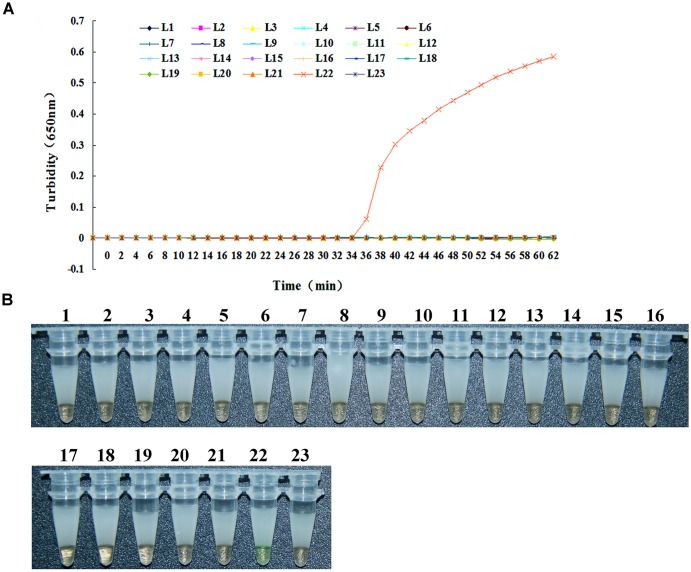
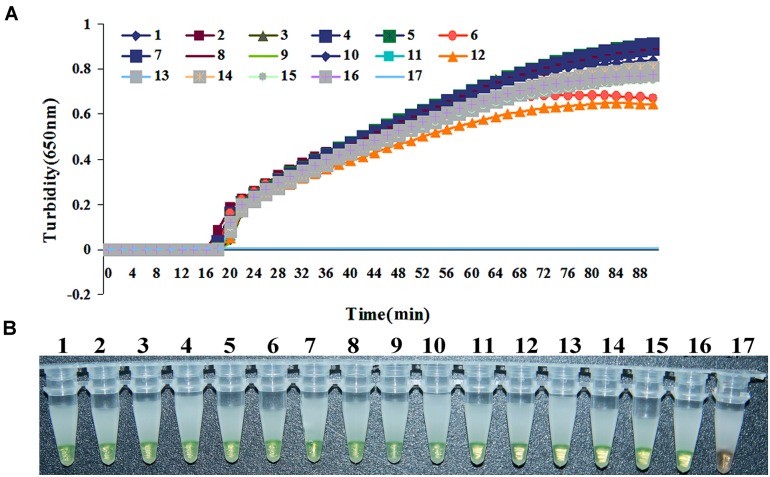
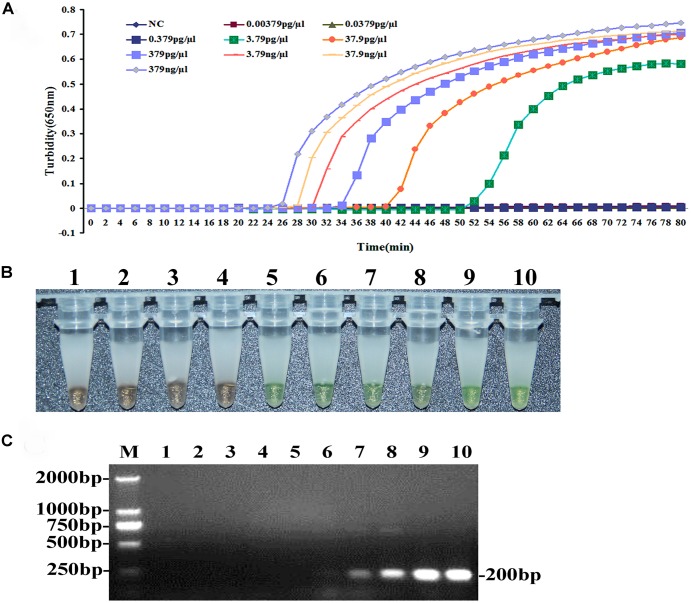
Intrinsic β-lactam resistance in Stenotrophomonas maltophilia is caused by bla L1 and/or bla L2, a kind of metallo-β-lactamase with a broad substrate spectrum including carbapenems. A rapid and sensitive molecular method for the detection of bla L1 in clinical samples is needed to guide therapeutic treatment. In present study, we first described a loop-mediated isothermal amplification (LAMP) method for the rapid detection of bla L1 in clinical samples by using two methods including a chromogenic method using calcein/Mn(2+) complex and the real-time turbidity monitoring to assess the reaction. Then dissemination of L1-producing S. maltophilia was investigated from ICU patients in three top hospital in Beijing, China. The results showed that both methods detected the target DNA within 60 min under isothermal conditions (65°C). The detection limit of LAMP was 3.79 pg/μl DNA, and its sensitivity 100-fold greater than that of conventional PCR. All 21 test strains except for S. maltophilia were negative for bla L1, indicative of the high-specificity of the primers for the bla L1. A total of 22 L1-positive isolates were identified for LAMP-based surveillance of bla L1 from 105 ICU patients with clinically suspected multi-resistant infections. The sequences of these bla L1 genes were conservative with only a few sites mutated, and the strains had highly resistant to β-lactam antibiotics. The MLST recovered that 22 strains belonged to seven different S. maltophilia sequence types (STs). Furthermore, co-occurrence of bla L1 and bla L2 genes were detected in all of isolates. Strikingly, S. maltophilia DCPS-01 was recovered to contain bla L1, bla L2, and bla NDM-1 genes, possessing an ability to hydrolyse all β-lactams antibiotics. Our data showed the diversity types of S. maltophilia carrying bla L1 and co-occurrence of many resistant genes in the clinical strains signal an ongoing and fast evolution of S. maltophilia resulting from their wide spread in the respiratory infections, and therefore will be difficult to control.
嗜麦芽窄食单胞菌固有β-内酰胺耐药性由 bla L1 和/或 bla L2 引起,这是一种具有广泛底物谱的金属β-内酰胺酶,包括碳青霉烯类。需要一种快速、灵敏的分子方法来检测临床样本中的 bla L1,以指导治疗。在本研究中,我们首次描述了一种环介导等温扩增(LAMP)方法,通过两种方法快速检测临床样本中的 bla L1,包括使用钙黄绿素/Mn(2+)复合物的显色法和实时浊度监测评估反应。然后,我们调查了来自中国北京三家顶级医院 ICU 患者的产 bla L1 嗜麦芽窄食单胞菌的传播情况。结果表明,两种方法在等温条件(65°C)下 60 分钟内均可检测到靶 DNA。LAMP 的检测限为 3.79 pg/μl DNA,其灵敏度比常规 PCR 高 100 倍。除嗜麦芽窄食单胞菌外,所有 21 株试验菌株均对 bla L1 呈阴性,表明引物对 bla L1 具有高度特异性。通过基于 LAMP 的 bla L1 监测,从 105 例临床疑似多重耐药感染的 ICU 患者中鉴定出 22 株 bla L1 阳性分离株。这些 bla L1 基因序列保守,仅有少数位点发生突变,菌株对β-内酰胺类抗生素高度耐药。MLST 结果表明,22 株菌属于 7 种不同的嗜麦芽窄食单胞菌序列型(STs)。此外,所有分离株均检测到 bla L1 和 bla L2 基因的共发生。值得注意的是,嗜麦芽窄食单胞菌 DCPS-01 携带 bla L1、bla L2 和 bla NDM-1 基因,能够水解所有β-内酰胺类抗生素。我们的数据显示,携带 bla L1 的嗜麦芽窄食单胞菌的多样性类型以及临床菌株中许多耐药基因的共发生表明,由于其在呼吸道感染中的广泛传播,嗜麦芽窄食单胞菌正在不断快速进化,因此将难以控制。