Cell Signalling Section, Division of Immunology, Department of Pathology, University of Cambridge , Cambridge , UK.
Front Immunol. 2014 Dec 4;5:619. doi: 10.3389/fimmu.2014.00619. eCollection 2014.
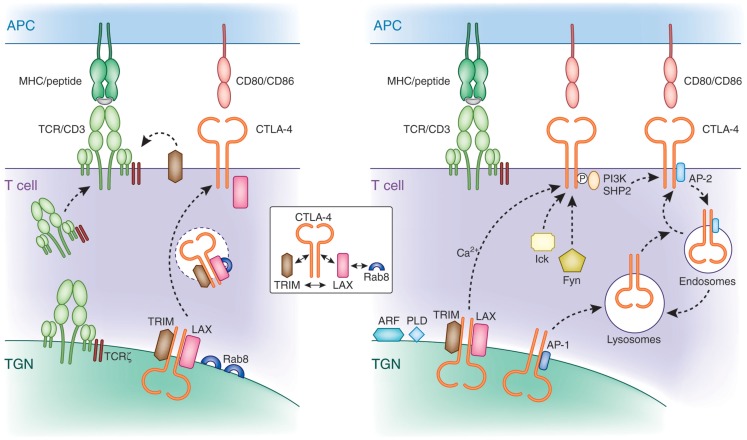
T-cell co-receptor cytotoxic T-cell antigen-4 (CTLA-4) is a critical inhibitory regulator of T-cell immunity and antibody blockade of the co-receptor has been shown to be effective in tumor immunotherapy. Paradoxically, the majority of CTLA-4 is located in intracellular compartments from where it is transported to the cell surface and rapidly internalized. The intracellular trafficking pathways that control transport of the co-receptor to the cell surface ensures the appropriate balance of negative and positive signaling for a productive immune response with minimal autoimmune disorders. It will also influence the degree of inhibition and the potency of antibody checkpoint blockade in cancer immunotherapy. Current evidence indicates that the mechanisms of CTLA-4 transport to the cell surface and its residency are multifactorial involving a combination of immune cell-specific adapters such as TRIM and LAX, the small GTPase Rab8 as well as generic components such as ARF-1, phospholipase D, and the heterotetrameric AP1/2 complex. This review covers the recent developments in our understanding of the processes that control the expression of this important co-inhibitory receptor for the modulation of T-cell immunity. Interference with the processes that regulate CTLA-4 surface expression could provide an alternate therapeutic approach in the treatment of cancer and autoimmunity.
T 细胞共受体细胞毒性 T 细胞抗原-4(CTLA-4)是 T 细胞免疫的关键抑制调节因子,抗体阻断共受体已被证明在肿瘤免疫治疗中有效。矛盾的是,大多数 CTLA-4 位于细胞内隔室中,从那里它被运输到细胞表面并迅速内化。控制共受体向细胞表面运输的细胞内运输途径确保了正信号和负信号之间的适当平衡,以产生具有最小自身免疫紊乱的有效免疫反应。它还将影响抗体检查点阻断在癌症免疫治疗中的抑制程度和效力。目前的证据表明,CTLA-4 向细胞表面运输及其驻留的机制是多因素的,涉及免疫细胞特异性适配器(如 TRIM 和 LAX)、小 GTPase Rab8 以及通用成分(如 ARF-1、磷脂酶 D 和异源四聚体 AP1/2 复合物)的组合。这篇综述涵盖了我们对控制这个重要的共抑制受体表达的过程的理解的最新进展,这些过程调节了 T 细胞免疫。干扰调节 CTLA-4 表面表达的过程可能为癌症和自身免疫的治疗提供一种替代的治疗方法。