Department of Plant Physiology, Faculty of Biology, Philipps University , Marburg, Germany.
Front Plant Sci. 2014 Dec 4;5:685. doi: 10.3389/fpls.2014.00685. eCollection 2014.
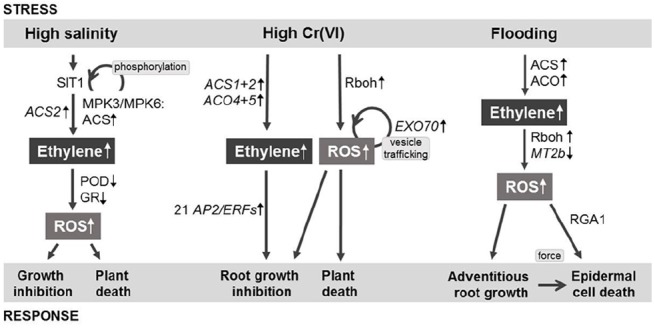
Plant growth and developmental processes as well as abiotic and biotic stress adaptations are regulated by small endogenous signaling molecules. Among these, phytohormones such as the gaseous alkene ethylene and reactive oxygen species (ROS) play an important role in mediating numerous specific growth or cell death responses. While apoplastic ROS are generated by plasma membrane-located respiratory burst oxidase homolog proteins, intracellular ROS are produced mainly in electron transfer chains of mitochondria and chloroplasts. Ethylene accumulates in plants due to physical entrapment or by enhanced ethylene biosynthesis. A major crop that must endure high salt and heavy metal concentrations upon flooding in regions of Asia is rice. Ethylene and ROS have been identified as the major signals that mediate salinity, chromium, and flooding stress in rice. This mini review focuses on (i) what is known about ethylene and ROS level control during these abiotic stresses in rice, (ii) how the two signals mediate growth or death processes, and (iii) feedback mechanisms that in turn regulate ethylene and ROS signaling.
植物的生长和发育过程以及非生物和生物胁迫适应受小分子内源性信号分子的调节。在这些信号分子中,植物激素如气态烯烃乙烯和活性氧(ROS)在介导许多特定的生长或细胞死亡反应中起着重要作用。虽然质外体 ROS 是由质膜定位的呼吸爆发氧化酶同源蛋白产生的,但细胞内 ROS 主要在线粒体和叶绿体的电子传递链中产生。乙烯在植物中积累是由于物理截留或增强的乙烯生物合成。亚洲洪水地区的一种主要作物水稻必须耐受高盐和重金属浓度。乙烯和 ROS 已被确定为介导水稻盐度、铬和洪水胁迫的主要信号。这篇综述主要关注:(i)在这些非生物胁迫下,水稻中乙烯和 ROS 水平控制的已知情况;(ii)这两个信号如何介导生长或死亡过程;(iii)反过来调节乙烯和 ROS 信号的反馈机制。