Blanco Eduardo, Pavón Francisco J, Palomino Ana, Luque-Rojas María Jesús, Serrano Antonia, Rivera Patricia, Bilbao Ainhoa, Alen Francisco, Vida Margarita, Suárez Juan, Rodríguez de Fonseca Fernando
Unidad de Gestión Clínica de Salud Mental, Instituto IBIMA-Hospital Regional Universitario de Málaga, Málaga, Spain (Drs Blanco, Pavón, Palomino, Luque-Rojas, Serrano, Rivera, Alen, Vida, Suárez, and de Fonseca); Departamento de Psicobiología y Metodología de las Ciencias del Comportamiento, Facultad de Psicología, Universidad de Málaga, Málaga, Spain (Dr Blanco); Institute of Psychopharmacology, Central Institute of Mental Health, Medical Faculty of Mannheim, University of Heidelberg, Mannheim, Germany (Dr Bilbao).
Int J Neuropsychopharmacol. 2014 Oct 31;18(1):pyu024. doi: 10.1093/ijnp/pyu024.
Endocannabinoids modulate the glutamatergic excitatory transmission by acting as retrograde messengers. A growing body of studies has reported that both signaling systems in the mesocorticolimbic neural circuitry are involved in the neurobiological mechanisms underlying drug addiction.
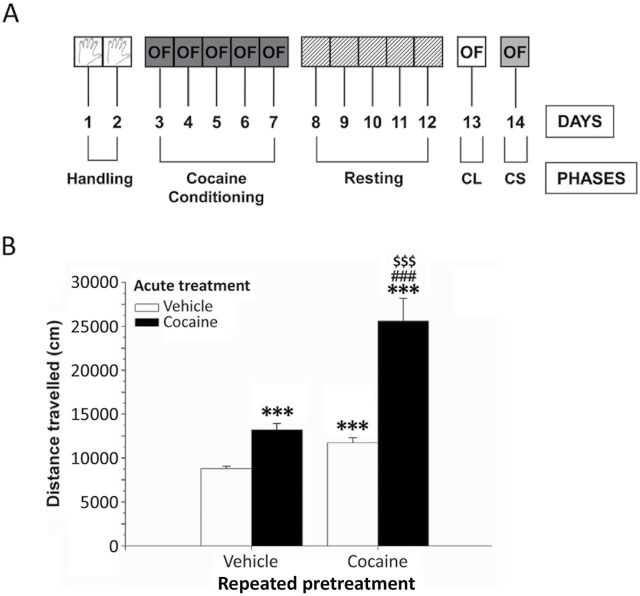
We investigated whether the expression of both endocannabinoid and glutamatergic systems in the prefrontal cortex (PFC) were altered by an acute and/or repeated cocaine administration schedule that resulted in behavioral sensitization. We measured the protein and mRNA expression of the main endocannabinoid metabolic enzymes and the cannabinoid receptor type 1 (CB1). We also analyzed the mRNA expression of relevant components of the glutamate-signaling system, including glutamate-synthesizing enzymes, metabotropic receptors, and ionotropic receptors.
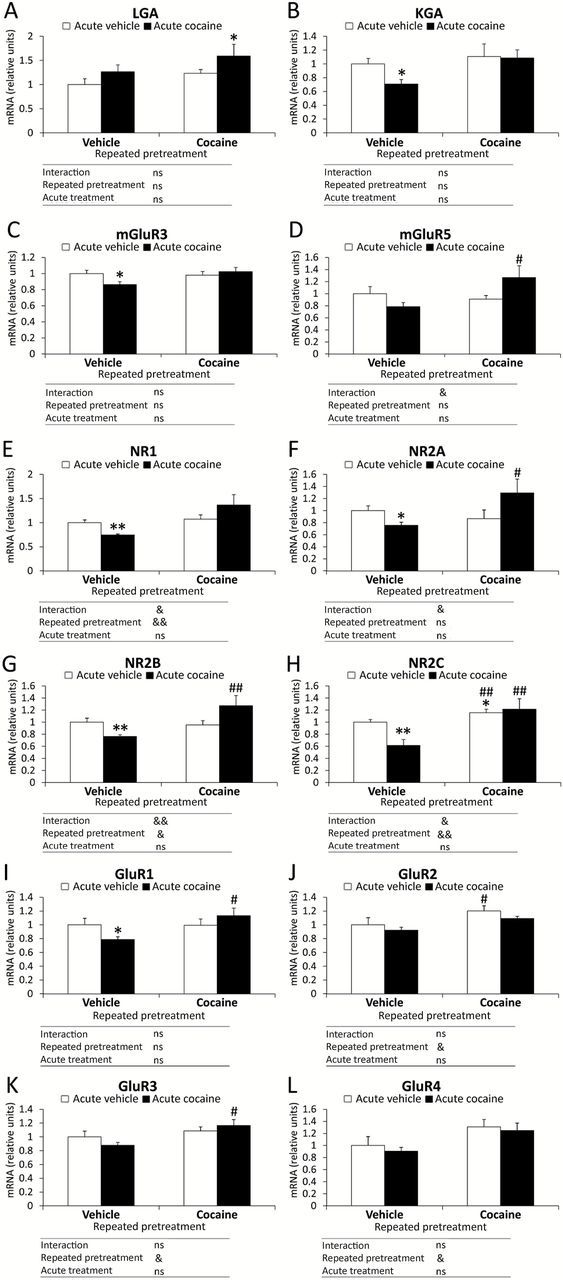
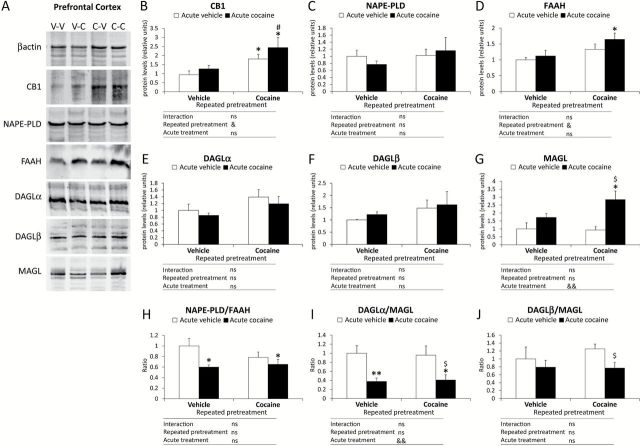
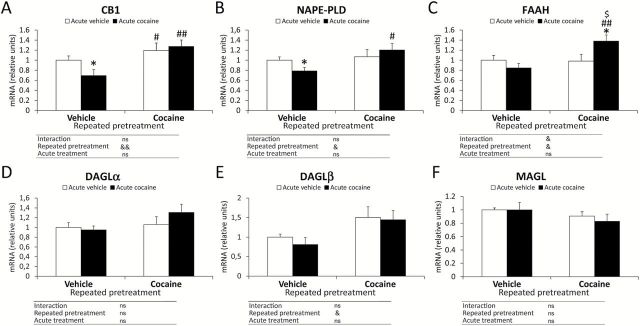
Although acute cocaine (10 mg/kg) produced no significant changes in the endocannabinoid-related proteins, repeated cocaine administration (20 mg/kg daily) induced a pronounced increase in the CB1 receptor expression. In addition, acute cocaine administration (10 mg/kg) in cocaine-sensitized mice (referred to as cocaine priming) induced a selective increase in the endocannabinoid-degrading enzymes fatty acid amide hydrolase (FAAH) and monoacylglycerol lipase (MAGL). These protein changes were accompanied by an overall decrease in the ratios of endocannabinoid synthesis/degradation, especially the N-acyl phosphatidylethanolamine phospholipase D/FAAH and diacylglycerol lipase alpha/MAGL ratios. Regarding mRNA expression, while acute cocaine administration produced a decrease in CB1 receptors and N-acyl phosphatidylethanolamine phospholipase D, repeated cocaine treatment enhanced CB1 receptor expression. Cocaine-sensitized mice that were administered priming injections of cocaine mainly displayed an increased FAAH expression. These endocannabinoid changes were associated with modifications in glutamatergic transmission-related genes. An overall decrease was observed in the mRNA expression of the glutamate-synthesizing gene kidney-type glutaminase (KGA), the metabotropic glutamate receptors (mGluR3 and GluR), and subunits of NMDA ionotropic receptors (NR1, NR2A, NR2B and NR2C) after acute cocaine administration, while mice repeatedly exposed to cocaine only displayed an increase in NR2C. However, in cocaine-sensitized mice primed with cocaine, this inhibition was reversed and a strong increase was detected in the mGluR5, NR2 subunits, and both GluR1 and GluR3.
These findings indicate that cocaine sensitization is associated with an endocannabinoid downregulation and a hyperglutamatergic state in the PFC that, overall, contribute to an enhanced glutamatergic input into PFC-projecting areas.
内源性大麻素作为逆行信使调节谷氨酸能兴奋性传递。越来越多的研究报告称,中脑边缘神经回路中的这两种信号系统都参与了药物成瘾的神经生物学机制。
我们研究了急性和/或重复给予可卡因导致行为敏化后,前额叶皮质(PFC)内源性大麻素和谷氨酸能系统的表达是否发生改变。我们测量了主要内源性大麻素代谢酶和1型大麻素受体(CB1)的蛋白质和mRNA表达。我们还分析了谷氨酸信号系统相关成分的mRNA表达,包括谷氨酸合成酶、代谢型受体和离子型受体。
虽然急性给予可卡因(10 mg/kg)对内源性大麻素相关蛋白无显著影响,但重复给予可卡因(每天20 mg/kg)可诱导CB1受体表达显著增加。此外,对可卡因致敏小鼠急性给予可卡因(10 mg/kg,即可卡因激发)可诱导内源性大麻素降解酶脂肪酸酰胺水解酶(FAAH)和单酰甘油脂肪酶(MAGL)选择性增加。这些蛋白质变化伴随着内源性大麻素合成/降解比率的总体下降,尤其是N-酰基磷脂酰乙醇胺磷脂酶D/FAAH和二酰甘油脂肪酶α/MAGL比率。关于mRNA表达,急性给予可卡因可使CB1受体和N-酰基磷脂酰乙醇胺磷脂酶D减少,而重复给予可卡因则增强CB1受体表达。接受可卡因激发注射的可卡因致敏小鼠主要表现为FAAH表达增加。这些内源性大麻素变化与谷氨酸能传递相关基因的改变有关。急性给予可卡因后,谷氨酸合成基因肾型谷氨酰胺酶(KGA)、代谢型谷氨酸受体(mGluR3和GluR)以及NMDA离子型受体亚基(NR1、NR2A、NR2B和NR2C)的mRNA表达总体下降,而反复接触可卡因的小鼠仅表现出NR2C增加。然而,在接受可卡因激发的可卡因致敏小鼠中,这种抑制作用被逆转,mGluR5、NR2亚基以及GluR1和GluR3均显著增加。
这些发现表明,可卡因致敏与PFC内源性大麻素下调和谷氨酸能亢进状态有关,总体上有助于增强向PFC投射区域的谷氨酸能输入。