Department of Archaeology and Natural History, School of Culture, History and Languages, ANU College of Asia and the Pacific, Australian National University Canberra, ACT, 0200, Australia.
Center for Integrative Conservation, Xishuangbanna Tropical Botanical Garden, Chinese Academy of Sciences Yunnan, 666303, China.
Ecol Evol. 2014 Nov;4(22):4380-98. doi: 10.1002/ece3.1287. Epub 2014 Oct 30.
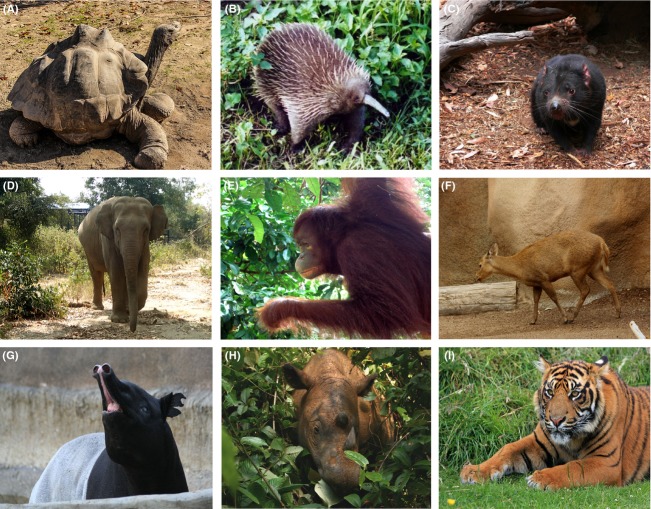
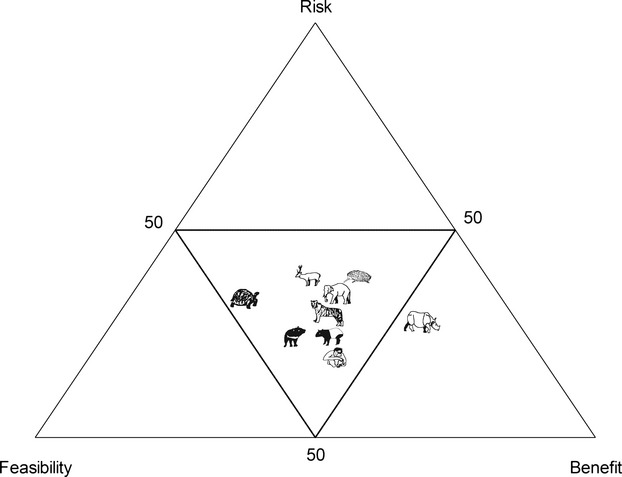
Alarm over the prospects for survival of species in a rapidly changing world has encouraged discussion of translocation conservation strategies that move beyond the focus of 'at-risk' species. These approaches consider larger spatial and temporal scales than customary, with the aim of recreating functioning ecosystems through a combination of large-scale ecological restoration and species introductions. The term 'rewilding' has come to apply to this large-scale ecosystem restoration program. While reintroductions of species within their historical ranges have become standard conservation tools, introductions within known paleontological ranges-but outside historical ranges-are more controversial, as is the use of taxon substitutions for extinct species. Here, we consider possible conservation translocations for nine large-bodied taxa in tropical Asia-Pacific. We consider the entire spectrum of conservation translocation strategies as defined by the IUCN in addition to rewilding. The taxa considered are spread across diverse taxonomic and ecological spectra and all are listed as 'endangered' or 'critically endangered' by the IUCN in our region of study. They all have a written and fossil record that is sufficient to assess past changes in range, as well as ecological and environmental preferences, and the reasons for their decline, and they have all suffered massive range restrictions since the late Pleistocene. General principles, problems, and benefits of translocation strategies are reviewed as case studies. These allowed us to develop a conservation translocation matrix, with taxa scored for risk, benefit, and feasibility. Comparisons between taxa across this matrix indicated that orangutans, tapirs, Tasmanian devils, and perhaps tortoises are the most viable taxa for translocations. However, overall the case studies revealed a need for more data and research for all taxa, and their ecological and environmental needs. Rewilding the Asian-Pacific tropics remains a controversial conservation strategy, and would be difficult in what is largely a highly fragmented area geographically.
对快速变化的世界中物种生存前景的担忧,促使人们讨论超越“濒危”物种焦点的转移保护策略。这些方法考虑了比通常更大的空间和时间尺度,旨在通过大规模生态恢复和物种引进相结合,重建功能生态系统。“重新野化”一词适用于这种大规模的生态系统恢复计划。虽然在历史范围内重新引入物种已成为标准的保护工具,但在已知古生物范围内但不在历史范围内的引入则更具争议性,就像使用灭绝物种的分类群替代一样。在这里,我们考虑了热带亚太地区九个大体型分类群的可能保护转移。我们考虑了除重新野化之外,IUCN 定义的所有保护转移策略。所考虑的分类群分布在不同的分类和生态谱中,在我们的研究区域内,所有分类群都被 IUCN 列为“濒危”或“极危”。它们都有足够的书面和化石记录,可以评估过去的范围变化,以及生态和环境偏好,以及它们衰退的原因,并且自更新世晚期以来,它们的范围都受到了大规模的限制。我们回顾了转移策略的一般原则、问题和益处,作为案例研究。这些使我们能够开发一个保护转移矩阵,对风险、利益和可行性进行分类。在这个矩阵中对分类群进行比较表明,猩猩、貘、袋獾,也许还有龟类是最适合转移的分类群。然而,总体而言,案例研究表明,所有分类群都需要更多的数据和研究,以及它们的生态和环境需求。在很大程度上,亚洲-太平洋热带地区的重新野化仍然是一个有争议的保护策略,因为该地区在地理上是高度破碎的。