Yoest Katie E, Cummings Jennifer A, Becker Jill B
205 Zina Pitcher Place, Ann Arbor, MI 48109, USA.
Cent Nerv Syst Agents Med Chem. 2014;14(2):83-9. doi: 10.2174/1871524914666141226103135.
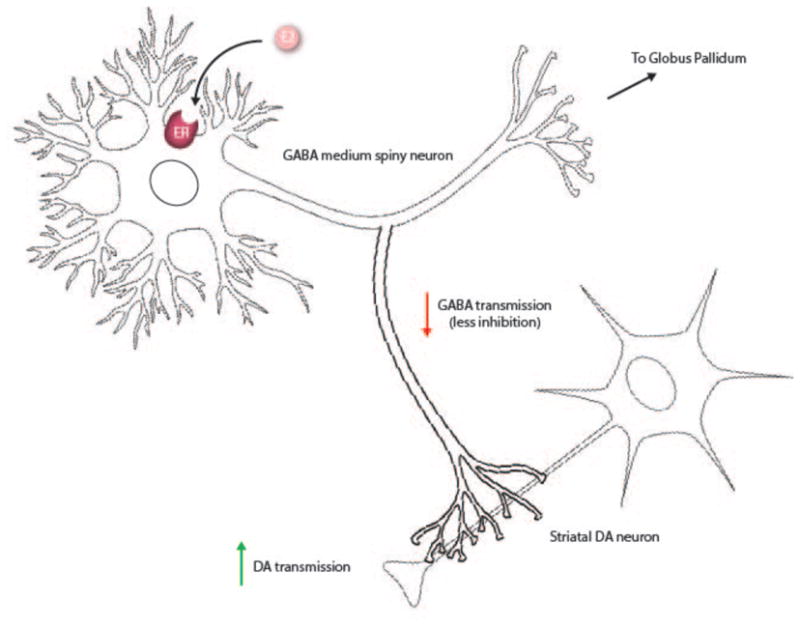
The gonadal hormone estradiol modulates mesolimbic dopamine systems in the female rat. This modulatory effect is thought to be responsible for the observed effects of estradiol on motivated behaviors. Dopamine acting in the nucleus accumbens is thought to be important for the attribution of incentive motivational properties to cues that predict reward delivery, while dopamine in the striatum is associated with the expression of repetitive or stereotyped behaviors. Elevated concentrations of estradiol are associated with increased motivation for sex or cues associated with access to a mate, while simultaneously attenuating motivation for food. This shift in motivational salience is important for adaptive choice behavior in the natural environment. Additionally, estradiol's adaptive effects on motivation can be maladaptive when increasing motivation for non-natural reinforcers, such as drugs of abuse. Here we discuss the effect of estradiol on mesotelencephalic dopamine transmission and subsequent effects on motivated behaviors.
性腺激素雌二醇可调节雌性大鼠的中脑边缘多巴胺系统。这种调节作用被认为是雌二醇对动机行为产生观察到的影响的原因。作用于伏隔核的多巴胺被认为对于将奖励激励属性赋予预测奖励发放的线索很重要,而纹状体中的多巴胺与重复或刻板行为的表达有关。雌二醇浓度升高与对性行为或与接触配偶相关线索的动机增加有关,同时会减弱对食物的动机。这种动机显著性的转变对于自然环境中的适应性选择行为很重要。此外,当增加对非自然强化物(如滥用药物)的动机时,雌二醇对动机的适应性影响可能会变成适应不良。在此,我们讨论雌二醇对中脑腹侧多巴胺传递的影响以及随后对动机行为的影响。