Cannito Stefania, Turato Cristian, Paternostro Claudia, Biasiolo Alessandra, Colombatto Sebastiano, Cambieri Irene, Quarta Santina, Novo Erica, Morello Elisabetta, Villano Gianmarco, Fasolato Silvano, Musso Tiziana, David Ezio, Tusa Ignazia, Rovida Elisabetta, Autelli Riccardo, Smedile Antonina, Cillo Umberto, Pontisso Patrizia, Parola Maurizio
Department of Clinical and Biological Sciences, Unit of Experimental Medicine and Interuniversity Center for Liver Pathophysiology, University of Torino, Italy.
Department of Medicine, University of Padova, Italy.
Oncotarget. 2015 Feb 10;6(4):2206-21. doi: 10.18632/oncotarget.2943.
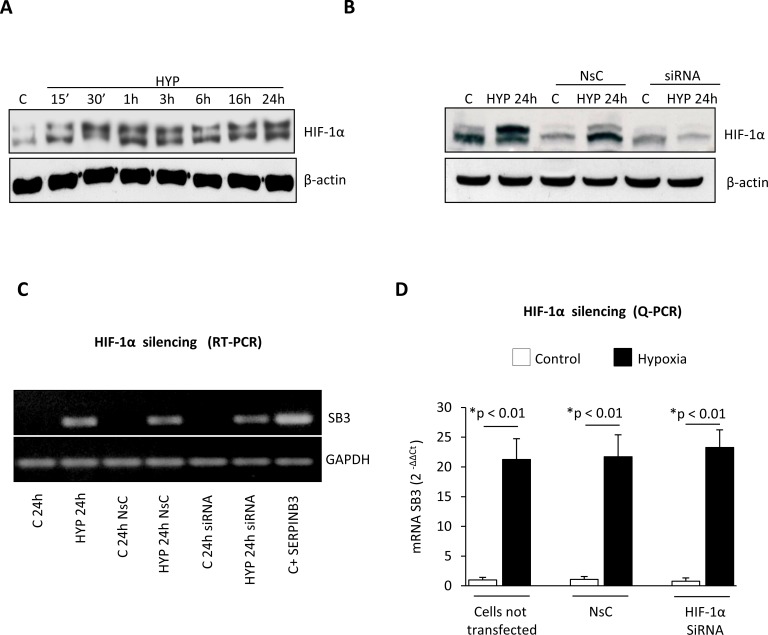
SERPINB3 is a cysteine-proteases inhibitor up-regulated in a significant number of cirrhotic patients carrying hepatocellular carcinoma (HCC) and recently proposed as a prognostic marker for HCC early recurrence. SERPINB3 has been reported to stimulate proliferation, inhibit apoptosis and, similar to what reported for hypoxia, to trigger epithelial-to-mesenchymal transition (EMT) and increased invasiveness in liver cancer cells. This study has investigated whether SERPINB3 expression is regulated by hypoxia-related mechanisms in liver cancer cells. Exposure of HepG2 and Huh7 cells to hypoxia up-regulated SERPINB3 transcription, protein synthesis and release in the extracellular medium. Hypoxia-dependent SERPINB3 up-regulation was selective (no change detected for SERPINB4) and operated through hypoxia inducible factor (HIF)-2α (not HIF-1α) binding to SERPINB3 promoter, as confirmed by chromatin immuno-precipitation assay and silencing experiments employing specific siRNAs. HIF-2α-mediated SERPINB3 up-regulation under hypoxic conditions required intracellular generation of ROS. Immuno-histochemistry (IHC) and transcript analysis, performed in human HCC specimens, revealed co-localization of the two proteins in liver cancer cells and the existence of a positive correlation between HIF-2α and SERPINB3 transcript levels, respectively. Hypoxia, through HIF-2α-dependent and redox-sensitive mechanisms, up-regulates the transcription, synthesis and release of SERPINB3, a molecule with a high oncogenic potential.
丝氨酸蛋白酶抑制剂B3(SERPINB3)是一种半胱氨酸蛋白酶抑制剂,在大量患有肝细胞癌(HCC)的肝硬化患者中上调,最近被提议作为HCC早期复发的预后标志物。据报道,SERPINB3可刺激增殖、抑制凋亡,并且与缺氧情况类似,可触发肝癌细胞的上皮-间质转化(EMT)并增加侵袭性。本研究调查了SERPINB3表达是否受肝癌细胞中缺氧相关机制的调控。将HepG2和Huh7细胞暴露于缺氧环境中可上调SERPINB3的转录、蛋白质合成以及在细胞外培养基中的释放。缺氧依赖性SERPINB3上调具有选择性(未检测到SERPINB4有变化),并通过缺氧诱导因子(HIF)-2α(而非HIF-1α)与SERPINB3启动子结合来发挥作用,染色质免疫沉淀试验和使用特异性小干扰RNA(siRNA)的沉默实验证实了这一点。缺氧条件下HIF-2α介导的SERPINB3上调需要细胞内活性氧(ROS)的产生。在人类HCC标本中进行的免疫组织化学(IHC)和转录分析分别显示了这两种蛋白在肝癌细胞中的共定位以及HIF-2α与SERPINB3转录水平之间存在正相关。缺氧通过HIF-2α依赖性和氧化还原敏感机制上调具有高致癌潜力的分子SERPINB3的转录、合成和释放。