Kuhn Marion, Höger Nora, Feige Bernd, Blechert Jens, Normann Claus, Nissen Christoph
Department of Psychiatry and Psychotherapy, University Medical Center Freiburg, Freiburg, Germany.
Division of Clinical Psychology, Psychotherapy, and Health Psychology, Department of Psychology, University of Salzburg, Salzburg, Austria.
PLoS One. 2014 Dec 29;9(12):e115280. doi: 10.1371/journal.pone.0115280. eCollection 2014.
The neuroplasticity hypothesis of major depressive disorder proposes that a dysfunction of synaptic plasticity represents a basic pathomechanism of the disorder. Animal models of depression indicate enhanced plasticity in a ventral emotional network, comprising the amygdala. Here, we investigated fear extinction learning as a non-invasive probe for amygdala-dependent synaptic plasticity in patients with major depressive disorder and healthy controls.
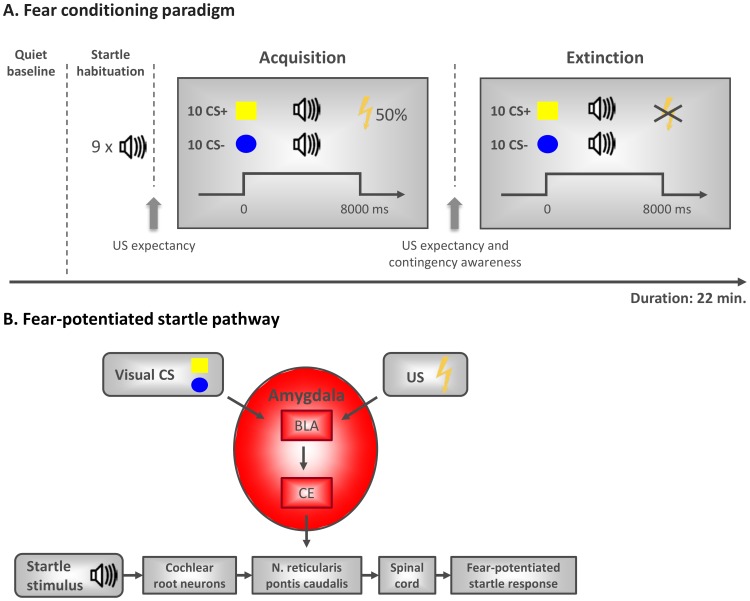
Differential fear conditioning was measured in 37 inpatients with severe unipolar depression (International Classification of Diseases, 10th revision, criteria) and 40 healthy controls. The eye-blink startle response, a subcortical output signal that is modulated by local synaptic plasticity in the amygdala in fear acquisition and extinction learning, was recorded as the primary outcome parameter.
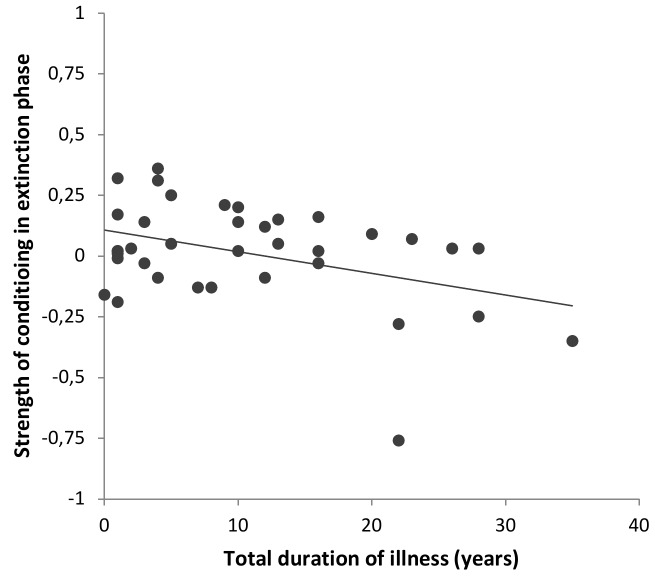
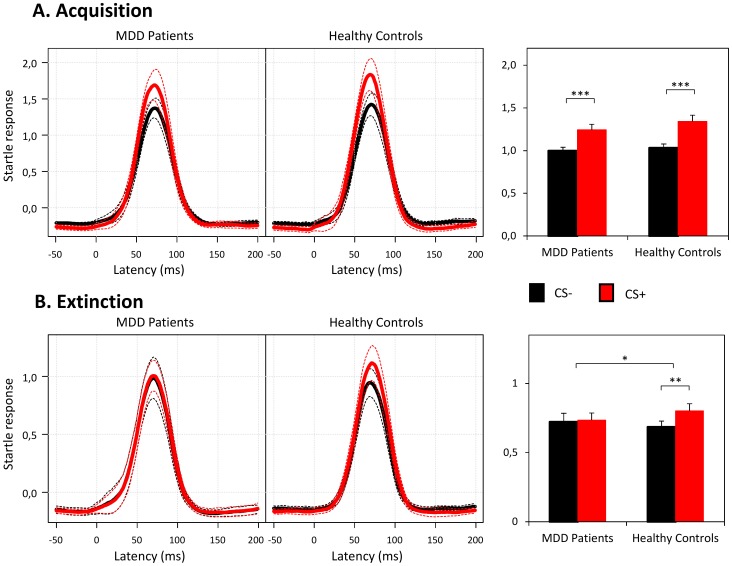
After robust and similar fear acquisition in both groups, patients with major depressive disorder showed significantly enhanced fear extinction learning in comparison to healthy controls, as indicated by startle responses to conditioned stimuli. The strength of extinction learning was positively correlated with the total illness duration.
The finding of enhanced fear extinction learning in major depressive disorder is consistent with the concept that the disorder is characterized by enhanced synaptic plasticity in the amygdala and the ventral emotional network. Clinically, the observation emphasizes the potential of successful extinction learning, the basis of exposure therapy, in anxiety-related disorders despite the frequent comorbidity of major depressive disorder.
重度抑郁症的神经可塑性假说提出,突触可塑性功能障碍是该疾病的一种基本病理机制。抑郁症动物模型表明,在包括杏仁核在内的腹侧情绪网络中可塑性增强。在此,我们研究了恐惧消退学习,将其作为重度抑郁症患者和健康对照中杏仁核依赖性突触可塑性的一种非侵入性探测方法。
对37例重度单相抑郁症住院患者(符合国际疾病分类第10版标准)和40例健康对照进行差异恐惧条件反射测量。眨眼惊跳反应是一种皮质下输出信号,在恐惧习得和消退学习中受杏仁核局部突触可塑性调节,被记录为主要结局参数。
两组在强烈且相似的恐惧习得后,与健康对照相比,重度抑郁症患者表现出显著增强的恐惧消退学习,这通过对条件刺激的惊跳反应得以体现。消退学习的强度与总病程呈正相关。
重度抑郁症中恐惧消退学习增强这一发现与该疾病以杏仁核和腹侧情绪网络中突触可塑性增强为特征的概念一致。临床上,这一观察结果强调了尽管重度抑郁症常合并其他疾病,但成功的消退学习(暴露疗法的基础)在焦虑相关障碍中的潜力。