Muigg Patrik, Hetzenauer Alfred, Hauer Gabriele, Hauschild Markus, Gaburro Stefano, Frank Elisabeth, Landgraf Rainer, Singewald Nicolas
Department of Pharmacology and Toxicology, Institute of Pharmacy, Center for Molecular Biosciences Innsbruck, University of Innsbruck, Peter-Mayer-Strasse 1, A-6020 Innsbruck, Austria.
Eur J Neurosci. 2008 Dec;28(11):2299-309. doi: 10.1111/j.1460-9568.2008.06511.x. Epub 2008 Nov 3.
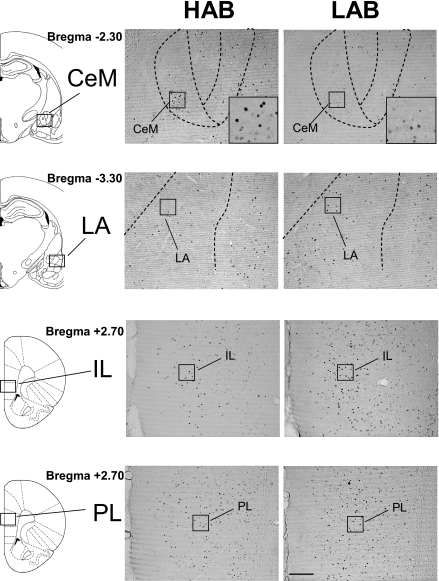
The impaired extinction of acquired fear is a core symptom of anxiety disorders, such as post-traumatic stress disorder, phobias or panic disorder, and is known to be particularly resistant to existing pharmacotherapy. We provide here evidence that a similar relationship between trait anxiety and resistance to extinction of fear memory can be mimicked in a psychopathologic animal model. Wistar rat lines selectively bred for high (HAB) or low (LAB) anxiety-related behaviour were tested in a classical cued fear conditioning task utilizing freezing responses as a measure of fear. Fear acquisition was similar in both lines. In the extinction trial, however, HAB rats showed a marked deficit in the attenuation of freezing responses to repeated auditory conditioned stimulus presentations as compared with LAB rats, which exhibited rapid extinction. To gain information concerning the putatively altered neuronal processing associated with the differential behavioural response between HAB and LAB rats, c-Fos expression was investigated in the main prefrontal-amygdala pathways important for cued fear extinction. HAB compared to LAB rats showed an attenuated c-Fos response to repeated conditioned stimulus presentations in infralimbic and cingulate cortices, as well as in the lateral amygdala, but facilitated the c-Fos response in the medial part of the central amygdala. In conclusion, the present results support the notion that impaired extinction in high anxiety rats is accompanied by an aberrant activation profile in extinction-relevant prefrontal-amygdala circuits. Thus, HAB rats may represent a clinically relevant model to study the mechanisms and potential targets to accelerate delayed extinction processes in subjects with enhanced trait anxiety.
习得性恐惧消退受损是焦虑症的核心症状,如创伤后应激障碍、恐惧症或惊恐障碍,并且已知对现有的药物治疗具有特别的抗性。我们在此提供证据表明,在一个精神病理学动物模型中可以模拟特质焦虑与恐惧记忆消退抗性之间的类似关系。对高焦虑相关行为(HAB)或低焦虑相关行为(LAB)进行选择性培育的Wistar大鼠品系,在经典的线索性恐惧条件反射任务中接受测试,利用僵住反应作为恐惧的衡量指标。两个品系的恐惧习得情况相似。然而,在消退试验中,与表现出快速消退的LAB大鼠相比,HAB大鼠在对重复听觉条件刺激呈现的僵住反应衰减方面表现出明显缺陷。为了获取与HAB和LAB大鼠之间不同行为反应相关的假定改变的神经元加工信息,在对线索性恐惧消退重要的主要前额叶 - 杏仁核通路中研究了c-Fos表达。与LAB大鼠相比,HAB大鼠在腹内侧前额叶皮质、扣带回皮质以及外侧杏仁核中对重复条件刺激呈现的c-Fos反应减弱,但在中央杏仁核内侧部分促进了c-Fos反应。总之,目前的结果支持这样一种观点,即高焦虑大鼠的消退受损伴随着与消退相关的前额叶 - 杏仁核回路中的异常激活模式。因此,HAB大鼠可能代表一种临床相关模型,用于研究加速特质焦虑增强的受试者延迟消退过程的机制和潜在靶点。