Lee Dong-Hoon, Liu Yinling, Lee Hyun-Wook, Xia Bo, Brice Allyn R, Park Sung-Hyun, Balduf Hunter, Dominy Brian N, Cao Weiguo
Department of Genetics and Biochemistry, South Carolina Experiment Station, Clemson University, 049 Life Sciences Facility, 190 Collings Street, Clemson, SC 29634, USA.
367 Hunter Laboratories, Department of Chemistry, Clemson University, Clemson, SC 29634, USA.
Nucleic Acids Res. 2015 Jan;43(2):1081-9. doi: 10.1093/nar/gku1332. Epub 2014 Dec 30.
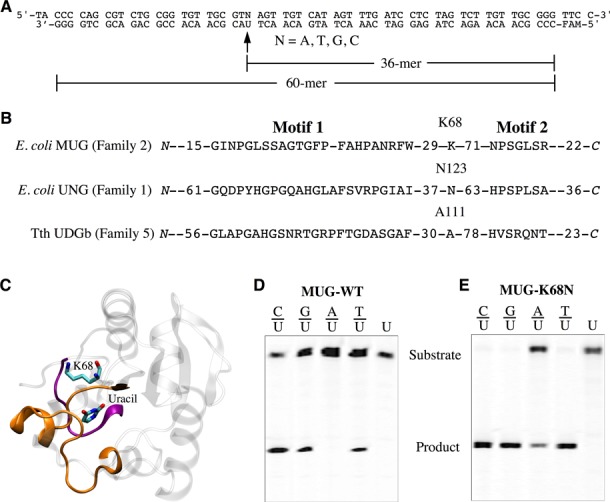
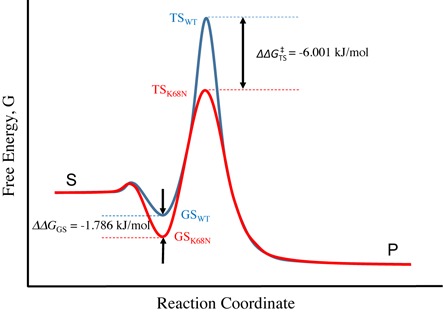
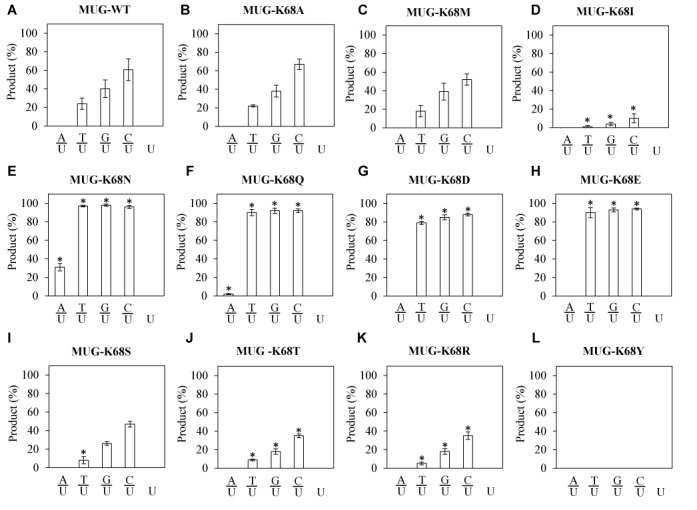
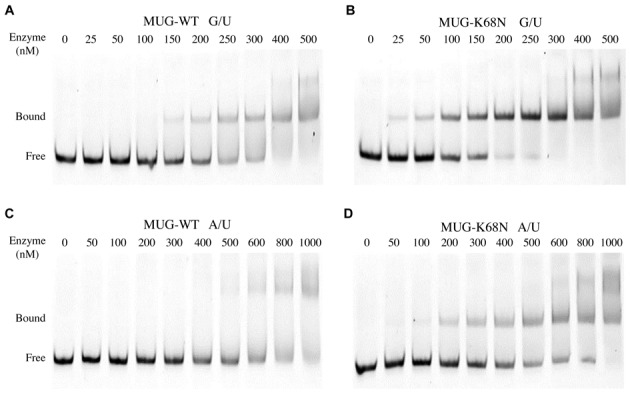
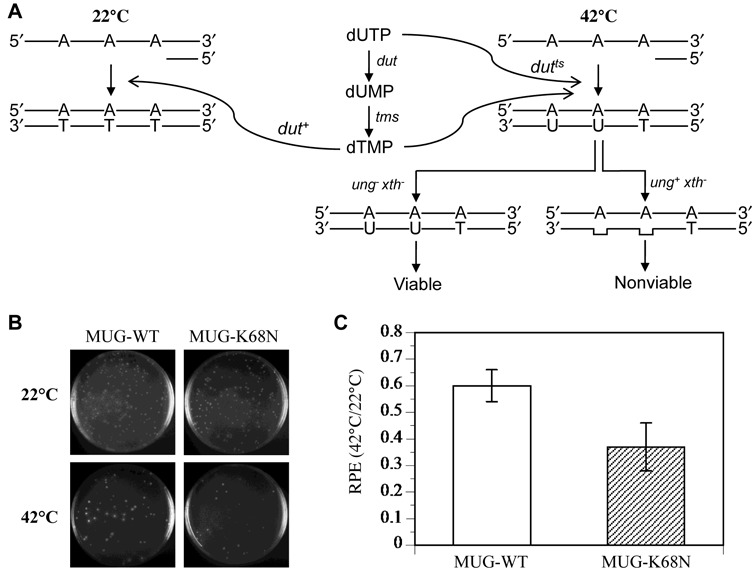
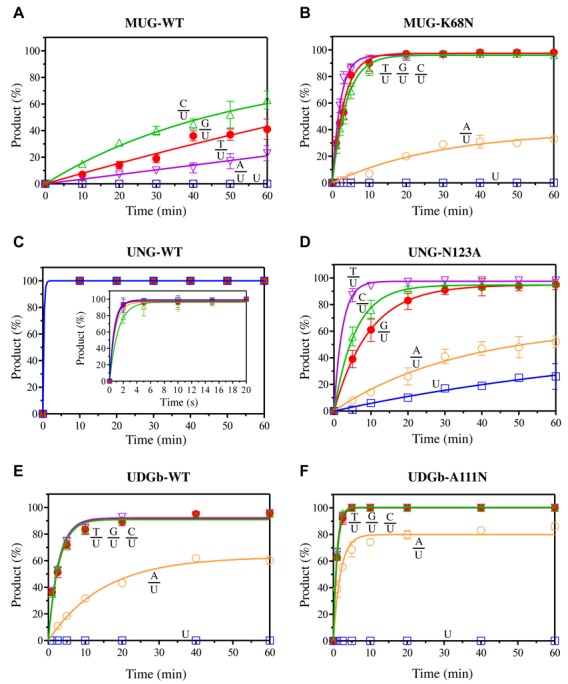
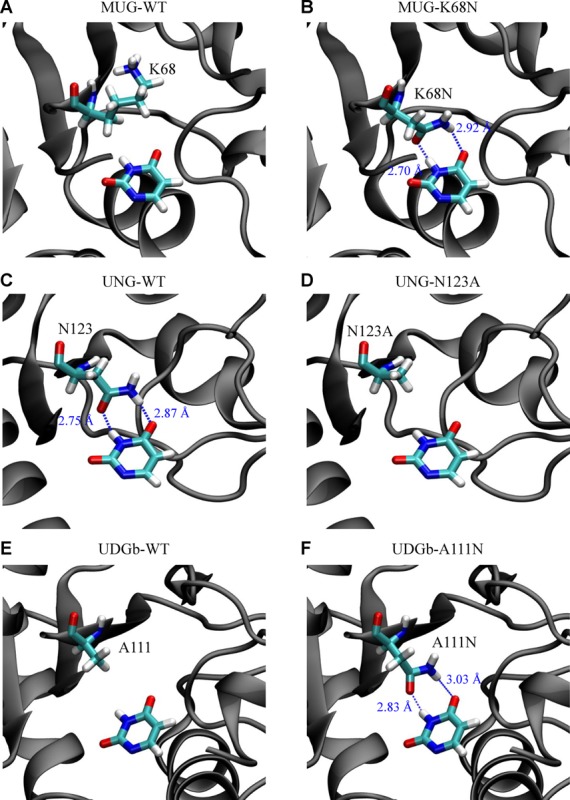
The uracil DNA glycosylase superfamily consists of several distinct families. Family 2 mismatch-specific uracil DNA glycosylase (MUG) from Escherichia coli is known to exhibit glycosylase activity on three mismatched base pairs, T/U, G/U and C/U. Family 1 uracil N-glycosylase (UNG) from E. coli is an extremely efficient enzyme that can remove uracil from any uracil-containing base pairs including the A/U base pair. Here, we report the identification of an important structural determinant that underlies the functional difference between MUG and UNG. Substitution of a Lys residue at position 68 with Asn in MUG not only accelerates the removal of uracil from mismatched base pairs but also enables the enzyme to gain catalytic activity on A/U base pairs. Binding and kinetic analysis demonstrate that the MUG-K68N substitution results in enhanced ground state binding and transition state interactions. Molecular modeling reveals that MUG-K68N, UNG-N123 and family 5 Thermus thermophiles UDGb-A111N can form bidentate hydrogen bonds with the N3 and O4 moieties of the uracil base. Genetic analysis indicates the gain of function for A/U base pairs allows the MUG-K68N mutant to remove uracil incorporated into the genome during DNA replication. The implications of this study in the origin of life are discussed.
尿嘧啶DNA糖基化酶超家族由几个不同的家族组成。已知来自大肠杆菌的2型错配特异性尿嘧啶DNA糖基化酶(MUG)对三种错配碱基对T/U、G/U和C/U具有糖基化酶活性。来自大肠杆菌的1型尿嘧啶N-糖基化酶(UNG)是一种极其高效的酶,它可以从任何含尿嘧啶的碱基对中去除尿嘧啶,包括A/U碱基对。在此,我们报告了一个重要结构决定因素的鉴定,该因素是MUG和UNG功能差异的基础。在MUG中,将第68位的赖氨酸残基替换为天冬酰胺不仅加速了从错配碱基对中去除尿嘧啶,还使该酶获得了对A/U碱基对的催化活性。结合和动力学分析表明,MUG-K68N替换导致基态结合和过渡态相互作用增强。分子建模显示,MUG-K68N、UNG-N123和5型嗜热栖热菌UDGb-A111N可以与尿嘧啶碱基的N3和O4部分形成双齿氢键。遗传分析表明,对A/U碱基对功能的获得使MUG-K68N突变体能够去除DNA复制过程中掺入基因组的尿嘧啶。本文讨论了这项研究对生命起源的意义。