IESE Business School, University of Navarra, Barcelona, Spain.
Int J Integr Care. 2014 Dec 15;14:e035. doi: 10.5334/ijic.1980. eCollection 2014 Oct.
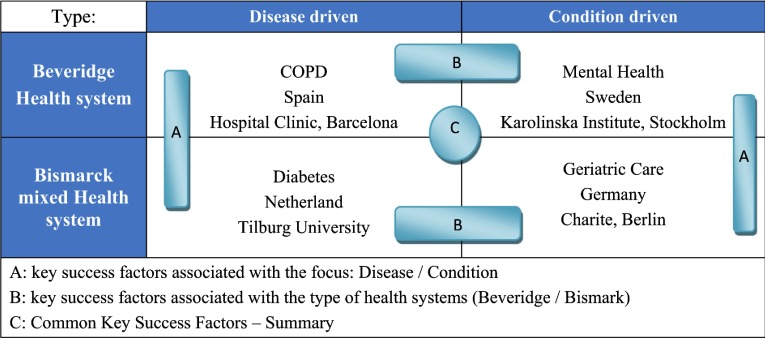
The use of case studies in health services research has proven to be an excellent methodology for gaining in-depth understanding of the organisation and delivery of health care. This is particularly relevant when looking at the complexity of integrated healthcare programmes, where multifaceted interactions occur at the different levels of care and often without a clear link between the interventions (new and/or existing) and their impact on outcomes (in terms of patients health, both patient and professional satisfaction and cost-effectiveness). Still, integrated care is seen as a core strategy in the sustainability of health and care provision in most societies in Europe and beyond. More specifically, at present, there is neither clear evidence on transferable factors of integrated care success nor a method for determining how to establish these specific success factors. The drawback of case methodology in this case, however, is that the in-depth results or lessons generated are usually highly context-specific and thus brings the challenge of transferability of findings to other settings, as different health care systems and different indications are often not comparable. Project INTEGRATE, a European Commission-funded project, has been designed to overcome these problems; it looks into four chronic conditions in different European settings, under a common methodology framework (taking a mixed-methods approach) to try to overcome the issue of context specificity and limited transferability. The common methodological framework described in this paper seeks to bring together the different case study findings in a way that key lessons may be derived and transferred between countries, contexts and patient-groups, where integrated care is delivered in order to provide insight into generalisability and build on existing evidence in this field.
To compare the different integrated care experiences, a mixed-methods approach has been adopted with the creation of a common methodological framework (including data collection tools and case study template report) to be used by the case studies for their analyses.
The four case studies attempt to compare health care services before and after the 'integration' of care, while triangulating the findings using quantitative and qualitative data, and provide an in-depth description of the organisation and delivery of care, and the impact on outcomes. The common framework aims to allow for the extraction of key transferable learning from the cases, taking into account context-dependency.
The application and evaluation of the common methodological approach aim to distill and identify important elements for successful integrated care, in order to strengthen the evidence base for integrated care (by facilitating cross-context comparisons), increase the transferability of findings from highly context-specific to other settings and lead to concrete and practical policy and operational recommendations.
在卫生服务研究中使用案例研究已被证明是深入了解医疗保健组织和提供方式的绝佳方法。当观察到综合医疗保健计划的复杂性时,这一点尤其相关,因为在不同的护理级别会发生多方面的相互作用,并且新的和/或现有的干预措施与其对结果的影响(就患者的健康、患者和专业人员的满意度以及成本效益而言)之间通常没有明确的联系。尽管如此,综合护理在欧洲和其他地区的大多数社会中仍然被视为维持医疗保健服务的核心战略。更具体地说,目前,既没有关于综合护理成功的可转移因素的明确证据,也没有确定如何建立这些具体成功因素的方法。然而,在这种情况下,案例研究方法的缺点是生成的深入结果或经验教训通常高度特定于背景,因此存在将研究结果转移到其他环境中的挑战,因为不同的医疗保健系统和不同的适应症通常无法进行比较。欧洲委员会资助的项目 INTEGRATE 旨在克服这些问题;它在不同的欧洲环境中研究了四种慢性病,采用共同的方法框架(采用混合方法方法)来克服特定背景和有限的可转移性问题。本文所述的共同方法框架旨在以一种可以得出关键经验教训并在提供综合护理的国家、背景和患者群体之间进行转移的方式将不同的案例研究结果结合在一起,以便深入了解普遍性并在此基础上建立该领域的现有证据。
为了比较不同的综合护理经验,采用了混合方法方法,并创建了一个共同的方法框架(包括数据收集工具和案例研究模板报告),以便案例研究用于分析。
四项案例研究试图比较“整合”护理前后的医疗保健服务,同时使用定量和定性数据对研究结果进行三角剖分,并对护理的组织和提供方式及其对结果的影响进行深入描述。共同框架旨在允许从案例中提取可转移的关键学习成果,同时考虑到背景相关性。
共同方法方法的应用和评估旨在提炼和确定成功综合护理的重要因素,以便为综合护理提供更有力的证据基础(通过促进跨背景比较),提高从高度特定于背景的发现到其他环境的可转移性,并提出具体和实际的政策和操作建议。