van Soldt Benjamin J, Metscher Brian D, Poelmann Robert E, Vervust Bart, Vonk Freek J, Müller Gerd B, Richardson Michael K
Institute of Biology, University of Leiden, Leiden, the Netherlands.
Department of Theoretical Biology, University of Vienna, Vienna, Austria.
PLoS One. 2015 Jan 2;10(1):e116416. doi: 10.1371/journal.pone.0116416. eCollection 2015.
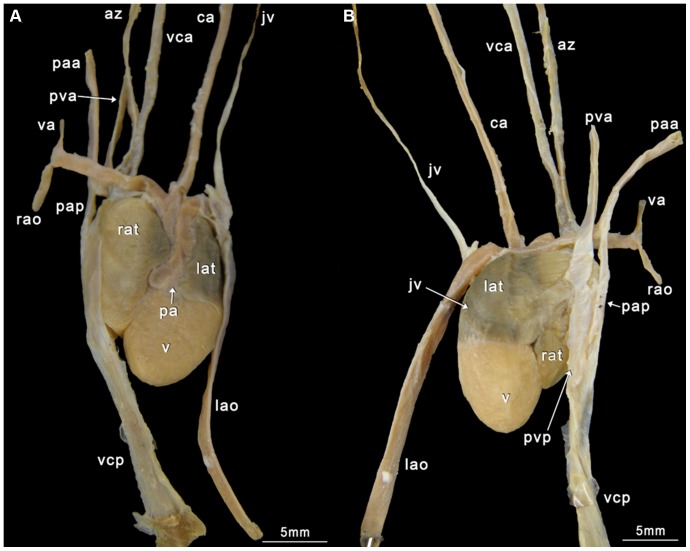
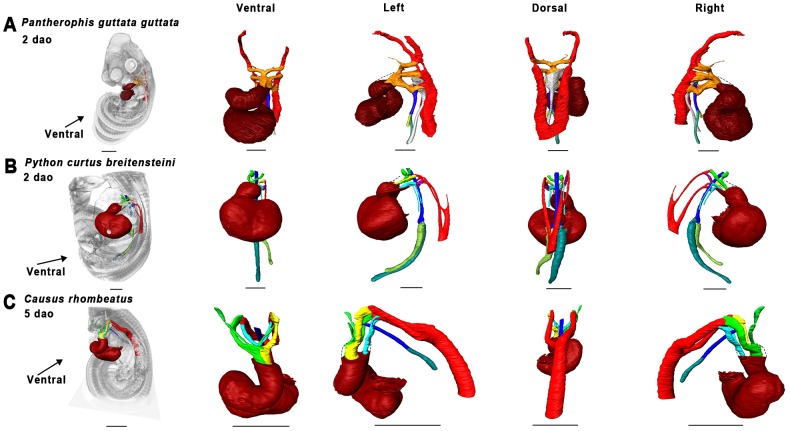
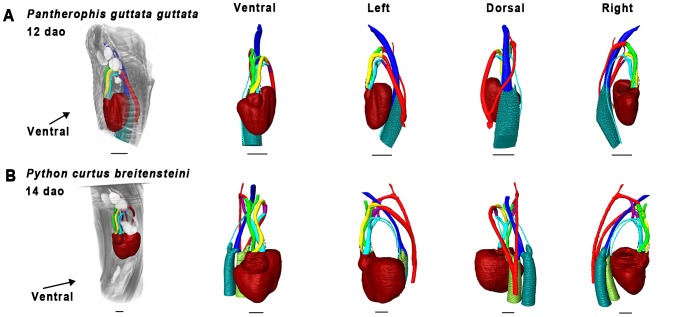
Snake lungs show a remarkable diversity of organ asymmetries. The right lung is always fully developed, while the left lung is either absent, vestigial, or well-developed (but smaller than the right). A 'tracheal lung' is present in some taxa. These asymmetries are reflected in the pulmonary arteries. Lung asymmetry is known to appear at early stages of development in Thamnophis radix and Natrix natrix. Unfortunately, there is no developmental data on snakes with a well-developed or absent left lung. We examine the adult and developmental morphology of the lung and pulmonary arteries in the snakes Python curtus breitensteini, Pantherophis guttata guttata, Elaphe obsoleta spiloides, Calloselasma rhodostoma and Causus rhombeatus using gross dissection, MicroCT scanning and 3D reconstruction. We find that the right and tracheal lung develop similarly in these species. By contrast, the left lung either: (1) fails to develop; (2) elongates more slowly and aborts early without (2a) or with (2b) subsequent development of faveoli; (3) or develops normally. A right pulmonary artery always develops, but the left develops only if the left lung develops. No pulmonary artery develops in relation to the tracheal lung. We conclude that heterochrony in lung bud development contributes to lung asymmetry in several snake taxa. Secondly, the development of the pulmonary arteries is asymmetric at early stages, possibly because the splanchnic plexus fails to develop when the left lung is reduced. Finally, some changes in the topography of the pulmonary arteries are consequent on ontogenetic displacement of the heart down the body. Our findings show that the left-right asymmetry in the cardiorespiratory system of snakes is expressed early in development and may become phenotypically expressed through heterochronic shifts in growth, and changes in axial relations of organs and vessels. We propose a step-wise model for reduction of the left lung during snake evolution.
蛇的肺部呈现出显著的器官不对称多样性。右肺总是完全发育,而左肺要么缺失、退化,要么发育良好(但比右肺小)。在一些分类群中存在“气管肺”。这些不对称性反映在肺动脉中。已知在红纹锦蛇和水游蛇的发育早期就出现了肺部不对称。不幸的是,对于左肺发育良好或缺失的蛇没有发育数据。我们使用大体解剖、显微计算机断层扫描(MicroCT)和三维重建技术,研究了短尾蟒、玉米锦蛇指名亚种、黑眉锦蛇赤峰亚种、圆斑蝰和角蝰的成年及发育阶段的肺和肺动脉形态。我们发现这些物种的右肺和气管肺发育方式相似。相比之下,左肺要么:(1)未能发育;(2)伸长较慢且早期夭折,(2a)无后续肺泡发育,或(2b)有后续肺泡发育;(3)或正常发育。右肺动脉总是发育,但只有左肺发育时左肺动脉才发育。与气管肺相关的肺动脉不发育。我们得出结论,肺芽发育的异时性导致了几种蛇类分类群的肺部不对称。其次,肺动脉在早期发育是不对称的,可能是因为当左肺退化时内脏神经丛未能发育。最后,肺动脉地形的一些变化是心脏在身体中发生个体发育位移的结果。我们的研究结果表明,蛇的心肺系统的左右不对称在发育早期就已表现出来,并且可能通过生长的异时性变化以及器官和血管轴向关系的改变而在表型上表现出来。我们提出了一个蛇类进化过程中左肺退化的逐步模型。