Kuparinen Anna, Stenseth Nils Christian, Hutchings Jeffrey A
Department of Environmental Sciences, University of Helsinki Helsinki, Finland.
Centre For Ecological and Evolutionary Synthesis, Department of Biosciences, University of Oslo Oslo, Norway.
Evol Appl. 2014 Dec;7(10):1218-25. doi: 10.1111/eva.12217. Epub 2014 Oct 8.
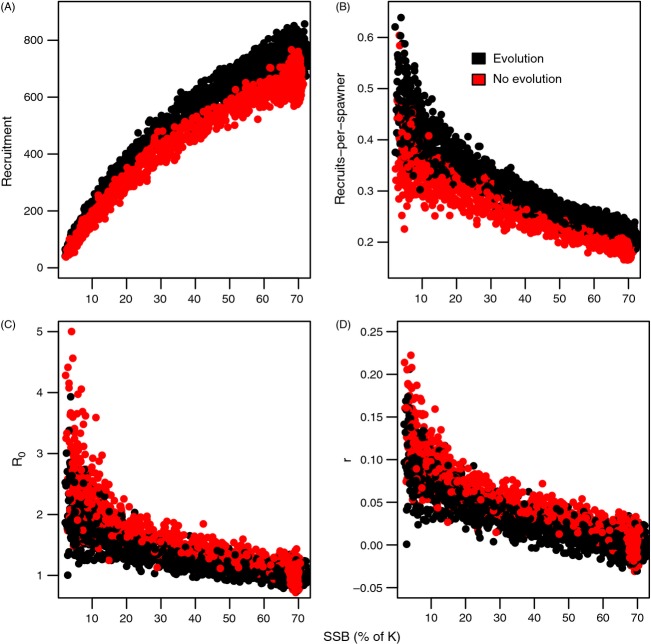
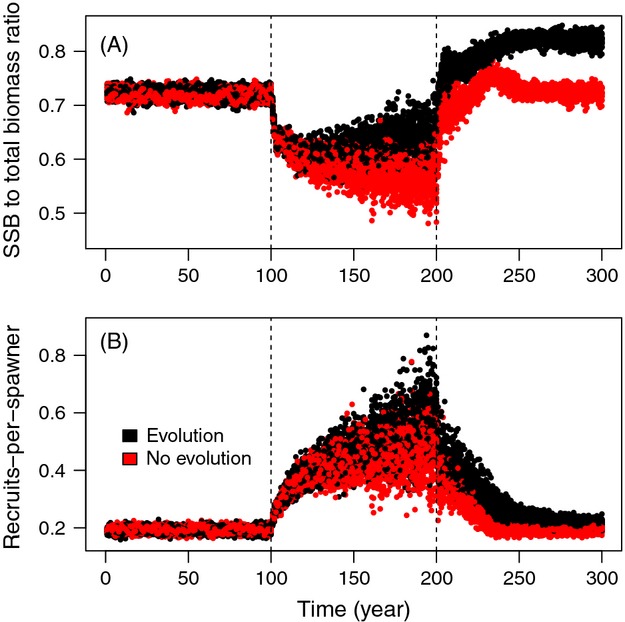
The evolution of life histories over contemporary time scales will almost certainly affect population demography. One important pathway for such eco-evolutionary interactions is the density-dependent regulation of population dynamics. Here, we investigate how fisheries-induced evolution (FIE) might alter density-dependent population-productivity relationships. To this end, we simulate the eco-evolutionary dynamics of an Atlantic cod (Gadus morhua) population under fishing, followed by a period of recovery in the absence of fishing. FIE is associated with increases in juvenile production, the ratio of juveniles to mature population biomass, and the ratio of the mature population biomass relative to the total population biomass. In contrast, net reproductive rate (R 0 ) and per capita population growth rate (r) decline concomitantly with evolution. Our findings suggest that FIE can substantially modify the fundamental population-productivity relationships that underlie density-dependent population regulation and that form the primary population-dynamical basis for fisheries stock-assessment projections. From a conservation and fisheries-rebuilding perspective, we find that FIE reduces R 0 and r, the two fundamental correlates of population recovery ability and inversely extinction probability.
在当代时间尺度上,生活史的演变几乎肯定会影响种群统计学。这种生态进化相互作用的一个重要途径是种群动态的密度依赖调节。在此,我们研究渔业诱导进化(FIE)如何改变密度依赖的种群生产力关系。为此,我们模拟了捕捞状态下大西洋鳕鱼(Gadus morhua)种群的生态进化动态,随后是在无捕捞情况下的恢复期。FIE与幼鱼产量增加、幼鱼与成熟种群生物量的比率以及成熟种群生物量相对于总种群生物量的比率相关。相比之下,净繁殖率(R0)和人均种群增长率(r)则随着进化而相应下降。我们的研究结果表明,FIE可以显著改变构成密度依赖种群调节基础的基本种群生产力关系,而这些关系是渔业资源评估预测的主要种群动态基础。从保护和渔业重建的角度来看,我们发现FIE降低了R0和r,这两个是种群恢复能力和灭绝概率倒数的基本相关指标。