Neal Bradley S, Griffiths Ian B, Dowling Geoffrey J, Murley George S, Munteanu Shannon E, Franettovich Smith Melinda M, Collins Natalie J, Barton Christian J
Pure Sports Medicine, London, UK ; Centre for Sports and Exercise Medicine, Queen Mary University of London, London, UK.
Pure Sports Medicine, London, UK.
J Foot Ankle Res. 2014 Dec 19;7(1):55. doi: 10.1186/s13047-014-0055-4. eCollection 2014.
Static measures of foot posture are regularly used as part of a clinical examination to determine the need for foot level interventions. This is based on the premise that pronated and supinated foot postures may be risk factors for or associated with lower limb injury. This systematic review and meta-analysis investigates foot posture (measured statically) as a potential risk factor for lower limb overuse injuries.
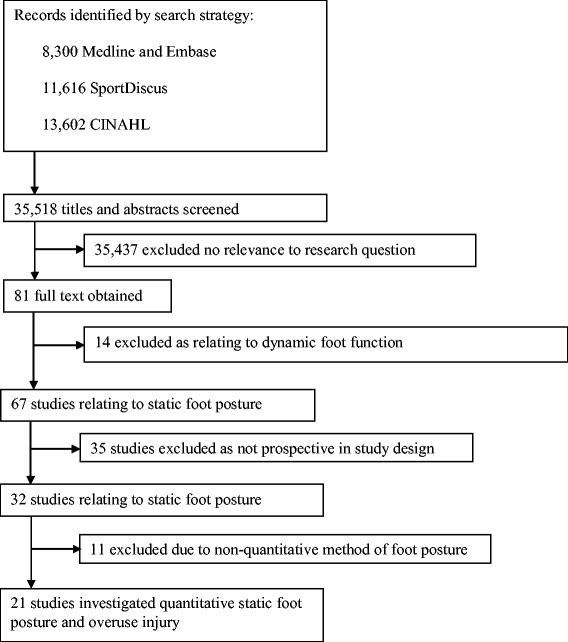
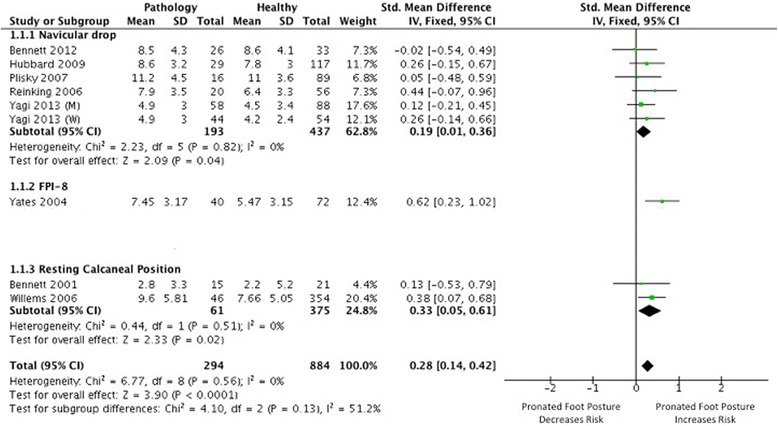
A systematic search was performed using Medline, CINAHL, Embase, SportDiscus in April 2014, to identify prospective cohort studies that investigated foot posture and function as a risk factor for lower limb overuse injury. Eligible studies were classified based on the method of foot assessment: (i) static foot posture assessment; and/or (ii) dynamic foot function assessment. This review presents studies evaluating static foot posture. The methodological quality of included studies was evaluated by two independent reviewers, using an adapted version of the Epidemiological Appraisal Instrument (EAI). Where possible, effects were expressed as standardised mean differences (SMD) for continuous scaled data, and risk ratios (RR) for nominal scaled data. Meta-analysis was performed where injuries and outcomes were considered homogenous.
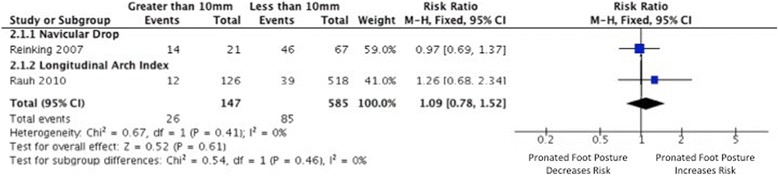
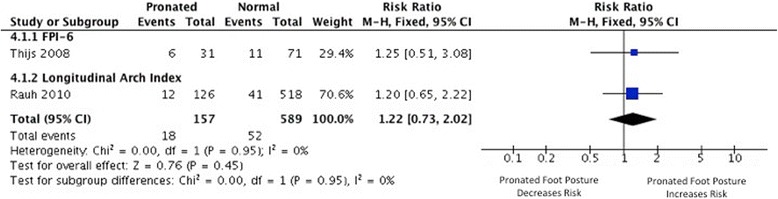
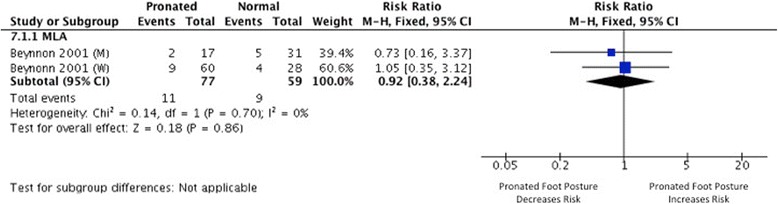
Twenty-one studies were included (total n = 6,228; EAI 0.8 to 1.7 out of 2.0). There was strong evidence that a pronated foot posture was a risk factor for medial tibial stress syndrome (MTSS) development and very limited evidence that a pronated foot posture was a risk factor for patellofemoral pain development, although associated effect sizes were small (0.28 to 0.33). No relationship was identified between a pronated foot posture and any other evaluated pathology (i.e. foot/ankle injury, bone stress reactions and non-specific lower limb overuse injury).
This systematic review identified strong and very limited evidence of small effect that a pronated foot posture is a risk factor for MTSS and patellofemoral pain respectively. Evaluation of static foot posture should be included in a multifactorial assessment for both MTSS and patellofemoral pain, although only as a part of the potential injury risk profile. Whilst the included measures are clinically applicable, further studies are required to determine their relationship with dynamic foot function.
足部姿势的静态测量常作为临床检查的一部分,以确定是否需要进行足部水平干预。这基于以下前提,即足内翻和足外翻姿势可能是下肢损伤的危险因素或与之相关。本系统评价和荟萃分析调查了静态测量的足部姿势作为下肢过度使用损伤的潜在危险因素。
2014年4月使用Medline、CINAHL、Embase、SportDiscus进行了系统检索,以确定调查足部姿势和功能作为下肢过度使用损伤危险因素的前瞻性队列研究。符合条件的研究根据足部评估方法进行分类:(i)静态足部姿势评估;和/或(ii)动态足部功能评估。本综述展示了评估静态足部姿势的研究。纳入研究的方法学质量由两名独立评审员使用流行病学评估工具(EAI)的改编版进行评估。在可能的情况下,对于连续尺度数据,效应以标准化均数差(SMD)表示,对于名义尺度数据,效应以风险比(RR)表示。当损伤和结局被认为具有同质性时,进行荟萃分析。
纳入21项研究(总计n = 6,228;EAI评分为2.0分中的0.8至1.7分)。有强有力的证据表明足内翻姿势是胫骨内侧应力综合征(MTSS)发生的危险因素,而关于足内翻姿势是髌股疼痛发生的危险因素的证据非常有限,尽管相关效应量较小(0.28至0.33)。未发现足内翻姿势与任何其他评估的病理情况(即足/踝损伤、骨应力反应和非特异性下肢过度使用损伤)之间存在关联。
本系统评价确定了强有力但非常有限的证据表明,足内翻姿势分别是MTSS和髌股疼痛的危险因素,且效应较小。对于MTSS和髌股疼痛的多因素评估应包括静态足部姿势评估,尽管这只是潜在损伤风险概况的一部分。虽然所纳入的测量方法在临床上适用,但仍需要进一步研究来确定它们与动态足部功能的关系。