Murata Kenji, Yoshimoto Mitsunori, Takebayashi Tsuneo, Ida Kazunori, Nakano Kazuhiko, Yamashita Toshihiko
Department of Orthopaedic Surgery, Sapporo Medical University School of Medicine, Sapporo, Japan.
Department of Orthopaedic Surgery, Nishioka Daiichi Hospital, Sapporo, Japan.
Asian Spine J. 2014 Dec;8(6):753-8. doi: 10.4184/asj.2014.8.6.753. Epub 2014 Dec 17.
Historical controlled trial.
To clarify the usefulness of cryotherapy after spine surgery.
Cryotherapy has generally been performed subsequent to surgery on joints and in this application its clinical effects are well understood. However, cryotherapy has yet to be used following spine surgery. Its clinical efficacy in this context is unknown.
Thirty six patients had undergone one level microendoscopic surgery. Sixteen were enrolled into the cooling group, with the remaining 20 making up the no postoperative cryotherapy control group. Cryotherapy was performed at 5℃ using an icing system. A silicone balloon catheter with a thermo sensor on the tip was placed in the surgical wound. The temperature in the wound was recorded every 30 minutes until the next morning. The relationship between the depth of the sensor and the temperature in the wound were investigated using simple linear regression analysis. Laboratory data, visual analogue scale (VAS) for wound pain and postoperative bleeding were investigated.
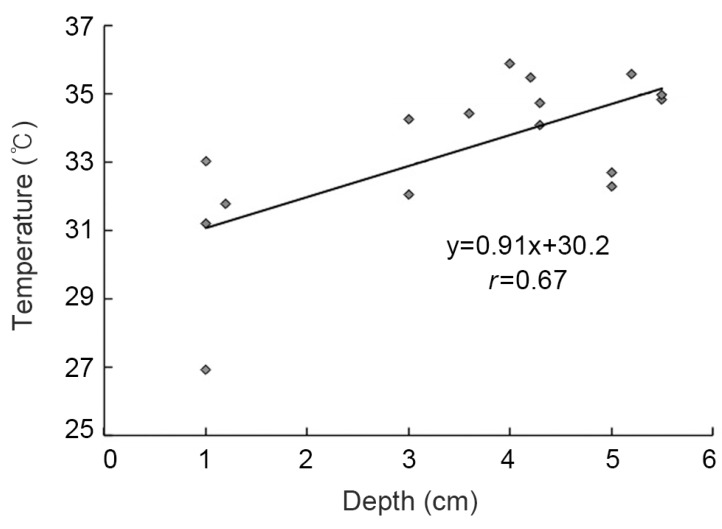
The mean temperature in the surgical wound was 37.0 in the control group and 35.0℃ in the cooling group (p<0.001). There was a positive correlation between the depth of the thermo sensor and the temperature in the wound in the cooling group (y=0.91x+30.2, r=0.67, p=0.004). There were no significant differences between the groups in terms of laboratory data, VAS or postoperative bleeding.
The temperature in the wound was decreased significantly by spinal surgery cryotherapy.
历史对照试验。
阐明脊柱手术后冷冻疗法的效用。
冷冻疗法通常在关节手术后进行,在这种应用中其临床效果已得到充分了解。然而,冷冻疗法尚未在脊柱手术后使用。其在此背景下的临床疗效尚不清楚。
36例患者接受了单节段显微内镜手术。16例纳入冷却组,其余20例组成术后无冷冻疗法对照组。使用冰敷系统在5℃下进行冷冻疗法。将尖端带有温度传感器的硅胶球囊导管置于手术伤口处。每隔30分钟记录伤口温度直至次日早晨。采用简单线性回归分析研究传感器深度与伤口温度之间的关系。研究实验室数据、伤口疼痛视觉模拟评分(VAS)和术后出血情况。
对照组手术伤口平均温度为37.0℃,冷却组为35.0℃(p<0.001)。冷却组中,温度传感器深度与伤口温度呈正相关(y = 0.91x + 30.2,r = 0.67,p = 0.004)。两组在实验室数据、VAS或术后出血方面无显著差异。
脊柱手术冷冻疗法可显著降低伤口温度。