Li Ling, Fath Melissa A, Scarbrough Peter M, Watson Walter H, Spitz Douglas R
Department of Radiation Oncology, Free Radical and Radiation Biology Program, Holden Comprehensive Cancer Center, University of Iowa, Iowa City, IA 52242, USA.
Duke Cancer Institute, Duke University, Durham, NC 27705, USA.
Redox Biol. 2015;4:127-35. doi: 10.1016/j.redox.2014.12.001. Epub 2014 Dec 10.
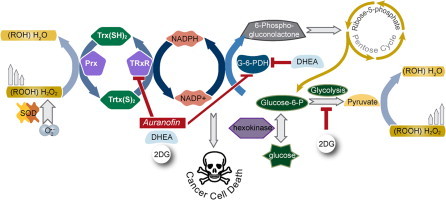
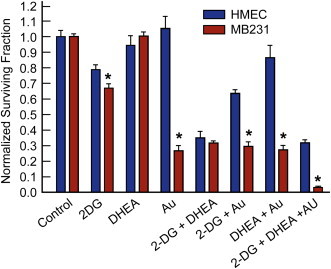
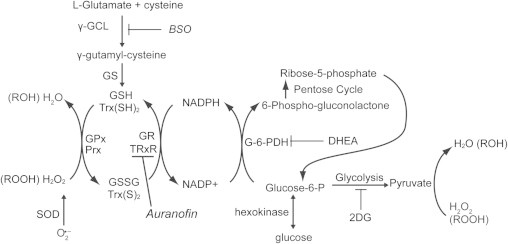
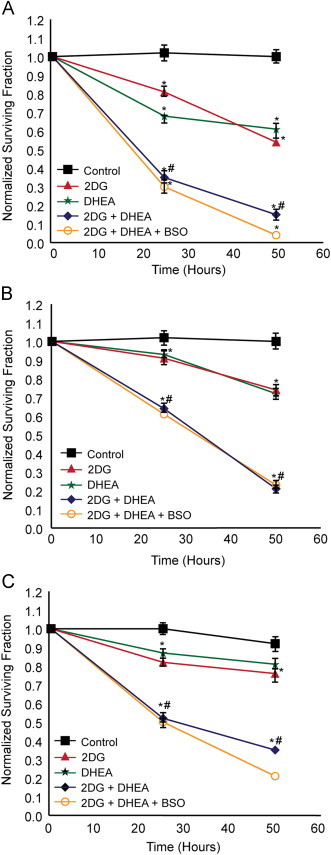
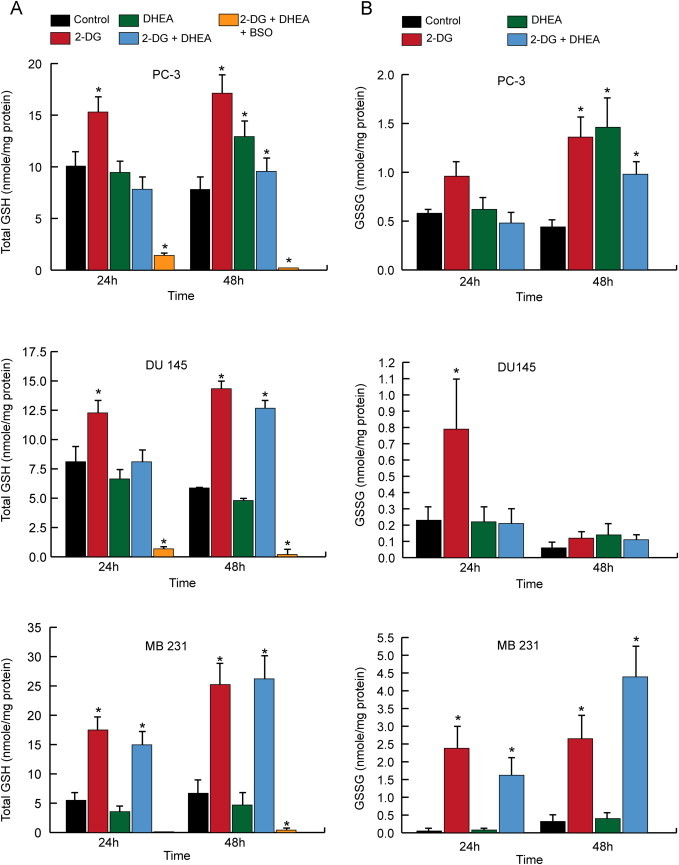
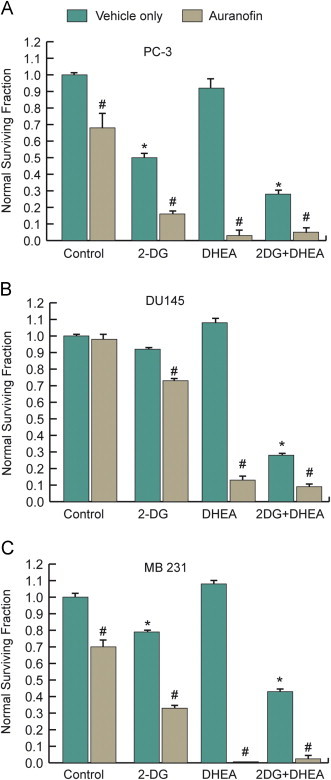
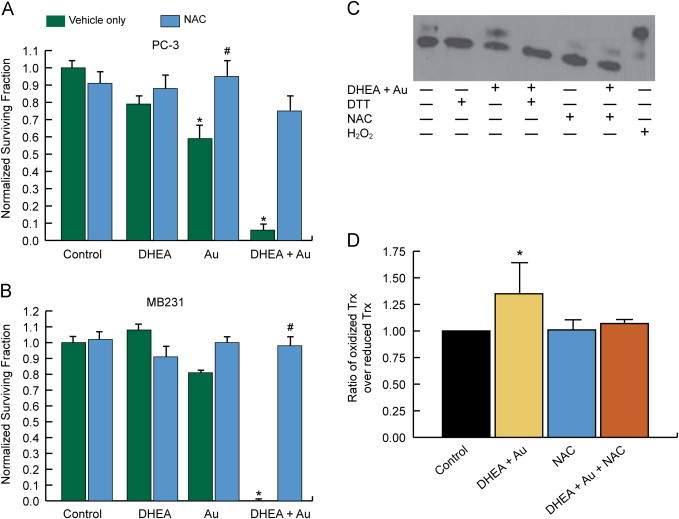
Inhibition of glycolysis using 2-deoxy-d-glucose (2DG, 20mM, 24-48h) combined with inhibition of the pentose cycle using dehydroepiandrosterone (DHEA, 300µM, 24-48h) increased clonogenic cell killing in both human prostate (PC-3 and DU145) and human breast (MDA-MB231) cancer cells via a mechanism involving thiol-mediated oxidative stress. Surprisingly, when 2DG+DHEA treatment was combined with an inhibitor of glutathione (GSH) synthesis (l-buthionine sulfoximine; BSO, 1mM) that depleted GSH>90% of control, no further increase in cell killing was observed during 48h exposures. In contrast, when an inhibitor of thioredoxin reductase (TrxR) activity (Auranofin; Au, 1µM), was combined with 2DG+DHEA or DHEA-alone for 24h, clonogenic cell killing was significantly increased in all three human cancer cell lines. Furthermore, enhanced clonogenic cell killing seen with the combination of DHEA+Au was nearly completely inhibited using the thiol antioxidant, N-acetylcysteine (NAC, 20mM). Redox Western blot analysis of PC-3 cells also supported the conclusion that thioredoxin-1 (Trx-1) oxidation was enhanced by treatment DHEA+Au and inhibited by NAC. Importantly, normal human mammary epithelial cells (HMEC) were not as sensitive to 2DG, DHEA, and Au combinations as their cancer cell counterparts (MDA-MB-231). Overall, these results support the hypothesis that inhibition of glycolysis and pentose cycle activity, combined with inhibition of Trx metabolism, may provide a promising strategy for selectively sensitizing human cancer cells to oxidative stress-induced cell killing.
使用2-脱氧-D-葡萄糖(2DG,20mM,24 - 48小时)抑制糖酵解,并联合使用脱氢表雄酮(DHEA,300µM,24 - 48小时)抑制戊糖循环,通过涉及硫醇介导的氧化应激机制,增加了人前列腺癌(PC-3和DU145)和人乳腺癌(MDA-MB231)细胞的克隆形成细胞杀伤。令人惊讶的是,当2DG+DHEA处理与谷胱甘肽(GSH)合成抑制剂(L-丁硫氨酸亚砜胺;BSO,1mM)联合使用,使GSH耗竭至对照的90%以上时,在48小时暴露期间未观察到细胞杀伤的进一步增加。相反,当硫氧还蛋白还原酶(TrxR)活性抑制剂(金诺芬;Au,1µM)与2DG+DHEA或单独的DHEA联合使用24小时时,在所有三种人癌细胞系中克隆形成细胞杀伤均显著增加。此外,使用硫醇抗氧化剂N-乙酰半胱氨酸(NAC,20mM)几乎完全抑制了DHEA+Au联合使用时观察到的增强的克隆形成细胞杀伤。PC-3细胞的氧化还原蛋白质印迹分析也支持了这一结论,即DHEA+Au处理增强了硫氧还蛋白-1(Trx-1)的氧化,而NAC抑制了这种氧化。重要的是,正常人乳腺上皮细胞(HMEC)对2DG、DHEA和Au联合使用的敏感性不如其癌细胞对应物(MDA-MB-231)。总体而言,这些结果支持了以下假设:抑制糖酵解和戊糖循环活性,联合抑制Trx代谢,可能为选择性地使人癌细胞对氧化应激诱导的细胞杀伤敏感提供一种有前景的策略。