Ferko Alexander, Orhalmi Julius, Dusek Tomas, Chobola Milan, Hovorkova Eva, Nikolov Dimitar Hadzi
Department of Surgery, University Hospital Hradec Kralove, Charles University in Prague, Faculty of Medicine, Hradec Kralove, Czech Republic.
Department of Surgery, University Hospital Hradec Kralove, Charles University in Prague, Faculty of Medicine, Hradec Kralove, Czech Republic ; Department of Military Surgery, Faculty of Military Health Sciences, University of Defense, Hradec Kralove, Czech Republic.
Wideochir Inne Tech Maloinwazyjne. 2014 Dec;9(4):569-77. doi: 10.5114/wiitm.2014.45733. Epub 2014 Oct 7.
Currently, the predominant question is whether a laparoscopic approach is comparatively radical in comparison with an open access approach, especially in the circumferential resection margin and quality of the completeness of total mesorectal excision. These factors are important in determining the quality of surgical care as well as long-term results of the treatment.
This article focuses on the evaluation of circumferential resection margins and on the quality of mesorectal excision of middle and lower rectum tumors. In addition, laparoscopic and open techniques are compared.
Data were collected prospectively and stored in a rectal cancer registry over a 3-year period. The parameters studied were age, sex, body mass index, localization and topography of the tumor, clinical stage, neoadjuvant chemotherapy and its response, the type of surgery, character of the circumferential and distal margins, quality of the mesorectal excision, pT and pN.
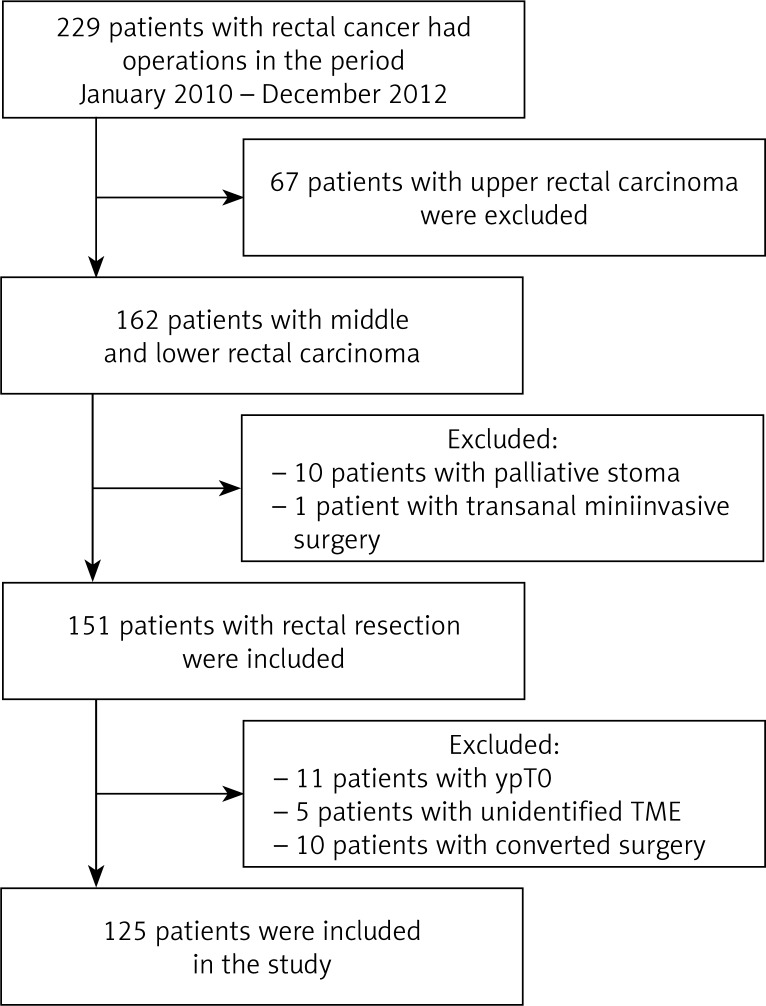
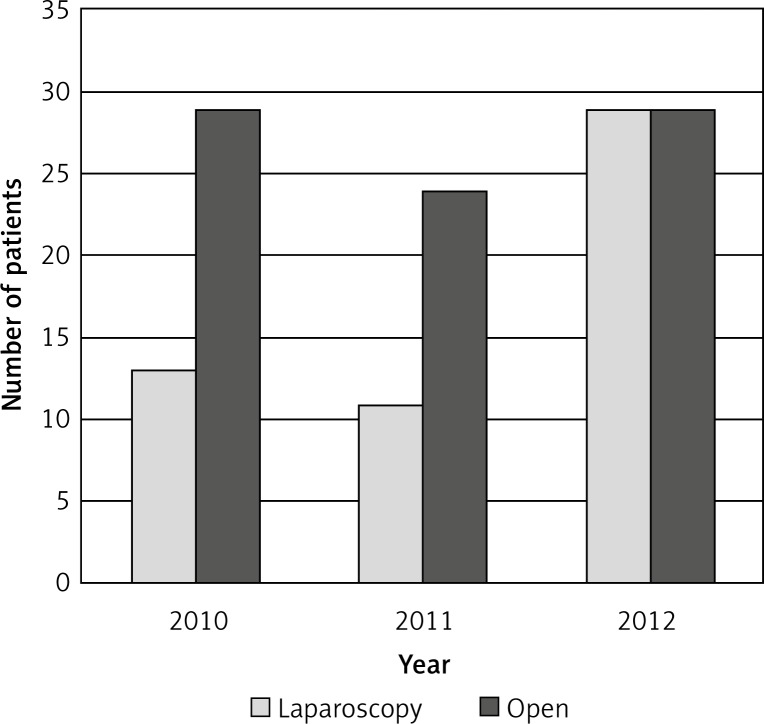
One hundred and twenty-five patients were chosen for our study. Laparoscopy was performed in 53 operations and a conventional approach was performed in 72 operations. Complete mesorectal excision was achieved in 54.7% of laparoscopic operations versus 44.4% in the conventional technique; partially complete excision was performed in 20.8 and 12.5%, respectively. Incomplete excisions were described in 24.5 and 43.1% (p = 0.085). Positive circumferential margin occurred during laparoscopic surgery in 11 (20.8%) patients, and in the case of conventional resection in 27 (37.5%) patients (p = 0.044).
Our study showed comparable results between laparoscopic and open access procedures during rectal resection. The results achieved, in particular in the quality of the mesorectal excision and negative circumferential resection margin, show that the laparoscopic approach is comparable to conventional surgical techniques, with an adequate surgical outcome, in the treatment of rectal cancer.
目前,主要问题在于与开放手术入路相比,腹腔镜手术入路是否相对更彻底,尤其是在环周切缘以及直肠全系膜切除完整性质量方面。这些因素对于确定手术治疗质量以及治疗的长期效果至关重要。
本文着重评估中低位直肠癌肿瘤的环周切缘以及直肠系膜切除质量。此外,还对腹腔镜技术与开放技术进行比较。
前瞻性收集数据,并在3年期间存储于直肠癌登记处。所研究的参数包括年龄、性别、体重指数、肿瘤的定位和形态、临床分期、新辅助化疗及其反应、手术类型、环周和远切缘特征、直肠系膜切除质量、pT和pN。
125例患者纳入本研究。53例手术采用腹腔镜手术,72例手术采用传统入路。腹腔镜手术中54.7%实现了直肠全系膜完整切除,传统技术组为44.4%;部分完整切除分别为20.8%和12.5%。不完全切除分别为24.5%和43.1%(p = 0.085)。腹腔镜手术中有11例(20.8%)患者出现环周切缘阳性,传统切除中有27例(37.5%)患者出现环周切缘阳性(p = 0.044)。
我们的研究表明,直肠切除术中腹腔镜手术入路与开放手术入路结果相当。所取得的结果,特别是在直肠系膜切除质量和环周切缘阴性方面,表明在直肠癌治疗中,腹腔镜手术入路与传统手术技术相当,手术效果良好。