de Araújo Walter Santos, Vieira Marcos Costa, Lewinsohn Thomas M, Almeida-Neto Mário
Programa de Pós-Graduação em Ecologia e Evolução, Instituto de Ciências Biológicas, Universidade Federal de Goiás, Goiânia, Goiás, Brazil; Laboratório de Interações Ecológicas e Biodiversidade, Departamento de Ecologia, Instituto de Ciências Biológicas, Universidade Federal de Goiás, Goiânia, Goiás, Brazil.
Laboratório de Interações Insetos-Plantas, Instituto de Biologia, Universidade Estadual de Campinas, Campinas, São Paulo, Brazil.
PLoS One. 2015 Jan 7;10(1):e0115606. doi: 10.1371/journal.pone.0115606. eCollection 2015.
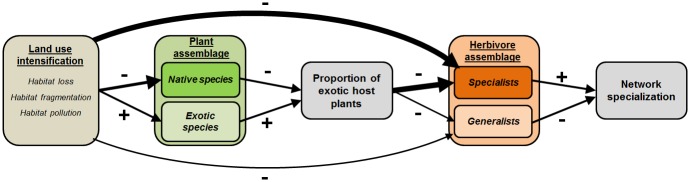
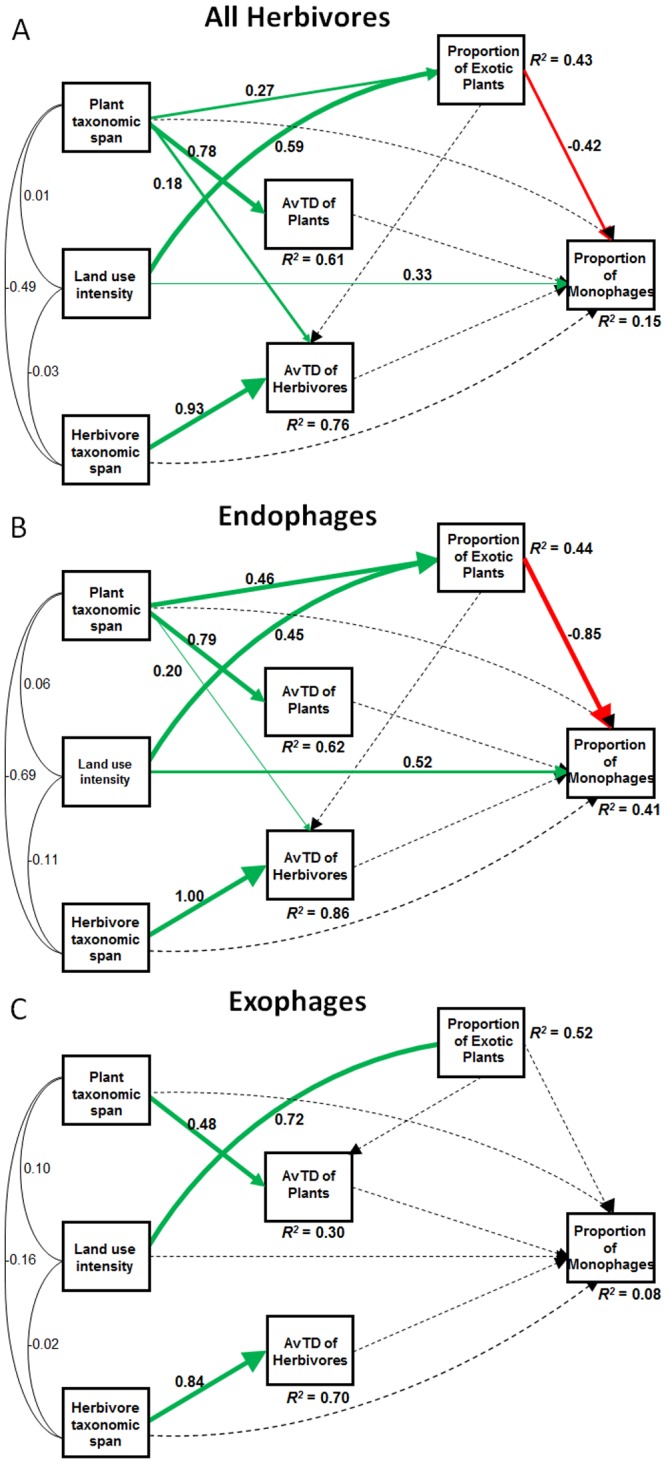
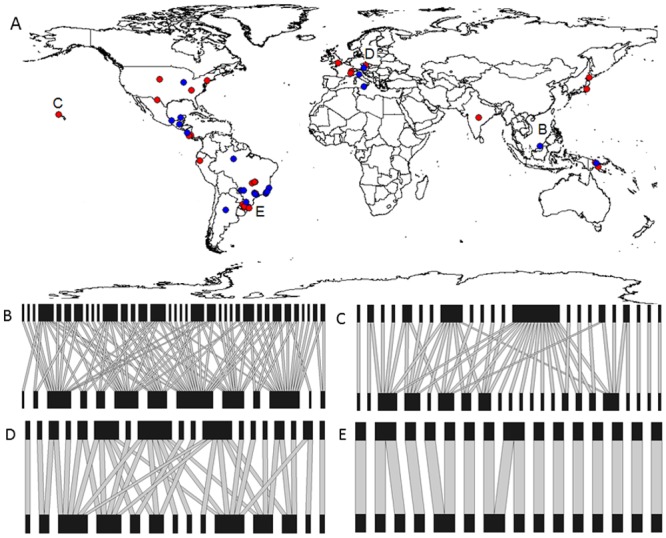
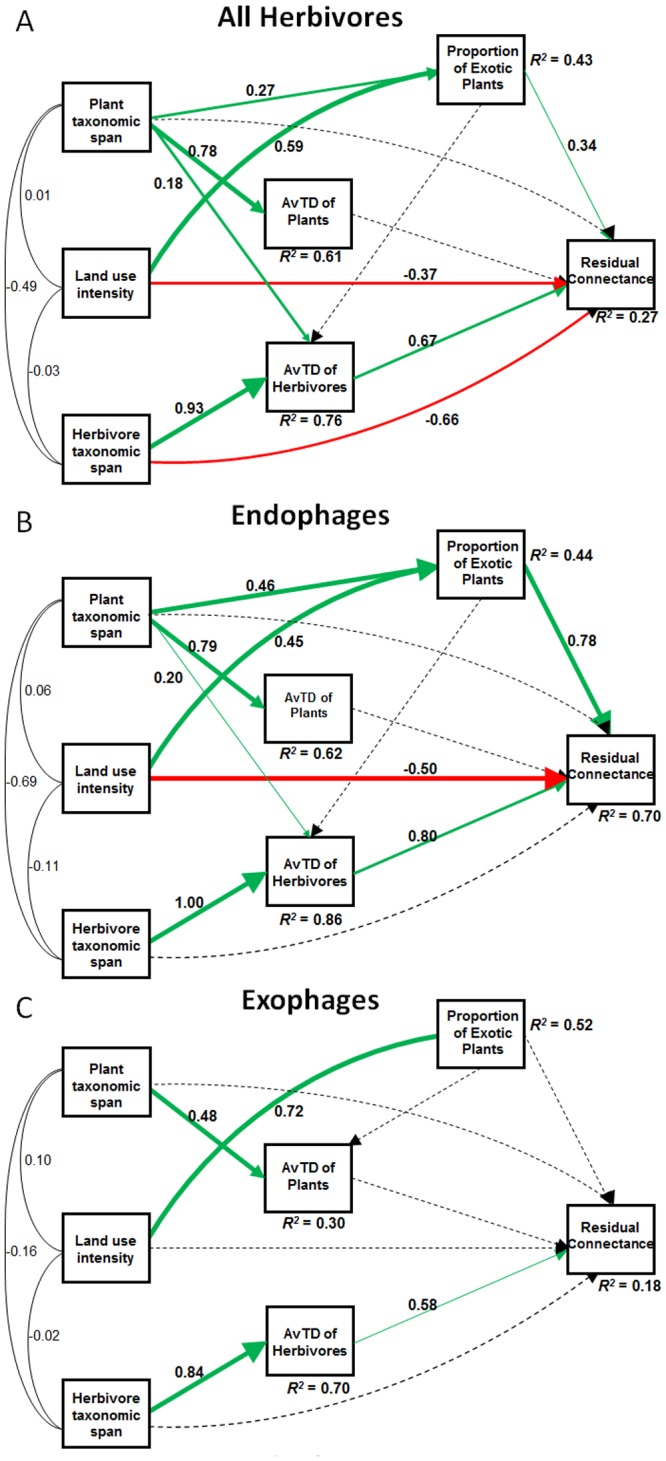
Human land use tends to decrease the diversity of native plant species and facilitate the invasion and establishment of exotic ones. Such changes in land use and plant community composition usually have negative impacts on the assemblages of native herbivorous insects. Highly specialized herbivores are expected to be especially sensitive to land use intensification and the presence of exotic plant species because they are neither capable of consuming alternative plant species of the native flora nor exotic plant species. Therefore, higher levels of land use intensity might reduce the proportion of highly specialized herbivores, which ultimately would lead to changes in the specialization of interactions in plant-herbivore networks. This study investigates the community-wide effects of land use intensity on the degree of specialization of 72 plant-herbivore networks, including effects mediated by the increase in the proportion of exotic plant species. Contrary to our expectation, the net effect of land use intensity on network specialization was positive. However, this positive effect of land use intensity was partially canceled by an opposite effect of the proportion of exotic plant species on network specialization. When we analyzed networks composed exclusively of endophagous herbivores separately from those composed exclusively of exophagous herbivores, we found that only endophages showed a consistent change in network specialization at higher land use levels. Altogether, these results indicate that land use intensity is an important ecological driver of network specialization, by way of reducing the local host range of herbivore guilds with highly specialized feeding habits. However, because the effect of land use intensity is offset by an opposite effect owing to the proportion of exotic host species, the net effect of land use in a given herbivore assemblage will likely depend on the extent of the replacement of native host species with exotic ones.
人类土地利用往往会降低本地植物物种的多样性,并促进外来物种的入侵和定殖。土地利用和植物群落组成的这种变化通常会对本地食草昆虫的群落产生负面影响。高度特化的食草动物预计对土地利用集约化和外来植物物种的存在特别敏感,因为它们既不能取食本地植物区系的替代植物物种,也不能取食外来植物物种。因此,更高水平的土地利用强度可能会降低高度特化食草动物的比例,这最终会导致植物-食草动物网络中相互作用的特化发生变化。本研究调查了土地利用强度对72个植物-食草动物网络特化程度的群落水平影响,包括由外来植物物种比例增加介导的影响。与我们的预期相反,土地利用强度对网络特化的净效应是积极的。然而,土地利用强度的这种积极效应被外来植物物种比例对网络特化的相反效应部分抵消。当我们分别分析仅由内食性食草动物组成的网络和仅由外食性食草动物组成的网络时,我们发现只有内食性食草动物在较高土地利用水平下网络特化表现出一致的变化。总之,这些结果表明,土地利用强度是网络特化的一个重要生态驱动因素,通过减少具有高度特化取食习性的食草动物类群的本地寄主范围来实现。然而,由于土地利用强度的效应被外来寄主物种比例的相反效应抵消,给定食草动物群落中土地利用的净效应可能取决于本地寄主物种被外来物种替代的程度。