Brigham and Women\'s Hospital, Department of Emergency Medicine, Boston, MA, United States.
JMIR Mhealth Uhealth. 2015 Jan 2;3(1):e1. doi: 10.2196/mhealth.3481.
Photographs are important tools to record, track, and communicate clinical findings. Mobile devices with high-resolution cameras are now ubiquitous, giving clinicians the opportunity to capture and share images from the bedside. However, secure and efficient ways to manage and share digital images are lacking.
The aim of this study is to describe the implementation of a secure application for capturing and storing clinical images in the electronic health record (EHR), and to describe initial user experiences.
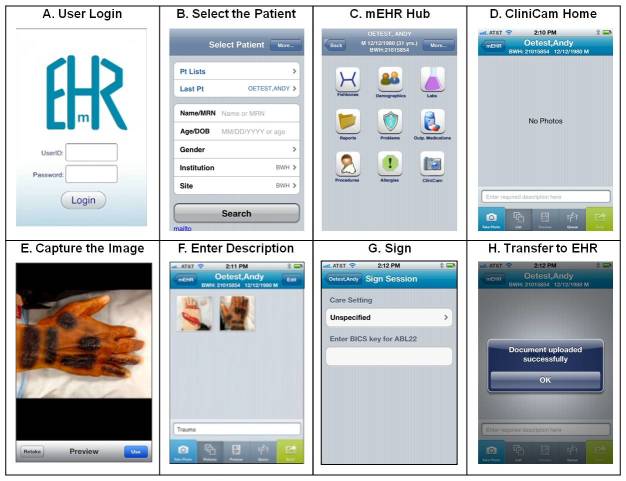
We developed CliniCam, a secure Apple iOS (iPhone, iPad) application that allows for user authentication, patient selection, image capture, image annotation, and storage of images as a Portable Document Format (PDF) file in the EHR. We leveraged our organization's enterprise service-oriented architecture to transmit the image file from CliniCam to our enterprise clinical data repository. There is no permanent storage of protected health information on the mobile device. CliniCam also required connection to our organization's secure WiFi network. Resident physicians from emergency medicine, internal medicine, and dermatology used CliniCam in clinical practice for one month. They were then asked to complete a survey on their experience. We analyzed the survey results using descriptive statistics.
Twenty-eight physicians participated and 19/28 (68%) completed the survey. Of the respondents who used CliniCam, 89% found it useful or very useful for clinical practice and easy to use, and wanted to continue using the app. Respondents provided constructive feedback on location of the photos in the EHR, preferring to have photos embedded in (or linked to) clinical notes instead of storing them as separate PDFs within the EHR. Some users experienced difficulty with WiFi connectivity which was addressed by enhancing CliniCam to check for connectivity on launch.
CliniCam was implemented successfully and found to be easy to use and useful for clinical practice. CliniCam is now available to all clinical users in our hospital, providing a secure and efficient way to capture clinical images and to insert them into the EHR. Future clinical image apps should more closely link clinical images and clinical documentation and consider enabling secure transmission over public WiFi or cellular networks.
照片是记录、跟踪和交流临床发现的重要工具。现在,具有高分辨率摄像头的移动设备无处不在,使临床医生有机会从床边捕获和共享图像。然而,缺乏安全有效的管理和共享数字图像的方法。
本研究旨在描述在电子健康记录 (EHR) 中捕获和存储临床图像的安全应用程序的实现,并描述初步的用户体验。
我们开发了 CliniCam,这是一个安全的 Apple iOS(iPhone、iPad)应用程序,允许用户进行身份验证、选择患者、捕获图像、对图像进行注释,并将图像以可移植文档格式 (PDF) 文件的形式存储在 EHR 中。我们利用我们组织的面向服务的企业架构将图像文件从 CliniCam 传输到我们的企业临床数据存储库。移动设备上没有永久存储受保护的健康信息。CliniCam 还要求连接到我们组织的安全 WiFi 网络。来自急诊医学、内科和皮肤科的住院医师在临床实践中使用 CliniCam 一个月。然后,他们被要求完成一份关于他们体验的调查。我们使用描述性统计分析了调查结果。
共有 28 名医生参与,其中 19/28(68%)完成了调查。在使用 CliniCam 的受访者中,89%的人认为它对临床实践有用或非常有用,并且易于使用,并希望继续使用该应用程序。受访者就 EHR 中照片的位置提供了建设性的反馈,希望将照片嵌入(或链接到)临床记录中,而不是将其存储为 EHR 中的单独 PDF。一些用户在 WiFi 连接方面遇到困难,这通过增强 CliniCam 在启动时检查连接性来解决。
CliniCam 已成功实施,被认为对临床实践既简单易用又有用。CliniCam 现在可供我们医院的所有临床用户使用,为捕获临床图像并将其插入 EHR 提供了安全有效的方法。未来的临床图像应用程序应更紧密地将临床图像和临床文档联系起来,并考虑通过公共 WiFi 或蜂窝网络实现安全传输。