Balachandran Rakhi, Kappanayil Mahesh, Sen Amitabh Chanchal, Sudhakar Abhish, Nair Suresh G, Sunil G S, Raj R Benedict, Kumar Raman Krishna
Department of Pediatric Cardiology, Amrita Institute of Medical Sciences and Research Center, Kochi, Kerala, India.
Ann Card Anaesth. 2015 Jan-Mar;18(1):52-7. doi: 10.4103/0971-9784.148322.
The International Quality Improvement Collaborative (IQIC) for Congenital Heart Surgery in Developing Countries was initiated to decrease mortality and major complications after congenital heart surgery in the developing world.
We sought to assess the impact of IQIC on postoperative outcomes after congenital heart surgery at our institution.
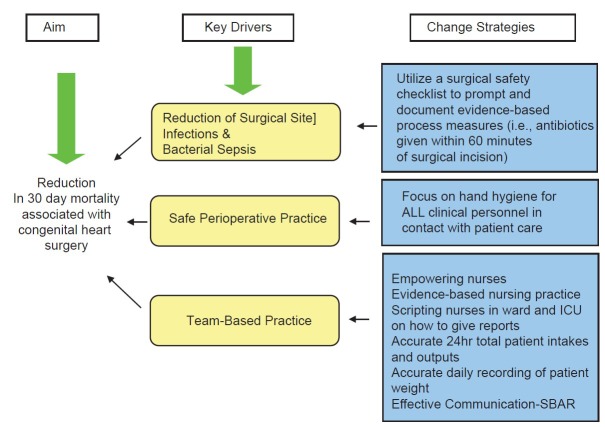
The key components of the IQIC program included creation of a robust worldwide database on key outcome measures and nurse education on quality driven best practices using telemedicine platforms. We evaluated 1702 consecutive patients ≤18 years undergoing congenital heart surgery in our institute from January 2010-December 2012 using the IQIC database. Preoperative variables included age, gender, weight at surgery and surgical complexity as per the RACHS-1 model. The outcome variables included, in- hospital mortality, duration of ventilation, intensive care unit (ICU) stay, bacterial sepsis and surgical site infection.
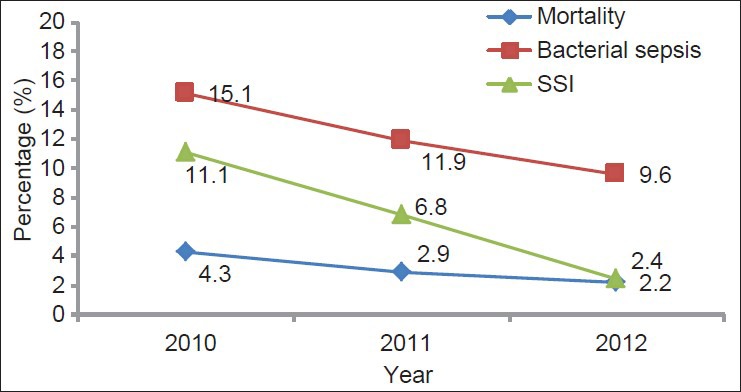
The 1702 patients included 771(45.3%) females. The median age was 8 months (0.03-216) and the median weight was 6.1Kg (1-100). The overall in-hospital mortality was 3.1%, Over the three years there was a significant decline in bacterial sepsis (from 15.1%, to 9.6%, P < 0.001), surgical site infection (11.1% to 2.4%, P < 0.001) and duration of ICU stay from 114(8-999) hours to 72 (18-999) hours (P < 0.001) The decline in mortality from (4.3% to 2.2%) did not reach statistical significance.
The inclusion of our institution in the IQIC program was associated with improvement in key outcome measures following congenital heart surgery over a three year period.
发展中国家先天性心脏病手术国际质量改进协作组织(IQIC)的成立旨在降低发展中国家先天性心脏病手术后的死亡率和主要并发症。
我们试图评估IQIC对我院先天性心脏病手术后结局的影响。
IQIC项目的关键组成部分包括建立一个关于关键结局指标的强大全球数据库,以及使用远程医疗平台对护士进行质量驱动的最佳实践教育。我们使用IQIC数据库评估了2010年1月至2012年12月在我院接受先天性心脏病手术的1702例年龄≤18岁的连续患者。术前变量包括年龄、性别、手术时体重以及根据RACHS-1模型确定的手术复杂性。结局变量包括住院死亡率、通气时间、重症监护病房(ICU)住院时间、细菌性败血症和手术部位感染。
1702例患者中包括771例(45.3%)女性。中位年龄为8个月(0.03 - 216个月),中位体重为6.1千克(1 - 100千克)。总体住院死亡率为3.1%。在这三年中,细菌性败血症显著下降(从15.1%降至9.6%,P < 0.001),手术部位感染(从11.1%降至2.4%,P < 0.001),ICU住院时间从114(8 - 999)小时降至72(18 - 999)小时(P < 0.001)。死亡率从(4.3%降至2.2%)未达到统计学显著性。
我院加入IQIC项目与先天性心脏病手术后关键结局指标在三年期间的改善相关。