Yun Ki Wook, Lee Hoan Jong, Kang Jin Han, Eun Byung Wook, Kim Yae-Jean, Kim Kyung-Hyo, Kim Nam Hee, Hong Young Jin, Kim Dong Ho, Kim Hwang Min, Cha Sung-Ho
BMC Infect Dis. 2015 Jan 8;15:7. doi: 10.1186/s12879-014-0744-4.
Although mouse brain-derived, inactivated Japanese encephalitis vaccines (JE-MBs) have been successfully used for a long time, potential rare neurological complications have prompted the development of a Vero cell culture-derived inactivated vaccine (JE-VC). In a phase III clinical study, we aimed to compare the safety and immunogenicity of a JE-VC, KD-287 with a JE-MB, JEV-GCC, in children.
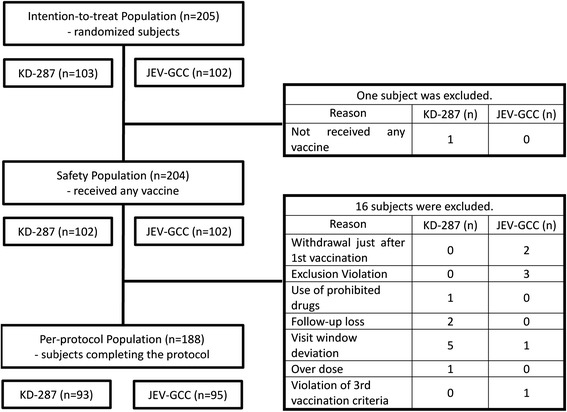
In this multicenter, double-blinded, randomized controlled trial, the study population consisted of 205 healthy Korean children aged 12-23 months. Each subject was subcutaneously vaccinated with either KD-287 or JEV-GCC twice at an interval of 2 weeks and then vaccinated once 12 months after the second vaccination. Neutralizing antibodies were measured by the plaque reduction neutralization test using the homologous and heterologous, as a post hoc analysis, challenge virus strains.
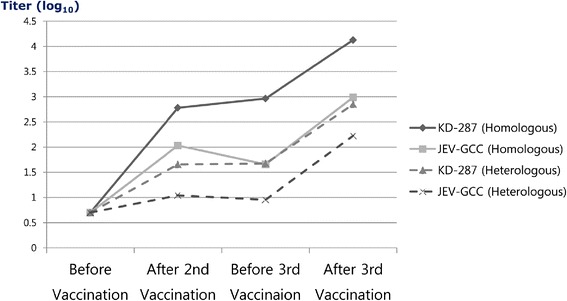
The three-dose regimen of KD-287 showed a comparable safety profile with JEV-GCC except higher incidence of fever after the first dose (30.4% and 14.7%, respectively). Most of the fever was mild degree (61.3% and 66.7%, respectively). KD-287 fulfilled the non-inferiority criteria for seroconversion rate (SCR) and geometric mean titer (GMT) of the neutralizing antibody, which were the primary endpoints, at 4 weeks after the third vaccination (95% CI: -1.00, 3.10 for the SCR difference and 10.8, 17.6 for the GMT ratio). The SCRs of KD-287 were all 100% and the GMTs were higher in the KD-287 group than in the JEV-GCC group after the second vaccination and before and after the third vaccination (GMT ratio: 5.59, 20.13, and 13.79, respectively, p < 0.001 in all). GMTs were higher in the KD-287 group in the heterologous analysis also (GMT ratio: 4.05, 5.15, and 4.19, respectively, p < 0.001 in all).
This study suggests that the KD-287, a JE-VC is as safe as and may be more effective than the licensed MB-derived vaccine. KD-287 could thus be useful as a second-generation vaccine and substitute for the current JE-MB vaccine in Korean children.
ClinicalTrials.gov: NCT01150942.
尽管源自鼠脑的灭活日本脑炎疫苗(JE-MB)已成功使用很长时间,但潜在的罕见神经并发症促使人们研发了一种源自Vero细胞培养的灭活疫苗(JE-VC)。在一项III期临床研究中,我们旨在比较一种JE-VC(KD-287)与一种JE-MB(JEV-GCC)在儿童中的安全性和免疫原性。
在这项多中心、双盲、随机对照试验中,研究人群包括205名12至23个月大的健康韩国儿童。每位受试者皮下接种KD-287或JEV-GCC,间隔2周接种两次,然后在第二次接种后12个月再接种一次。作为事后分析,使用同源和异源攻击病毒株,通过蚀斑减少中和试验测量中和抗体。
KD-287的三剂接种方案显示出与JEV-GCC相当的安全性概况,但第一剂后发热发生率较高(分别为30.4%和14.7%)。大多数发热为轻度(分别为61.3%和66.7%)。KD-287在第三次接种后4周达到了作为主要终点指标的中和抗体血清转化率(SCR)和几何平均滴度(GMT)的非劣效标准(SCR差异的95%置信区间:-1.00,3.10;GMT比值的95%置信区间:10.8,17.6)。第二次接种后以及第三次接种前后,KD-287的SCR均为100%,且KD-287组的GMT高于JEV-GCC组(GMT比值分别为5.59、20.13和13.79,均p<0.001)。在异源分析中,KD-287组的GMT也更高(GMT比值分别为4.05、5.15和4.19,均p<0.001)。
本研究表明,JE-VC的KD-287与已获许可的源自鼠脑的疫苗一样安全,且可能更有效。因此,KD-287可作为第二代疫苗,替代韩国儿童目前使用的JE-MB疫苗。
ClinicalTrials.gov:NCT01150942。